
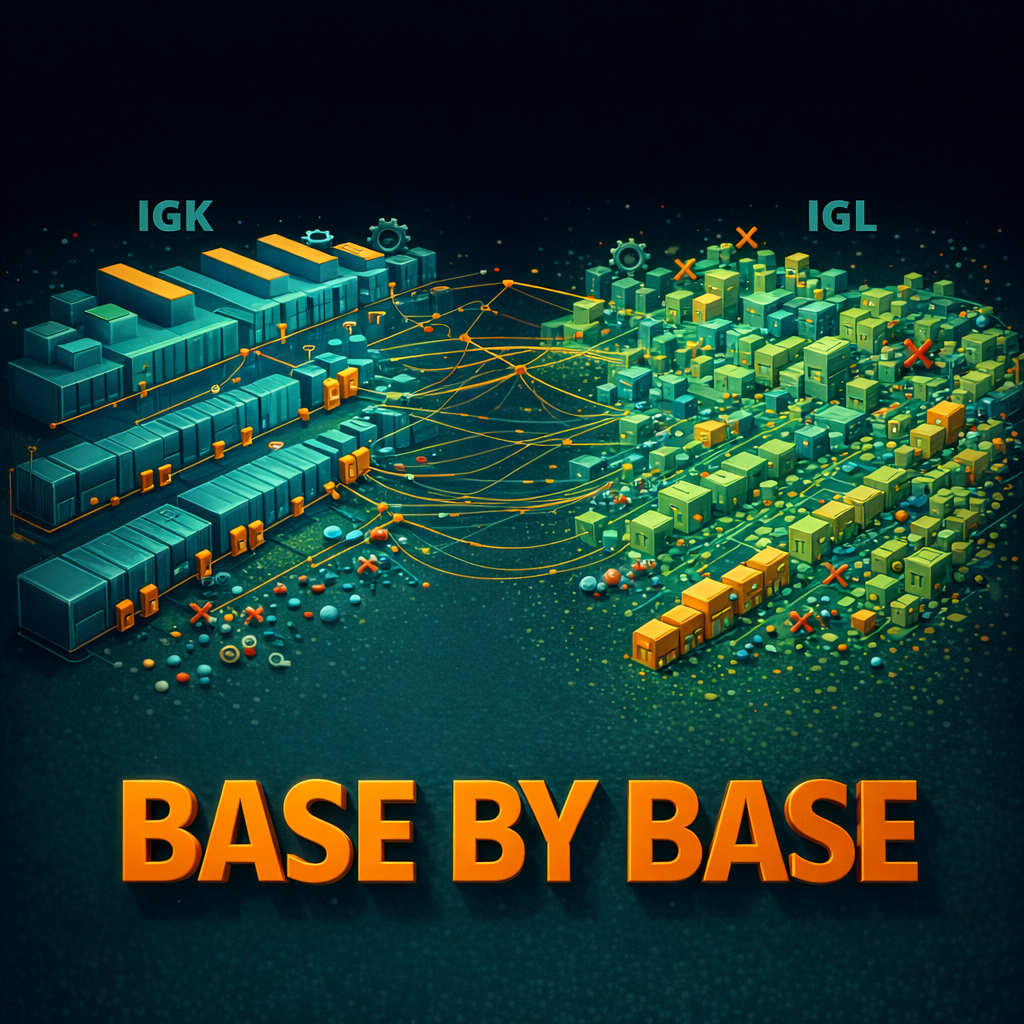
Episode 238

December 24, 2025

00:18:14

238: Germline polymorphisms shape antibody light chain repertoires

Hosted by

Gustavo B Barra
238: Germline polymorphisms shape antibody light chain repertoires
Base by Base
238: Germline polymorphisms shape antibody light chain repertoires

Dec 24 2025 | 00:18:14

/

Show Notes

️ Episode 238: Germline polymorphisms shape antibody light chain repertoires

In this episode of PaperCast Base by Base, we explore Long-read sequencing of IGK and IGL paired with AIRR-seq shows that common germline SNVs, SVs, and alleles drive inter-individual differences in light chain gene usage and CDR3 properties

Study Highlights:
The authors combined targeted long-read genomic sequencing of IGK and IGL in 177 donors with matched AIRR-seq (IGK n=164, IGL n=168) to generate phased SNV, SV, and allele callsets and personalized germline databases. Cis guQTL analysis identified 2,352 variants in the unmutated IGK repertoire linked to usage changes in 21 IGKV and 3 IGKJ genes, and 911 variants in IGL linked to 22 IGLV and 3 IGLJ genes, indicating germline variation affects >70% of light chain genes. Lead variants mapped to intergenic regions, RSSs, coding exons and structural variants, with examples including a premature stop in IGKV2-29, a K50D missense in IGKV1-5, RSS spacer changes in IGLV3-16, and copy-number SVs that alter gene usage. Genetic effects were stronger in the antigen-naïve repertoire, associated with shifts in encoded V/J alleles and CDR3 physicochemical properties, and IGK exhibited larger LD blocks and coordinated multi-gene usage compared with IGL.

Conclusion:
Germline polymorphisms across IGK and IGL establish reproducible baseline differences in light chain gene availability and amino acid composition that likely influence antibody-mediated responses.

Music:
Enjoy the music based on this article at the end of the episode.

Reference:
Engelbrecht E, Rodriguez OL, Lees W, Vanwinkle Z, Shields K, Schultze S, Gibson WS, Smith DR, Jana U, Saha S, Peres A, Yaari G, Smith ML, Watson CT. Germline polymorphisms in the immunoglobulin kappa and lambda loci underpinning antibody light chain repertoire variability. Nat Commun. 2025. https://doi.org/10.1038/s41467-025-66759-9

License:
This episode is based on an open-access article published under the Creative Commons Attribution 4.0 International License (CC BY 4.0) – https://creativecommons.org/licenses/by/4.0/

Support:
Base by Base – Stripe donations: https://donate.stripe.com/7sY4gz71B2sN3RWac5gEg00

Official website https://basebybase.com

Castos player https://basebybase.castos.com

On PaperCast Base by Base you’ll discover the latest in genomics, functional genomics, structural genomics, and proteomics.

Episode link: https://basebybase.castos.com/episodes/ig-light-chain-variation

Episode Slug: ig-light-chain-variation

Keywords: immunoglobulin-kappa, immunoglobulin-lambda, germline-variation, antibody-repertoire, long-read-sequencing

Chapters

  • (00:00:00) - How your genetic blueprint shapes your immunity
  • (00:01:38) - Personal genetics of the human genome
  • (00:05:13) - What Did Genomic Personalization Reveal About the Immunity
  • (00:08:21) - How genetic variation affects the way your body recognizes molecules

View Full Transcript

Episode Transcript

[00:00:00] Speaker A: Foreign. [00:00:14] Speaker B: Welcome to Base by Base, the papercast that brings genomics to you wherever you are. Thanks for listening and don't forget to follow and rate us in your podcast app. We're diving deep today into one of the most foundational secrets of human immunity. You know, the superpower. Your body can generate hundreds of millions of unique antibodies, Abs, ready to neutralize pretty much any threat. [00:00:36] Speaker A: It's an incredible system, but it also presents this huge medical. Why is it that one person can clear an infection, you know, almost effortlessly, while someone else, exposed to the very same thing, really struggles? [00:00:49] Speaker B: Or even vaccines? Why does one person get a perfect, robust response and another person barely registers any protection at all? [00:00:57] Speaker A: Exactly. And for decades, we've looked to genetics for the answer. We know that the antibody heavy chain, that's the big part of the Y shaped antibody, has genetic differences that play a huge role. [00:01:06] Speaker B: But the heavy chain is only half the story. Every one of those antibodies also needs a partner, the light chain. And that's where things get, well, complicated. [00:01:16] Speaker A: And that's really where the mystery has been hiding. Because if your personal genetic blueprint dictates which light chains your body can even build in the first place, that completely shapes your entire defensive strategy from day one. [00:01:28] Speaker B: So this deep dive is really about how that hidden genetic code in your light chains is setting the stage for your entire immune arsenal right from the start. [00:01:37] Speaker A: It is. And before we get into the weeds, we really want to celebrate the team that managed to crack this open. Today we're celebrating the work of Eric Engelbrecht, Oscar L. Rodriguez, William Lees, Corey T. Watson, and their colleagues. [00:01:51] Speaker B: They're primarily from the University of Louisville School of Medicine, and they really pushed through a major technical barrier to get these answers. [00:01:58] Speaker A: They absolutely did. [00:02:00] Speaker B: Okay, so let's do a quick refresher on how these antibodies are even made. They're part of our adaptive immune system. Right. The highly specific guided missiles. [00:02:08] Speaker A: Guided missiles. That's a good way to put it. They're made of two identical heavy chains and two identical light chains. And the key thing to remember is you don't inherit millions of different antibodies. [00:02:19] Speaker B: You inherit the. The building blocks. The gene segments. [00:02:23] Speaker A: Exactly. The V, D and J segments. Variable diversity and joining. The massive diversity comes from a cut and paste process called VDJ recombination, where. [00:02:33] Speaker B: Your cells are basically mixing and matching these segments to create unique receptors. [00:02:37] Speaker A: Right. It's this incredibly foundational step, but it's also where your personal genetics come roaring back into the picture. We knew the heavy chain genes were highly variable between people. [00:02:47] Speaker B: But the light chain genes, IGK on chromosome 2 and IGL on chromosome 22, they've always been, well, a black box. [00:02:55] Speaker A: A black box is right. They are structurally a mess. To be blunt. They're just full of what we call structural variants, duplications, undocumented alleles. [00:03:04] Speaker B: So if you try to map them with older short read sequencing, you just get a jumble of confusing fragments. [00:03:09] Speaker A: You do. It's like trying to assemble a massive puzzle where half the pieces look the same. That complexity has hidden the variability we knew had to be there. [00:03:17] Speaker B: So the mission of this paper was to cut through that complexity and ask, do the genetic differences in the light chains actually matter? Do they create these fundamental baseline differences between us? [00:03:28] Speaker A: That's the core question. They needed a way to finally read those messy genetic regions cleanly. [00:03:35] Speaker B: Okay, so how did they do it? What was the technical breakthrough that let them map this notoriously difficult part of the genome? [00:03:43] Speaker A: It was a really smart combination of technologies. First, they used targeted long read genomic sequencing. Think of it as being able to read huge long sentences of DNA instead of just tiny little words. [00:03:54] Speaker B: And that's the key, right? The long reads can span across those repetitive, confusing parts without getting lost. [00:04:00] Speaker A: Precisely. They can see the whole structure. And they applied this to 177 healthy individuals from diverse ancestries. This let them map out all the genetic variation for each individual in incredible detail. [00:04:12] Speaker B: And that's a revolutionary step. They didn't just compare these people to the generic human reference genome. They built a unique personalized genetic map for, for every single person in the study. [00:04:21] Speaker A: That's the crucial move. They created what they call personalized germline reference sets. So instead of a generic map of a city, they had a high res satellite image of every single person's unique neighborhood. [00:04:34] Speaker B: And why was that so critical? [00:04:36] Speaker A: Because the next step was to look at which antibody genes were actually being used by the B cells. That's a technique called rrseq. By using that personalized map, they could be incredibly accurate. They knew exactly what toolkit each person started with before they measured what tools were actually being pulled out and used. [00:04:55] Speaker B: That makes the data so much cleaner. And they also divided the data, right? [00:04:58] Speaker A: Yes. They separated the data into the unmutated repertoire. So B cells that haven't seen an antigen yet and the mutated or antigen experienced repertoire. [00:05:07] Speaker B: Ah, so they could check if these genetic effects stick around after your immune system has been in a few fights. [00:05:13] Speaker A: Exactly. [00:05:13] Speaker B: Okay, so let's get to the findings. What did those personalized maps Reveal? [00:05:17] Speaker A: Well, the results were just unambiguous. They looked for something called Go QTLs. You can think of these as genetic volume dials in your DNA that turn up or turn down. How often a specific gene segment gets. [00:05:32] Speaker B: Used and how many of the light chain genes were controlled by these dials? [00:05:35] Speaker A: The vast majority. It was over 70% of all the IGK and IGL genes. [00:05:39] Speaker B: 70%. [00:05:40] Speaker A: Wow. So your personal genetic code is basically setting the default expression level for more than three quarters of your available light chain genes. [00:05:48] Speaker B: That is a huge built in bias in your immune system before you've even encountered a single pathogen. And what about in those experienced B cells? [00:05:56] Speaker A: So the effects were strongest in the naive cells, which makes sense. That's the starting point. But, and this is critical, the effects persisted. They were still statistically significant even after B cells became antigen experienced. Your genetic starting point doesn't just get washed away. [00:06:12] Speaker B: Let's talk about the specific ways this happens. The mechanisms they found were pretty diverse depending on where the genetic variant was located. [00:06:19] Speaker A: They really were. The majority were actually in what we call non coding regions. These are variants that aren't in the gene itself, but seem to act as regulatory switches, probably affecting how the whole VDJ recombination machinery works. [00:06:32] Speaker B: So they're not breaking the gene, just changing how often it's used. [00:06:36] Speaker A: Right. But then you have the variants that are breaking the equipment. The ones that have a direct and sometimes dramatic impact. [00:06:43] Speaker B: Like the stop codon. [00:06:45] Speaker A: Exactly. A key variant for the gene IGKV229 actually introduced a premature stop codon. So if you have that variant, the gene just stops working functionally knocked out. And they saw its usage just plummet. [00:06:57] Speaker B: So a gene that's perfectly fine in me might be completely useless in you, just because of one tiny change. [00:07:03] Speaker A: And it's not always a total knockout. In another gene, IGKV1.5, a variant caused a missense change. It swapped one amino acid for another, which changed its electrical charge. The gene still worked, but people with that change used it less often. [00:07:18] Speaker B: As if the body's quality control is just a little less keen on using that slightly altered version. [00:07:23] Speaker A: It seems that way. And then there are the variants that affect the machinery itself. The recombination signal sequences, or rss. [00:07:30] Speaker B: Those are the landing pads for the enzymes that do the cutting and pasting. [00:07:33] Speaker A: Precisely. They found variants located right in those landing pads for the gene IGLV316. Two small changes in that signal sequence led to a massive 3.7 fold change in how Often that gene was used. [00:07:46] Speaker B: Wait. A nearly four fold difference just from two little changes in the cut here sign. [00:07:52] Speaker A: That's your DNA actively dictating how easily a gene can even get into the manufacturing pipeline in the first place. [00:07:57] Speaker B: It's incredible leverage. And what about the big structural changes like deleting or duplicating whole genes? [00:08:03] Speaker A: Gene copy number variations or CNVs? Yeah, that's the most straightforward mechanism. And it was the main driver for several genes. The effect was purely additive. If you had zero copies, you didn't use it one copy, you used it some two copies used it twice as much. [00:08:16] Speaker B: More raw material equals more final product. [00:08:19] Speaker A: It makes sense, it's beautifully simple. [00:08:21] Speaker B: So we've got all these different mechanisms, but one of the most fascinating findings for me was how different the two light chain locations IGK and IGL actually are. They have totally different genetic architecture. [00:08:33] Speaker A: Oh, they are drastically different. [00:08:35] Speaker B: Hmm. [00:08:35] Speaker A: The Capalocus IGK has what's called extensive linkage disequilibrium, or ld. This means huge blocks of genes and their variants are all inherited together, like. [00:08:46] Speaker B: They'Re physically linked, but they act as a single unit, like a convoy on a highway. [00:08:50] Speaker A: That's a great analogy. Over half the IGK locus is covered by these big LD blocks. And this leads to coordinated use. They found that 21 of the 24 associated IGK genes are all acted together in one giant super clique. [00:09:05] Speaker B: And the lambda locus, IGL is the. [00:09:07] Speaker A: Opposite, the complete opposite. It has more individual genetic variants, but very little LD, only about 13% is in large blocks. [00:09:14] Speaker B: So they're not all tied together, they're more like individual drivers making their own decisions. [00:09:18] Speaker A: Exactly. And because of that, they only formed four small disconnected cliques that regulated much more independently. [00:09:24] Speaker B: That fundamental difference in architecture must have huge downstream effects on the actual antibodies you can make. [00:09:30] Speaker A: It does. And this is the ultimate. So what of the paper? They showed that these genetic shifts in gene usage directly change the chemical properties of the CDR3 loop. [00:09:40] Speaker B: The CDR3, that's the business end of the antibody, right? The part that actually binds to the antigen. [00:09:45] Speaker A: It's the most critical part. And what they found is that your genetic variants, even the non coding ones, end up changing the final amino acid content and the physics of that binding region. [00:09:56] Speaker B: So a tiny switch in a non coding region of your DNA changes the shape of the lock that needs to fit the key of a virus. [00:10:03] Speaker A: That's the chain of events. A non coding variant might say, make your body prefer using one specific version or allele of a gene over another. And that preferred allele might have a tiny change in its CDR1 region. [00:10:16] Speaker B: And that one small change multiplied across thousands of B cells shifts the overall properties of your entire antibody repertoire. [00:10:24] Speaker A: Yes, they showed that these gene usage patterns were significantly linked to to changes in things like CDR3 aromaticity, bulk and polarity. You're literally tuning the chemical structure of your antibody arsenal based on which V genes your genetics favor. [00:10:41] Speaker B: It's just an amazing synthesis from the broadest genomic architecture right down to the specific protein function. [00:10:48] Speaker A: The take home message is really clear. Germline polymorphisms, the genetic variants you're born with in your Kappa and Lamballoci, they fundamentally determine the starting composition of your light chain repertoire. [00:10:58] Speaker B: So whether it's a stop codon, a tweaked recombination signal, or a whole missing gene, these differences create hardwired biases in your immune system. [00:11:06] Speaker A: And those biases influence everything. They affect how light chains pair with heavy chains, and ultimately they shape your ability to recognize antigens both in your naive B cells and your experienced ones. Genetic variation isn't just a minor tweak, it's the foundational blueprint. [00:11:21] Speaker B: So what does this all mean for us? I mean, if your own genetic code is pre programming biases into your antibody structures before you ever get sick, how can we start to use that knowledge? Could we predict or maybe even prepare for an individual's susceptibility to a certain disease or autoimmunity? That's something to mull over as you consider your own genetic blueprint. This episode was based on an Open Access article under the CC BY 4.0 license. You can find a direct link to the paper and the license in our episode. Description if you enjoyed this, follow or subscribe in your podcast app and leave a five star rating. If you'd like to support our work, use the donation link in the description Now. Stay with us for an original track created especially for this episode and inspired by the article you've just heard about. Thanks for listening and join us next time as we explore more science base by base. [00:12:36] Speaker C: In the quiet of the marrow before the fight begins. Blueprint in our chromosomes where every story spins Kappa street Lambda Avenues. [00:13:00] Speaker A: A city. [00:13:00] Speaker C: Built on ch Tiny changes in the pavement set the rhythm of the dance Long roads in one clean reading Stitch like ribbon into view Maps of hidden alleles Telling what the light changed to. It's not the storm that stops the river it's the storm Stones beneath the. [00:13:39] Speaker A: Flow. [00:13:43] Speaker C: A signal in the spacer A turn you never know these switches in the light Theta sour rises up which notes become the binding which hands can hold the cup from germline to the church from code to memories frame we don't begin the same no, we don't begin the Same Kappa Lambda 2 Skylines 1 Immune refrain these switches in the. [00:14:18] Speaker B: Light. [00:14:21] Speaker C: They bend the baseline. Some letters break a sentence Stop too soon the voice goes thin Some trade a charge for thunder. [00:14:45] Speaker A: And a new. [00:14:46] Speaker C: Path pulls you in between the jeans and open air the regulators breathe. [00:14:59] Speaker B: A. [00:14:59] Speaker C: Falling distant chromatic Like a seam beneath. [00:15:06] Speaker A: A sleeve. [00:15:09] Speaker C: And when the world has mocked us when experience rewrite the old constraints still whisper in the frequencies at night A copy gained a copy missing A door that won't unlock Smiling blocks like neighbors where many street share signs these switches in the light they decide what rises up which notes become the binding which hands can hold the cup from germline to the chorus from cold to memory's frame we don't begin the same no, we don't begin the Same capital lambda 2 skyline 1 immune refrain these switches in the light they bend the baseline. Here with their rags like conductors Counting distance Keeping time Choosing V and J Like lanterns in a long electric line A thousand subtle levers not one single master key yet every shift is evidence of who we're set to be be and in the loops of CDR3 where chemistry takes shape Aromatic sparks or aliphatic calm we draw the binding space. [00:17:06] Speaker B: These. [00:17:07] Speaker C: Switches in the light they decide we're rising is up which notes become the binding which hands can hold the cup? From first unmuted echoes to the learning living flame we don't begin the same no, we don't begin the same Kappa lambda to skyline one immune refrain these switches in the light they baseline.

Other Episodes