Episode Transcript
[00:00:00] Speaker A: Foreign.
Welcome to Base by Bass, the papercast that brings genomics to you wherever you are. Thanks for listening and don't forget to follow and rate us in your podcast app.
[00:00:22] Speaker B: Today involves a journey into the absolute mechanical limits of life.
We're zooming in on a process that is violent, incredibly fast, and operates on a razor's edge between success and catastrophe.
[00:00:37] Speaker A: I like the sound of that.
[00:00:38] Speaker B: Yeah.
[00:00:39] Speaker A: And to set the scene, I want you and everyone listening to visualize the most high stakes moment in the life of a cell. The very end of the line. Mitosis.
[00:00:48] Speaker B: The great divide.
[00:00:49] Speaker A: Right. You know, we usually see those textbook diagrams where chromosomes line up all politely in the middle and then they just sort of drift apart to opposite sides like they're doing a synchronized swim. But the reality is much more physical, isn't it?
[00:01:00] Speaker B: Oh, much more.
[00:01:00] Speaker A: It's a biological tug of war. You have these massive forces pulling the genetic material to opposite poles.
[00:01:06] Speaker B: It is extremely physical. And while it might look clean from a distance or, you know, under a standard microscope, the separation is rarely perfect. Biology is messy.
[00:01:16] Speaker A: That is the understatement of the year. So what happens in that messiness?
[00:01:20] Speaker B: Well, as the two new daughter cells are trying to pull away from each other, they often remain tethered. There are these invisible threads connecting them.
[00:01:28] Speaker A: Invisible threads?
[00:01:29] Speaker B: We call them ultra fine anaphase bridges, or UFBs.
[00:01:33] Speaker A: So essentially, the DNA hasn't fully untangled.
[00:01:36] Speaker B: Correct.
Imagine you have two balls of yarn and you pull them apart violently.
Sometimes a few strands just get knotted in the middle.
These UFBs are those knots. They're threads of DNA that didn't get the memo to separate.
[00:01:51] Speaker A: And the stakes here, I mean, they aren't small. If the cell keeps pulling and that.
[00:01:55] Speaker B: Thread snaps, you're looking at genomic chaos. Shattered chromosomes. This is how you get translocations. Genomic instability, potential cancer.
[00:02:03] Speaker A: Or just cell death.
[00:02:04] Speaker B: Or just immediate cell death.
[00:02:05] Speaker A: It's a complete disaster scenario. So the cell needs a bomb squad. It needs something to cut or untie that knot before the tension breaks the thread. But here's where the mystery has been for a long time. Mitosis is a sprint.
[00:02:17] Speaker B: It happens fast, extremely fast. We're talking about a window of just seconds.
[00:02:23] Speaker A: So the question is, does the cell actually have a machine fast enough to untie a microscopic knot in that split second before the bridge breaks?
The math. For a long time, it just didn't seem to add up.
[00:02:35] Speaker B: That is the core tension. We knew who the crew was, but we didn't know if they had the speed to actually pull off the rescue.
[00:02:41] Speaker A: Which brings us to the source of today's deep dive. We're looking at a really impressive piece of work that finally sheds light on this high speed rescue mission.
[00:02:48] Speaker B: We certainly are. And we really need to take a moment to celebrate the large collaborative team behind this. We're talking about Diane Spackman, Andreas S.B. brcher, Anna H. Buzard, Ian D. Hixson, Erwin J.G. peterman, Djs J.L. white and Graham A. King.
[00:03:03] Speaker A: That is a serious lineup. And looking at the affiliations, this, this is a heavy hitter collaboration. You've got Rie Universit Amsterdam, the University of Copenhagen and University College London all represented here.
[00:03:15] Speaker B: A truly international effort to solve a, well, a microscopic problem.
[00:03:20] Speaker A: We're diving into their paper titled Mechanistic Basis for relaxation of DNA supercoils by human to poison race Alpha RMI1 RMI2, which was published in PNAS on January 23, 2026.
[00:03:33] Speaker B: It's a dense title, but it tells you exactly who the stars of the show are.
[00:03:36] Speaker A: It does. But to poison race the third RMI1 RMI2 is a bit of a mouthful for a casual conversation.
[00:03:43] Speaker B: It is, yeah. The paper abbreviates the complex as trr. I think we should probably stick with that.
[00:03:48] Speaker A: TRR it is. So let's strip this down. Who are the characters in this drama? We have the knot and we have the untanglers.
[00:03:55] Speaker B: Okay, so first you have to understand the family of enzymes known as topoisomerases. I like to think of them as the architects of DNA. Topology, architects. Well, DNA is a double helix. It's coiled. If you try to pull it apart or access it for any reason, it just gets tangled and twisted. Topoisomerases solve this by temporarily cutting the DNA to relieve that tension.
[00:04:15] Speaker A: Cutting the DNA sounds counterintuitive. If you're trying to save it from.
[00:04:20] Speaker B: Snapping, it does, but it's a controlled demolition. Specifically, we're looking at type 1A topoisomerases. They. They cut just one single strand of the DNA.
[00:04:28] Speaker A: Just one.
[00:04:29] Speaker B: Okay.
[00:04:29] Speaker A: Pass the other strand through that gap and then seal it right back up.
[00:04:33] Speaker B: Okay. So it's like that magic trick where solid rings pass through each other. They cut, pass, seal, no harm done.
[00:04:38] Speaker A: Precisely. Now, TRR is a specific team of these magicians. The heavy lifter, the one holding the scissors, so to speak, is human twice Amerase III. But it doesn't work alone. It's combined with two regulatory proteins called RMI1 and RMI2, hence TRR.
[00:04:56] Speaker B: So TRR is the hero, but Every hero needs a conflict. In this case, it's the knot on the bridge.
But that knot isn't just there by accident, is it? There's another character involved.
[00:05:06] Speaker A: There is. Enter the partner, or maybe the instigator, depending on how you look at it, a protein called pich.
Pich.
[00:05:13] Speaker B: And what's Pich doing on this invisible bridge?
[00:05:16] Speaker A: PICH is a translocasomotor protein. It patrols the bridge. Its job is essentially to bind to the DNA and stretch it out, trying to help resolve the connection. But in doing so, Pich creates these loops of DNA.
[00:05:29] Speaker B: And this is where the physics gets a little tricky. These loops are negatively supercoiled. Break that down for us. Okay. Imagine you have a piece of rope that's twisted really tight. If you grab the middle and pull it apart to make a loop, all that twist has to go somewhere. Pich essentially underwinds the DNA in these loops. It twists it against the spiral.
[00:05:46] Speaker A: So if normal DNA is like a coiled phone cord, Pich is twisting it the wrong way to open it up.
[00:05:52] Speaker B: Exactly. These are negatively supercoiled loops.
[00:05:55] Speaker A: And this is the scientific gap we're addressing.
[00:05:58] Speaker B: Right. The working model for years was that Pich creates these loops to expose the DNA and then our hero, TRR, is supposed to come in and relax them.
[00:06:07] Speaker A: Relax them, meaning remove the twists?
[00:06:10] Speaker B: Yes. And this is crucial. If TRR relaxes the negative coils, the basic mechanics of the DNA cause the remaining section to become positively supercoiled.
[00:06:19] Speaker A: Okay. Okay. And why do we want positive supercoils?
[00:06:21] Speaker B: Because a completely different enzyme, topotator alpha, specifically needs those positive supercoils to recognize where to make the final putt that separates the chromosomes for good.
[00:06:31] Speaker A: Ah, so it's an assembly line. Pich twists it open, TRR relaxes that twist, which winds up the rest of it just enough for Topo 2 to come in and say, snip.
[00:06:40] Speaker B: That's the elegant choreography. But the doubt. The thing keeping researchers up at night was the speed.
[00:06:46] Speaker A: Right. We're in anaphase. The cell is splitting now.
[00:06:49] Speaker B: Exactly. Pich loops are fleeting. If TRR is too slow, the loop collapses before it's relaxed, the bridge isn't resolved, and you get that genomic chaos we talked about. The question was, is TRR physically capable of moving fast enough to beat the clock?
[00:07:06] Speaker A: To answer that, you can't just look at a cell under a standard microscope. It's too small, too fast. You need to get hands on with the molecules.
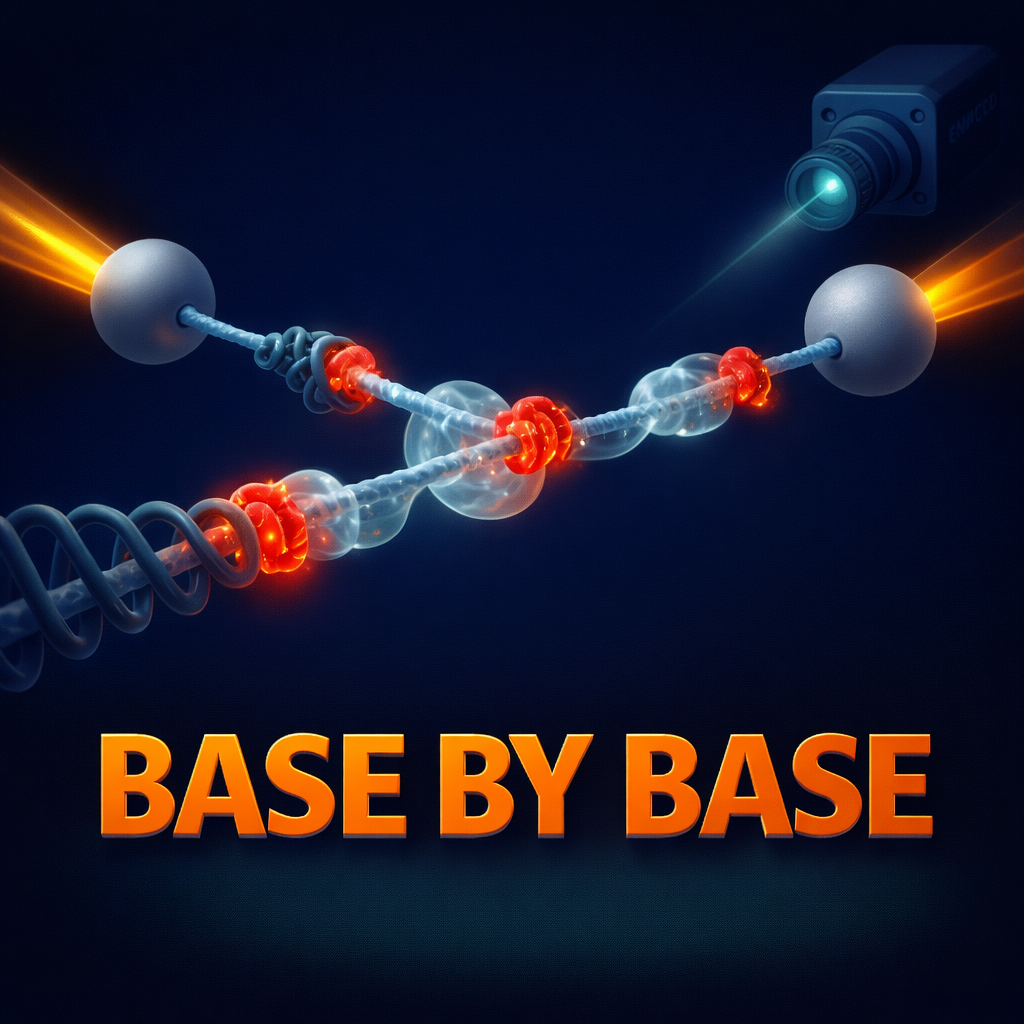
[00:07:13] Speaker B: And this is where the paper's methodology becomes just beautiful engineering. They use something called Dual trap optical tweezers.
[00:07:20] Speaker A: Optical tweezers is one of those terms that always sounds like it belongs in science fiction.
[00:07:24] Speaker B: It really does. But the concept is actually pretty straightforward. Imagine a microscopic rack. They take a single strand of DNA. They attach one end to a tiny bead held by a laser beam.
[00:07:34] Speaker A: Okay.
[00:07:35] Speaker B: And the other end to another bead held by another laser beam.
[00:07:38] Speaker A: So they have the DNA suspended between two tractor beams?
[00:07:41] Speaker B: Essentially, yes. And they. They used a technique called ods. Optical DNA supercoiling. By rotating one of the lasers, they can actually spin the bead so they.
[00:07:51] Speaker A: Can wind up the DNA on demand. Like winding a watch.
[00:07:54] Speaker B: Exactly. They can crank it to create those specific negative supercoils, mimicking exactly what PICH does in the cell.
[00:08:02] Speaker A: But they didn't just pull and twist it. They needed to see the enzyme working.
[00:08:06] Speaker B: Right. So they combine the tweezers with fluorescence microscopy. They took the TRR complex and labeled it with mm, cherry, a red glowing tag.
[00:08:15] Speaker A: So they can physically see the protein landing on the DNA while they're twisting it with lasers. That's incredible.
[00:08:21] Speaker B: And to make it even more sophisticated, they did all this in a microfluidic flow cell. The authors describe the setup almost like a car wash. A car wash?
[00:08:29] Speaker A: How so?
[00:08:30] Speaker B: Well, imagine you have these extremely thin lanes of fluid flowing side by side. Because of the physics at that scale, it's called laminar flow. The liquids don't mix. They just flow parallel to each other.
[00:08:41] Speaker A: Okay, got it.
[00:08:42] Speaker B: So they can hold the DNA in a buffer lane, twist it up with the lasers, and then literally move the lasers to dip the DNA into the lane containing the protein.
[00:08:52] Speaker A: Like, they just dip it.
[00:08:53] Speaker B: They dip it in, let the enzyme bite, and then move it back out to watch what happens.
[00:08:58] Speaker A: That is wild. So how do you measure relaxation? If I'm watching this movie, what am I looking for?
[00:09:03] Speaker B: You're looking at the length of the. The extension of the DNA strand.
[00:09:07] Speaker A: Because coiled DNA is shorter.
[00:09:08] Speaker B: Exactly. Think of that phone cord. Again, if it's all twisted up on itself, it's bunched up and short. As the enzyme relaxes those coils, the cord straightens out and gets longer.
[00:09:18] Speaker A: So by measuring how fast the DNA lengthens, they can calculate exactly how fast the enzyme is working?
[00:09:25] Speaker B: Yes, they calculate something called the linking number or dollars. They can literally count how many twists the. The enzyme is removing per second in real time.
[00:09:33] Speaker A: That is just incredible resolution.
[00:09:35] Speaker B: Oh, okay.
[00:09:35] Speaker A: So they've built this microscopic torture rack. They've got the glowing enzymes, and they're cranking the handle. What did they find is trr, the speed demon we need it to be.
[00:09:44] Speaker B: It turns out TRR is an absolute powerhouse.
[00:09:48] Speaker A: Give me the stats. How fast are we talking?
[00:09:50] Speaker B: A single TRR complex. Just one can relax negative supercoils at a rate of roughly 35 ballers per second.
[00:09:58] Speaker A: 35 twists per second.
[00:10:00] Speaker B: It's a blur. Now, to be fair, if you compare it to its bacterial cousin, E. Coli topoi, it's actually about 10 times slower. Bacteria are just speed demons in general because they have to replicate so fast. But for a human enzyme doing this specific delicate job, it's very impressive.
[00:10:18] Speaker A: But speed isn't just about how fast you spin. It's about efficiency. Right, because you do one twist and then just fall off.
[00:10:23] Speaker B: And that was the other major finding. The data showed that TRR is highly.
[00:10:27] Speaker A: Processive, meaning it holds on.
[00:10:29] Speaker B: It holds on tight. It doesn't just snip, fix one twist and let go. That would be incredibly inefficient because it would have to find the spot and rebind every single time. Instead, it acts in bursts, like a zip or a machine gun. Once it grabs the DNA, it performs thousands of strand passages, thousands of relaxation events without falling off. It just runs down the line.
[00:10:49] Speaker A: That explains the speed. It creates a stable gate and just pumps the DNA through it. Correct.
[00:10:54] Speaker B: And interestingly, they found this rate follows the Arrhenius law.
[00:10:58] Speaker A: Arrhenius law?
You're bringing me back to high school chemistry. Refresh my memory.
[00:11:03] Speaker B: In this context, it just means the rate depends on the force, the tension on the DNA. The more you pull on the DNA with the tweezers, the harder it is for the enzyme to do its job. But the data showed that even under significant tension, TRR still manages these massive bursts.
[00:11:19] Speaker A: Okay, so it's fast, and it works in long bursts. But DNA isn't a uniform string. Does TRR care where it binds?
[00:11:26] Speaker B: It cares a lot. The fluorescence imaging let them see exactly where those little red dots, the TRR complexes, were landing. And they found a really strong preference for AT rich sequences.
[00:11:36] Speaker A: Adenine, thymine regions. Why those specifically?
[00:11:39] Speaker B: Well, think about the bonds holding the DNA helix together. GC pairs, guanine, cytosine, they have three hydrogen bonds. They're tight, difficult to pull apart. But AT pairs only have two hydrogen bonds. They're weaker.
[00:11:51] Speaker A: So they're the weak links in the chain.
[00:11:52] Speaker B: Exactly. When you negatively supercoil DNA, when you underwind it, like Pich does, it wants to relieve that stress by popping open. It melts these melted spots, or bubbles of single stranded DNA happen most easily at those at rich sections.
[00:12:09] Speaker A: And TRR needs single stranded DNA to work because it has to cut one strand precisely.
[00:12:15] Speaker B: So TRR is a hunter. It hunts for these flimsy AT rich bubbles. It latches on there and creates a stable gate in that single strand to pass the other one through.
[00:12:25] Speaker A: So far, this is painting a perfect picture. It's fast, it's efficient, it hunts for the right spots. But then I read the section about the sticky surprise and this seemed to throw a wrench in the gears.
[00:12:35] Speaker B: This was the finding that really made the researchers pause. It's the plot twist of the paper.
[00:12:40] Speaker A: Tell us about the stickiness.
[00:12:41] Speaker B: So usually you expect an enzyme to do its job and leave. It finds the knot, unties it and moves on to the next problem.
[00:12:48] Speaker A: Right? Job done, clock out.
[00:12:50] Speaker B: But in these experiments, they found that even after the DNA was fully relaxed, meaning the job was completely finished, the linking number was back to normal. The TRR complex did not let go.
[00:12:59] Speaker A: It just sat there.
[00:13:00] Speaker B: It sat there. In the data, they show TRR staying bound to the DNA for over 30 minutes after the relaxation was finished.
30 minutes, half an hour.
[00:13:10] Speaker A: In the cellular world, that's not just a long time, that's an eternity. Mitosis takes minutes. Total 30 minutes is like staying at a party three days after it ended.
[00:13:20] Speaker B: It is remarkably persistent. And it wasn't just sitting on double stranded DNA. It actually seemed to be stabilizing those bubbles. It was actively holding the DNA open.
[00:13:29] Speaker A: Wait, if it holds the DNA open, isn't that keeping the DNA damaged or at least vulnerable?
[00:13:35] Speaker B: That is the big question. Why would an enzyme that's supposed to fixed DNA refused to leave the scene of the crime.
[00:13:41] Speaker A: Here's where it gets really interesting. For me, we had to reconcile this stickiness with the job it's supposed to do.
So let's go to the discussion. How do we connect these lab findings back to that tug of war on the antiphase bridge?
[00:13:54] Speaker B: Let's look at the numbers again. It really is a math problem.
[00:13:57] Speaker A: Remember pich, the motor making the loops?
[00:13:59] Speaker B: Right. Previous research established that PICH extrudes a loop of DNA that only lasts for about 1.3 seconds.
[00:14:06] Speaker A: 1.3 seconds. That is the window of opportunity. That's the deadline.
[00:14:10] Speaker B: Correct. If the loop collapses before the supercoils are relaxed, you're in trouble. But now we know TRR relaxes at $35 per second.
[00:14:17] Speaker A: So in 1.3 seconds it can relax what, about 45 twists?
[00:14:22] Speaker B: Roughly. And the average PICH loop only contains.
[00:14:25] Speaker A: About six supercoils oh, so TRR isn't just fast enough. It's overkill.
[00:14:30] Speaker B: It's massive overkill. This confirms mechanically that TRR is more than capable of resolving those loops before PICH lets them. The speed matches the biological requirement perfectly. It validates the entire model of how we think UFBs are resolved.
[00:14:44] Speaker A: So the hero arrives on time, but the hero doesn't leave.
Let's go back to that conundrum. If TRR stays stuck for 30 minutes, but the cell divides in five minutes, isn't that a problem?
[00:14:56] Speaker B: It would be, yes if TRR stayed stuck to the DNA indefinitely in a living cell, it could actually cause genomic instability itself. It would be a literal roadblock for other machinery trying to read or copy the DNA.
[00:15:08] Speaker A: So what's happening? Is the experiment wrong?
[00:15:10] Speaker B: Not wrong, but isolated. Remember, this is a single molecule experiment in a clean buffer. Just the DNA and the enzyme.
[00:15:18] Speaker A: Ah, the vacuum of space approach. No other variables.
[00:15:21] Speaker B: In a real cell, it's a crowded dance floor. The experts speculate that the stickiness we see in the lab is likely regulated by something else in the cell.
[00:15:29] Speaker A: A bouncer.
[00:15:30] Speaker B: Exactly. A molecular bouncer.
There are a few theories. One is facilitated dissociation.
Basically, other proteins might come along and physically push it off. Or think about the mechanics again. We said TRR relaxes negative supercoils, which helps generate positive supercoiling elsewhere.
[00:15:49] Speaker A: Right.
[00:15:50] Speaker B: It's possible that the buildup of positive supercoiling acts as a kind of mechanical ejector sea, forcing the enzyme to detach.
Or maybe its partner, protein blm, changes the shape of the complex and makes it let go.
[00:16:02] Speaker A: So the stickiness shows us that TRR has a really high affinity for these bubbles. It really wants to be there. But the cell must have checks and balances to make sure it doesn't overstay its welcome.
[00:16:11] Speaker B: Precisely. And that's what makes the study so important. It isolates the intrinsic behavior of the enzyme. It tells us this is what TRR wants to do. Now we can go looking for the factors that tell it to stop.
[00:16:22] Speaker A: And beyond just trr, this whole method seems like a game changer.
[00:16:26] Speaker B: Oh, absolutely. The combination of ODs, the twisting and the fluorescence is incredibly powerful. They mention in the paper that this can now be used to decode other deport poison rises. We can watch how drugs interact with them, how mutations affect them. It opens a whole new window into DNA topology.
[00:16:43] Speaker A: It's like upgrading from a still photo to a high def movie of the enzymes at work.
[00:16:48] Speaker B: That is a very fair analogy. And when you're dealing with things as fleeting and dynamic as anaphase bridges. You really need that movie.
[00:16:55] Speaker A: So let's wrap this up. What is the big take home message for everyone listening?
[00:16:59] Speaker B: The takeaway is that TRR is a highly processive, specialized machine. It targets the weak points in our DNA, those at rich bubbles, and relaxes them with incredible speed. It is perfectly tuned to keep up with the rapid fire mechanics of cell division, ensuring those invisible threads don't snap and cause chaos.
[00:17:17] Speaker A: It's the bomb squad that defuses the explosive with 0.1 seconds left on the clock every single time your cells divide.
[00:17:24] Speaker B: And it does it by holding on tight and not letting go until presumably, something else tells it the job is truly done.
[00:17:30] Speaker A: Which leads us to our provocative thought for the day. We know TRR is sticky. We know it refuses to leave the DNA on its own in the lab. So if you're a cell biologist listening to this, who is the bouncer?
[00:17:43] Speaker B: That is the million dollar question.
What is the molecular signal that breaks that incredibly strong bond once the DNA is safe? Is it a push, a twist, or some kind of chemical modification?
[00:17:54] Speaker A: If you figure it out, let us know. We'd love to do a deep dive on that paper too. This episode was based on an Open Access article under the CCBY 4.0 license. You can find a direct link to the paper and the license in our episode description. If you enjoyed this, follow or subscribe in your podcast app and leave a five star rating. If you'd like to support our work, use the donation link in the description.
Now. Stay with us for an original track created especially for this episode and inspired by the article you've just heard about. Thanks for listening and join us next time as we explore more science. Bass by bass.
[00:18:52] Speaker C: I hold the helix like a wiring rain A quiet twist with a negative stain Underwound spiral soft and tight Shadow coils hiding from the light Three names arrive like a single hand they don't need noise to understand.
A gate in the backbone belly seen a hush where the strand slips in between no fireworks, just pressure and grace A lock that opens in a narrow slow release don't let go Unwind and burst and breathe it so stay with me when the tension's gone still on the line when the twist moves on slow release hover I feel the knots come undone.
A pause like a bling then it runs again Count the turns like a secret pen Warm roads echoes low and near each small collapse you can almost hear 80 pages soften bubbles appear and something steady holds them here Hoops rise and fall in a heartbeat spin, but you're already there with a patient plan. Before the loop can disappear, you clear the spin, you draw it clear. Slow release, don't let go. Unwind and burst and breathe it slow. Stay with me when the tension's gone still on the line when the twist moves on. So really it's hover home.
I feel the knots come undone, undone, done.
Not a blade in the open air, but a hidden switch that handles care. You don't chase freedom, you created one quiet past and calibrated. If catamine's threaten to bind the day, you make a path where they can stay.
Slow release, don't let go. Unwind and burst and breathe it slow. When the force falls, when the coil is flat just till the mark where it used to set. Slow release harbor home from under wild night till morning sun.
Slow really.