Episode 470

October 29, 2026

00:17:23

470: The hidden swaps CRISPR leaves between sister chromosomes

Hosted by

Gustavo B Barra
470: The hidden swaps CRISPR leaves between sister chromosomes
Base by Base
470: The hidden swaps CRISPR leaves between sister chromosomes

Oct 29 2026 | 00:17:23

/

Show Notes

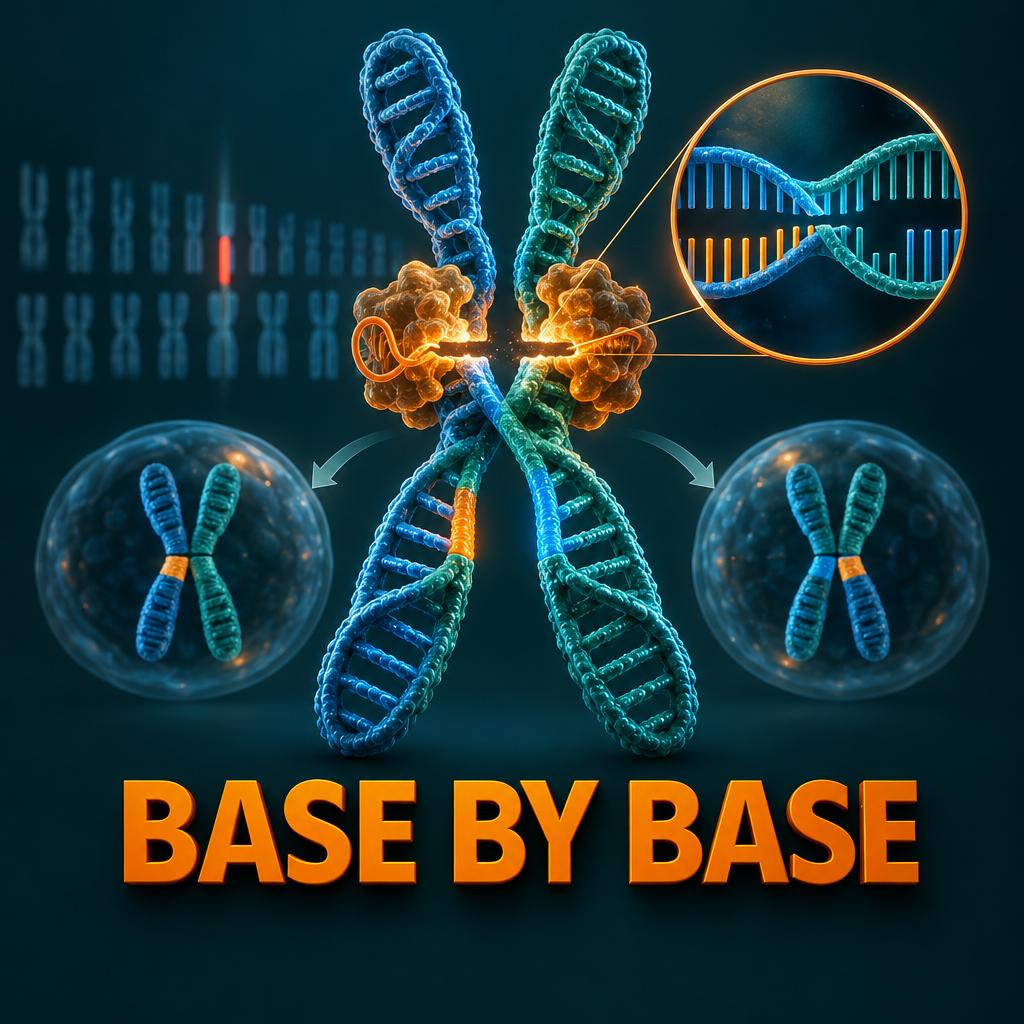
Chovanec P et al., eLife - When CRISPR/Cas9 cuts DNA, editing is usually judged by the small insertions and deletions left at the break. But a cut can also be repaired by swapping DNA between the two identical sister chromatids, an exchange that leaves no sequence change and is invisible to standard sequencing. Using sci-L3-Strand-seq, a single-cell method that reads which parental template strand each daughter cell inherited, this study mapped Cas9-induced sister chromatid exchange (SCE) in human cells, after cutting either one unique site or 237 repetitive Alu sites at once. Key terms: CRISPR/Cas9, sister chromatid exchange, Strand-seq, DNA double-strand break repair, structural variants.

Study Highlights:
Duplex Cas9 cleavage at a single site or at 237 repetitive targets caused a pronounced G1/S arrest within 24 hr, while the D10A and H840A nickases did not measurably perturb cell-cycle progression after washout. Cutting a unique locus strongly enriched SCE at the break site, reaching 41% in the same cell cycle and 17% in the subsequent division. Across all cells, cutting 237 Alu sites gave only mild on-target enrichment, 1.20-fold in the post-washout condition (n=2547 cells), but a high-SCE subset of 261 cells showed 1.39-fold enrichment with an average of 14.61 on-target SCEs per cell. Reciprocal daughter-cell pair analysis found that 14 of 50 Cas9-induced SCE events were coupled with structural variants, in contrast to 87 of 87 spontaneous SCEs in XRCC1-null cells that were reciprocal and copy-neutral in a companion study. Cutting inside LIG3, LIG4, XRCC1 and XRCC4 did not change genome-wide SCE counts, with a median of three SCEs per cell in all four conditions, consistent with delayed functional loss after editing.

Conclusion:
Cas9-induced double-strand breaks are potent local triggers of sister chromatid exchange, and a measurable fraction of these exchanges carries structural alterations that conventional sequencing cannot see, so they do not universally reflect error-free homologous recombination. All experiments were done in wild-type cells, Cas9 can cut the same site several times so individual outcomes cannot be tied to a single cleavage event, and the deletion signature pointing to a TRAIP/under-replicated-region pathway rests on a single daughter-cell pair.

Article title:
Genome-wide mapping of Cas9-induced sister chromatid exchange across single and over 200 genomic sites in human cells

First author:
Chovanec P

Journal:
eLife

DOI:
10.7554/eLife.112073

Reference:
Chovanec P., He S., Yin Y. Genome-wide mapping of Cas9-induced sister chromatid exchange across single and over 200 genomic sites in human cells. eLife, 15. (2026). https://doi.org/10.7554/eLife.112073

License:
This episode is based on an open-access article published under the Creative Commons Attribution 4.0 International License (CC BY 4.0) – https://creativecommons.org/licenses/by/4.0/

Support:
Base by Base is independent and ad-free — no sponsors, no paywall. If an episode was worth your time, chip in and keep the papers audited and the original songs coming:
❤️ Support monthly: https://buy.stripe.com/cNifZhclVebvagk2JDgEg01
☕ One-time donation: https://donate.stripe.com/7sY4gz71B2sN3RWac5gEg00
▶️ Watch with chapters on YouTube: https://www.youtube.com/@basebybase
More at basebybase.com

On PaperCast Base by Base you'll discover the latest in genomics, functional genomics, structural genomics, and proteomics.

Episode link: https://basebybase.com/episodes/cas9-sister-chromatid-exchange-strand-seq

QC:
This episode was checked against the original article PDF and publication metadata for the episode release published on 2026-10-29.

QC Scope:
- article metadata and core scientific claims from the narration
- excludes analogies, intro/outro, and music
- transcript coverage: The scientific body from the cold open through the take-home was audited; the fixed intro, outro and the card-deck analogy were not treated as factual claims.
- transcript topics: sister chromatid exchange as a silent repair outcome; Cas9 double-strand breaks and isochromatid geometry; sci-L3-Strand-seq template-strand sequencing; cell-cycle arrest after Cas9 and nickase treatment; on-target SCE at single unique loci; SCE enrichment across 237 repetitive Alu targets

QC Summary:
- factual score: 10/10
- metadata score: 10/10
- supported core claims: 8
- claims flagged for review: 0
- metadata checks passed: 4
- metadata issues found: 0

Metadata Audited:
- article_doi
- article_title
- article_journal
- license

Factual Items Audited:
- 41% on-target SCE in the first division and 17% after washout
- largest post-washout reduction of 74%
- ~90% bulk editing efficiency and why it is not the same as the SCE rate
- median of three SCEs per cell across the four repair-gene conditions
- 1.20-fold enrichment with 6.13 on-target SCEs per cell in 2547 cells
- 1.39-fold enrichment with 14.61 on-target SCEs per cell in 261 high-SCE cells

QC result: Pass.

Chapters

  • (00:00:03) - The Deck of Cards Analogy
  • (00:00:41) - Intro and Fact-Check Note
  • (00:01:02) - Sister Chromatids and Silent Swaps
  • (00:01:33) - Cas9 Scissors and Hidden Repairs
  • (00:02:08) - Paper Introduction
  • (00:02:44) - How Cas9 Cuts Are Normally Repaired
  • (00:03:24) - Bigger Damage Beyond Small Edits
  • (00:03:57) - Defining Sister Chromatid Exchange
  • (00:04:17) - Four Broken Ends and Open Questions
  • (00:05:28) - Strand-Seq: Reading the Backs of the Cards
  • (00:06:37) - Experimental Design and Guides
  • (00:07:46) - Cell Cycle Arrest Findings
  • (00:08:22) - Exchanges Pile Up at the Cut Site
  • (00:08:53) - Interpreting the 41% Exchange Rate
  • (00:10:02) - Checking Repair Gene Targets
  • (00:10:34) - Cutting 237 Sites at Once
  • (00:11:11) - High-Exchange Cell Subsets
  • (00:12:22) - Reciprocal Daughter Pairs and Clean Trades
  • (00:12:53) - When Trades Aren't Clean
  • (00:13:24) - Rethinking How We Judge Edits
  • (00:14:00) - Isochromatid Breaks and Mechanism
  • (00:14:59) - Caveats on Causation and Single Observations
  • (00:15:55) - Conclusions and Implications
  • (00:16:51) - Closing and Credits
View Full Transcript

Episode Transcript

[00:00:03] Picture two decks of cards, identical in every way. Same cards, same order, ace to king. The only difference is the backs. One deck has blue, backs the other red. [00:00:14] Now cut both decks at exactly the same card and swap the halves. Turn them face up and nothing has changed. Every card is still in perfect order. [00:00:24] Turn them face down and the swap jumps out at you. Blue gives way to red right at the cut. [00:00:30] Now ask yourself, what if your cells do this to their own chromosomes every time we edit them? [00:00:41] This is base by base. Every episode is built with AI tools from a real open access paper curated by a human. And every claim is checked against the paper before we publish. You'll find this episode's fact check score on our website. Now back to the story. [00:01:02] Here is why that question matters. When a cell copies a chromosome, it makes two identical sisters joined in the middle. If one sister breaks, the cell can repair it by trading pieces with the other. [00:01:16] Because the sisters are identical, the trade changes no DNA letters at all. It is the fake face up deck. Standard sequencing reads only the letters, so it cannot see the swap. To see it, you need a way to look at the backs of the cards. [00:01:33] And the scissors in this story are the most famous ones in modern biology. Cas9 cuts DNA at a site chosen by a short guide. Labs use it every day to switch off genes. [00:01:45] We usually judge an edit by what it leaves behind of the cut. [00:01:49] A few letters added or lost. [00:01:52] But what if many cuts are repaired by a silent swap between sisters instead? [00:01:57] And what if some of those swaps are not as clean as they look? [00:02:01] How would anyone know? [00:02:08] Today we celebrate the work of Peter Chovinek, Cheong he and Yi Yin from the Department of Human Genetics at the the David Geffen School of Medicine who have advanced our understanding of how cells repair the cuts we make in them. [00:02:23] This base by base episode is based on their Open Access article. Genome wide mapping of Cas9 induced sister chromatid exchange across single and over 200 genomic sites in human cells. Published in eLife in October 20. [00:02:44] Lets start with the cut itself. Cas9 makes a double strand break, a clean snap through both strands of the helix. The cell then has to fix it. Two repair routes are best known. End joining glues the ends back together and often adds or removes a few letters. That is how most gene knockouts happen. [00:03:04] Homologous recombination copies the missing information from a matching template in the lab. That template can be a piece of donor DNA which allows a precise edit. Both routes have been studied in detail, letter by letter for Years. Those small local changes were the whole story. [00:03:24] Then the picture got bigger. Earlier work cited by the authors found large deletions spanning kilobases at the cut site. Other studies found that these breaks can shatter a chromosome entirely. [00:03:37] In edited human embryos, whole chromosomes and large segments were lost. And in edited cancer cell lines, rearrangements were often missed by the usual PCR chicks. So the scissors can do far more than nick a few letters. But one outcome stayed largely overlooked. [00:03:57] That outcome is sister chromatid exchange. The authors define it simply as a reciprocal strand switch between the two sister chromatids. [00:04:07] They are careful not to tie it to one mechanism. It can come from recombination between sisters. It can also come from end joining across two breaks, one on each sister. [00:04:17] Why would that happen here? Because Cas9 usually cuts both sisters at the same spot. That leaves four broken ends and neither sister intact. [00:04:30] Now think about how those four ends can can be rejoined. If each sister is glued back to its own ends, the original arrangement returns. If the top of one sister is joined to the bottom of the other, you get a strand switch. Put another way, the decks were cut and the halves swapped. And that switch looks exactly like a classic recombination exchange. [00:04:53] Which of these routes produces the exchanges we see had not been determined. [00:05:00] So three questions were open. Does a single targeted break efficiently trigger a local exchange? [00:05:07] What happens when hundreds of sites are cut at once? And are these exchanges always error free? Or do some hide structural damage? Answering any of them means seeing something that leaves no trace in the sequence. That is the gap this study set out to fill. [00:05:28] How do you see the backs of the cards? [00:05:31] The team used a method called ECL3 strand seq, a single cell form of template strand sequencing. Here is the trick. While a cell copies its DNA, it is fed a modified building block called brdu. The new strands soak it up. The method then destroys those new strands and sequences only the old parental ones. Each parental strand runs in one of two directions, called Watson and Crick. [00:06:01] Those two directions are the blue and red backs of our cards. [00:06:05] Along a normal chromosome, a daughter cell inherits one direction for the whole length. If the direction flips partway along, that flip marks an exchange. No letter has to change. [00:06:17] The method reads the pattern of the backs, cell by cell, across the whole genome. And because it handles many cells at once, it can sometimes capture both daughters of the same division. The authors call those reciprocal daughter cell pairs. With both daughters in hand, you can check whether a trade was really clean. [00:06:37] Now the experiment itself. The team delivered Cas9 as a ready made complex of protein and guide, a common way to make knockouts. They worked in two human cell lines. [00:06:49] Four guides each cut a single unique site inside a DNA repair gene. Those genes were lig3, lig4, xrcc1 and xrcc4. [00:07:02] A fifth guide matched a repetitive ALU sequence and cut 237 sites at once. [00:07:11] The timing matters here. In one setup, the scissors and the label went in tape together for 24 hours. So the cut and the labeling happened in the same cell division. In the other, the scissors were washed out first and the label added afterwards to read the next division. [00:07:28] The team also tested two nick cases, versions called D10A and H840A. Each of them cuts only one strand of the DNA instead of both. They were built to be gentler. [00:07:46] The first result came before any sequencing. Cutting with full CAS9 at one site or at the repetitive targets caused a pronounced arrest within 24 hours. Even a single break was enough to trigger it. [00:07:59] That arrest lasted after the scissors were removed, only in cells hit at the repetitive sites, consistent with damage piling up across many places at once. [00:08:09] The two nick cases, by contrast, did not measurably disturb the cell cycle. After washout, one cut strand was largely tolerated. Two cut strands were not. [00:08:22] Then the main question where do the exchanges land? [00:08:26] The team stacked up every exchange from every single cell across the genome in windows of one megabase for all four single site guides. Exchanges piled up right at the programmed cut. [00:08:39] The signal was strongest in the first division after delivery and weaker after washout. [00:08:44] So a single targeted break turns out to be a potent local trigger of sister chromatid exchange. [00:08:53] How strong? The combined on target Exchange rate reached 41% in the first division. 41%. [00:09:01] Nearly half the cells in the following division after washout, it reached 60 17%. [00:09:08] Overall, the rate dropped by about half after washout, with the largest drop at 74%. [00:09:14] The authors note these exchanges happen at frequencies comparable to the small insertions and deletions normally used to measure editing. Yet standard sequencing does not see them at all. [00:09:28] There is an obvious objection here. Cas9, delivered this way, edits around nine 90% of cells in bulk. So is 41% just a measure of editing? The authors say no. The scissors can cut the same site many times, with repair in between. [00:09:45] So the number should not be read as knockout efficiency or as the rate of error free repair. It measures something narrower. It is the share of breaks repaired by trading with the sister rather than being fixed on the same chromatin. [00:10:02] Next, a check on the four target genes. They were all DNA repair genes. Would breaking them raise exchange everywhere in the genome? Not right away. All four conditions showed a median of three exchanges per cell, the same as untreated cells. The reason is timing. Even when both copies of a gene are disrupted, the protein already in the second cell does not vanish. It has to be diluted away through turnover and cell division before anything changes. [00:10:34] Now the harder experiment. What happens when you cut 237 sites at the same time? [00:10:41] You might expect exchanges everywhere. That is not what the data show. [00:10:46] Across all cells, the enrichment at the targeted sites was mild. [00:10:50] In the strongest condition, after washout, exchanges fell at the cut sites 1.20 times more often than at random spots. In 2,547 cells, that worked out to about 6.13 on target exchanges per cell. Real, measurable, but modest. [00:11:11] And that is where it gets complicated. The average hid something. [00:11:16] When the authors looked only at cells carrying an unusually high number of exchanges, the picture sharpened. In that subset of 261 cells, the enrichment rose to 1.39, with an average of 14.61 on target exchanges per cell. So most cells repaired their cuts some other way, without trading. A minority engaged the trade heavily. [00:11:40] The nickases, meanwhile, showed no meaningful enrichment at all. [00:11:47] Even in those busy cells, something is worth noticing. The number of on target exchanges per cell stayed below 15, far fewer than the 237 sites available to cut. [00:12:00] So most of those sites either were never cut or were repaired by a route that leaves no exchange. The authors cannot say which, and they do not pretend to. They offer two A cell cycle state that favors both cutting and recombination. Or simply chance in how much of the enzyme each cell took up. [00:12:22] Which brings us to the sharpest result. Remember the reciprocal daughter cell pairs where both halves of a division are captured? If an exchange is a clean trade, the two daughters should mirror each other other exactly, with no DNA gained or lost. In a companion study on spontaneous exchanges, that is precisely what happened. 87 out of 87 were reciprocal and copy neutral, every single one. So the trade can be perfectly clean. [00:12:53] With Cas9, it often was not. [00:12:56] Among the exchanges recovered from these daughter pairs, 14 of 50 came with large structural changes alongside them. In one pair, one daughter carried a strand switch at a junction, while the other carried a deletion at the matching spot. [00:13:11] Go back to our decks. The halves were swapped, but one deck came back with cards missing. And you would never know by reading the faces. [00:13:24] So what does this change? [00:13:26] First, how we judge an edit editing is usually measured by sequencing a small window around the cut or the whole genome. Neither sees a swap between identical sisters and neither sees these junction changes. The authors argue that single cell strand level resolution is needed for a full accounting of what programmable scissors leave behind. [00:13:49] But we should note the limitations limitation right here. Every experiment was done in ordinary unmodified cells and in two cell lines only. [00:14:00] Second, the shape of the break matters. When both sisters are cut at the same place, neither one is left intact to serve as a clean template. The authors call this geometry isochromatid. It is structurally different from the breaks that arise on their own during copying, where one good sister is always available. And that difference shows up in the results as a measurable fraction of outcomes that carry damage. [00:14:28] Third, a mechanistic hint and this one needs care. That pattern of a strand switch in one daughter and a deletion in the other does not fit classical recombination. [00:14:39] It does fit a different route in which REC regions of the chromosome that were never finished copying get cut and stitched back together. [00:14:47] Recent work has linked that route to a specific set of proteins. The authors say their observation is consistent with that mechanism. They do not say it proves it. [00:14:59] And the reason for that caution is that signature was seen in a single daughter cell 1 the authors state the limit plainly in the paper. [00:15:10] A single observation can point toward a mechanism. It cannot establish how often it happens or in which cells. Testing that will need many more pairs and conditions where the proposed route is deliberately disabled. [00:15:25] There is one more honest caveat, and it is about causation. Cas9 can cut the same spot over and over, with repair in between. So when a rearrangement shows up, it cannot be pinned to one cleavage event. The authors say this directly and it limits what any single outcome can tell us. [00:15:43] Tighter control over when the enzyme acts and how many times is what the next round of experiments will need. [00:15:55] So here is where this leaves us. A single Cas9 cut is a potent trigger of exchange between C sister chromatids, reaching 41% in the first division. Cutting hundreds of sites at once gives only a mild effect overall, concentrated in a minority of cells. And these exchanges are not uniformly benign. 14 of 50 came with structural changes attached against 87 of 87 clean ones when the exchange arose on its own. [00:16:26] Remember the two decks of cards? Read the faces and the swap is invisible. Read the backs and it is obvious, along with the cards that went missing, we have been reading the faces. What does this mean for the future of gene editing if the most common outcome of a cut is one we have not been measuring. [00:16:51] This episode was based on an over open Access article under the CC BY 4.0 license. You can find a direct link to the paper and the license in our episode description. If you enjoyed this, follow or subscribe in your podcast app and leave a five star rating. If you'd like to support our work, use the donation link in the description. Thanks for listening and join us next time as we explore more science base by base.

Other Episodes