Episode Transcript
[00:00:20] Speaker A: Welcome to Base by Base, the papercast that brings genomics to you wherever you are. Thanks for listening and don't forget to follow and rate us in your podcast app.
[00:00:29] Speaker B: Glad to be here for another one.
[00:00:30] Speaker A: So today I want to start you off with a mental image. I want you to picture the ultimate factory. Just the most sophisticated, high stakes manufacturing plant in the known universe.
[00:00:42] Speaker B: I mean, given our usual deep dives, I am assuming we are talking about the developing human brain.
[00:00:48] Speaker A: We are. It is this incredible assembly line that has to run with absolute perfection. It's building neurons, it's connecting circuits, it is practically knitting consciousness out of raw proteins. But now imagine there is a glitch in the shipping department. Just a tiny, seemingly insignificant error.
[00:01:05] Speaker B: The shipping department?
[00:01:06] Speaker A: Yeah, the workers, the proteins. Right. They aren't getting the right shipping labels. They exist. They are perfectly ready to be used, but they don't have the tag that tells them where to go. Or actually, more importantly, that tells the foreman they passed quality control.
[00:01:20] Speaker B: Right. Which is a major problem.
[00:01:21] Speaker A: Exactly. And because of that one missing sticker, the factory foreman completely panics.
[00:01:27] Speaker B: And by panic, I assume you mean the cellular stre response.
[00:01:30] Speaker A: I do. The foreman doesn't just slow down the line, he slams on the emergency brake, he shuts down the entire floor, the machinery overheats and the product comes out completely stunted.
[00:01:41] Speaker B: That is a terrifyingly accurate metaphor for the mechanism we are getting into today. Because when the cell's quality control system fails like that, the reaction can be catastrophic.
[00:01:53] Speaker A: And the stakes here aren't just hypothetical. We aren't talking about a bad day at a real factory. We are talking about microcephaly babies born with significantly smaller brains.
[00:02:03] Speaker B: Yeah.
[00:02:03] Speaker A: We're talking about severe epilepsy, intellectual disability, movement disorders.
[00:02:07] Speaker B: Right. These are life altering conditions for the patients and their families. And for a long time, the link between the genetic defect and the actual physical brain structure was, well, it was a bit of a black box.
[00:02:18] Speaker A: Right. We knew the what, but not the why.
[00:02:20] Speaker B: Exactly. Scientists knew that a specific system failure caused these diseases, but the why was really murky. Like, was the brain running out of parts? Was the machinery literally breaking down?
[00:02:33] Speaker A: And here's the question that really hooked me when I was looking at the source material for this deep dive.
What happens if you try to fix this incredibly complex genetic machinery failure with a drug that is probably sitting in millions of medicine cabinets right now.
[00:02:47] Speaker B: You are referring to an antidepressant.
[00:02:49] Speaker A: I am. Because the answer to that question might actually rewrite how we treat rare genetic disorders. And it implies we might not even need to fix the broken gene to fix the disease.
[00:03:00] Speaker B: It is a phenomenal study. And today we really have to celebrate the work of Katerina Perdegaon and her colleagues.
[00:03:05] Speaker A: Yes.
[00:03:06] Speaker B: They are at the Max Planck Institute for Multidisciplinary Sciences, specifically the Department of Molecular Neurobiology.
[00:03:12] Speaker A: And looking at the author lists, this was a massive team effort. They had collaborators from the University of Dundee and Charity University Medicine Berlin. This is big collaborative, cross border science.
[00:03:24] Speaker B: Absolutely. Their breakthrough study titled encephalopathy linked UFM1 variants impede neuronal Protein Translation development and function was published in MBO Molecular Medicine in 2026.
[00:03:37] Speaker A: So let's get into the weeds of this factory floor. We mentioned a labeling system earlier. What exactly is this system?
[00:03:44] Speaker B: We are talking about a process called UF myelation.
Right. And to understand that, you. You have to remember that when a cell makes a protein, the job isn't done. That protein is like raw steel coming out of a smelter. It often needs to be modified or folded or tagged to actually function. We call these post translational modifications.
[00:04:03] Speaker A: Like putting a stamp on a letter so it actually gets delivered. Or like a past inspection sticker.
[00:04:08] Speaker B: Precisely. And one of these stamps is a small protein called UFM1. It stands for ubiquitin fold modifier 1.
[00:04:14] Speaker A: Okay.
[00:04:15] Speaker B: It is a cousin to ubiquitin, which is the famous tag used for recycling proteins, basically marking cellular trash.
But UFM1 is different. Its specific role has been pretty enigmatic.
[00:04:25] Speaker A: Enigmatic is a polite way of saying we knew it was important, but we had absolutely no idea what it actually did day to day.
[00:04:31] Speaker B: Fair enough. We knew it was essential for life.
But to attach this UFM1 tag to a protein, the cell uses a sort of bucket brigade of enzymes.
[00:04:40] Speaker A: A bucket brigade?
[00:04:41] Speaker B: Yeah. So you have the E1 enzyme, which is called UBA5, and that activates the tag. Then it passes it to the E2 enzyme, USC1, and finally the E3 complex, UFL1 actually attaches it to the target.
[00:04:53] Speaker A: It's a relay race. So UBA 5 hands the baton to UFC 1, who hands it to the target.
[00:04:58] Speaker B: Exactly. And if anyone drops the baton, if you have genetic variants in UFM1 itself, or the E1 or the E2, you get these severe human diseases we mentioned
[00:05:07] Speaker A: earlier, and collectively those are called UF myelopathies.
[00:05:10] Speaker B: Right.
[00:05:10] Speaker A: Which is a mouthful, but it groups together a lot of human suffering.
[00:05:13] Speaker B: It does. The symptoms across these encephalopathies are really global developmental delay, intellectual disability, and epilepsy now, the study focused on two very specific scenarios seen in patients. First, simply not having enough UFM1.
[00:05:27] Speaker A: The out of stock problem. The factory literally ran out of labels.
[00:05:30] Speaker B: Exactly. This is UFM1 loss.
But the second scenario is much trickier and, frankly, far more interesting from a biochemical standpoint. It's a specific mutation called R81C.
[00:05:42] Speaker A: R81C? It sounds like a coordinate on a
[00:05:44] Speaker B: map in the protein's geography. It basically is. It means that at position 81 in the Amino acid chain, an arginine is replaced by a cysteine. The protein exists, the factory makes it. But it's wrong.
[00:05:58] Speaker A: So you have the tag, but maybe the glue on the back doesn't stick or the barcode is smudged.
[00:06:02] Speaker B: That is exactly what they wanted to find out. Is it just a dead tag, or does it do something worse? Does it actively gum up the machine?
[00:06:08] Speaker A: So how do you actually study this? Because I assume you can't just knock on the door of a developing neuron in a human fetus and ask it how it's feeling.
[00:06:16] Speaker B: No, obviously not. And you can't just delete the UFM1 gene from a mouse entirely either, because that's lethal.
[00:06:22] Speaker A: Right.
[00:06:22] Speaker B: The embryo simply doesn't survive without this system.
So the team used a conditional knockout model, The Eko. Right. They used a really clever genetic trick, the Krilox System, to delete UFM1 specifically in neurons just in the cortex and hippocampus and right during development.
[00:06:39] Speaker A: Okay, so the rest of the mouse is fine, but the brain is missing this labeling system.
[00:06:43] Speaker B: Exactly. And then to really understand the mechanism, they did something else. They used viral vectors to put UFM1 back in.
[00:06:49] Speaker A: Like a software patch?
[00:06:50] Speaker B: Yes. In some neurons, they put back the healthy wild type, UFM1. In others, they put in that patient variant we talked about, the R81C mutant.
[00:06:59] Speaker A: Oh, wow. So this allowed them to compare directly. Like, can the mutant fix the damage, or is it useless?
[00:07:05] Speaker B: Precisely. And they threw the kitchen sink at these neurons to analyze them.
[00:07:08] Speaker A: I saw they used something called shawl analysis.
[00:07:10] Speaker B: Yeah, that's a standard but very powerful way to visually trace how complex a neuron is. Imagine drawing concentric circles around the cell body like a target. You count how many times the branches of the dendrites cross those circles. It mathematically quantifies how branchy the tree is.
[00:07:27] Speaker A: Got it. And they also hook them up to electrodes. Right.
[00:07:30] Speaker B: Patch clamp, electrophysiology. They literally listen to the electrical firing and synaptic transmission of single neurons.
[00:07:38] Speaker A: But my absolute favorite Acronym in this deep dive has to be fun. NCAT.
[00:07:43] Speaker B: FunSat. Cat fluorescent non canonical amino acid tagging.
[00:07:47] Speaker A: Which sounds incredibly complicated, but if I understood the notes correctly, it's basically a way to watch the factory in real time.
[00:07:54] Speaker B: It is. It allows you to visualize and measure the rate of new protein synthesis. If the factory line is moving and making product, the cell glows. If the line is stalled, it's dark. It gives you a real time read on the productivity of the cell.
[00:08:08] Speaker A: So let's get to the results. They delete UFM1.
What happens to the neurons?
[00:08:12] Speaker B: Collapse. It is a complete morphological collapse.
[00:08:15] Speaker A: That sounds dramatic.
[00:08:16] Speaker B: It is dramatic. The neurons are stunted. The cell body, the soma, is physically smaller. And when they looked at the dendrites, those receiving branches we talked about, they were significantly less complex. They had far fewer branches to connect with other cells.
[00:08:29] Speaker A: So if a normal neuron looks like a big bushy oak tree, these look like what?
[00:08:33] Speaker B: Like a sapling that's struggling to grow in a drought.
And because the structure was stunted, the connections were missing, they saw a massive reduction in the number of synapses.
[00:08:43] Speaker A: And synapses are the whole point of a neuron. That's how they talk to each other.
[00:08:46] Speaker B: Exactly. Both excitatory and inhibitory synapses were heavily reduced. And when they listened to the electrical signals, the EPSC amplitudes, the strength of the signal were incredibly weak.
[00:08:59] Speaker A: Weak signals, fewer connections. But here's where I found a really surprising detail in the data.
The paper says the probability of release was normal.
[00:09:07] Speaker B: This is a crucial distinction to make. The synapses that did survive, they functioned perfectly fine structurally. Under the electron microscope, they looked completely normal. The pool of vesicles was smaller, but the probability of actually releasing a neurotransmitter was standard.
[00:09:23] Speaker A: So it's not a quality problem, it's a quantity problem.
[00:09:26] Speaker B: Precisely. The individual workers, the synapses are competent. There just aren't enough of them because the factory never built the infrastructure.
[00:09:34] Speaker A: So why is the factory understaffed? This brings us back to the engine room. What did F1 shit tell them about the assembly line?
[00:09:41] Speaker B: It revealed a severe reduction in global protein translation. The neurons essentially stopped building the proteins they needed to grow.
[00:09:48] Speaker A: The assembly line actually did stop.
[00:09:51] Speaker B: It halted. And the reason seems to be directly linked to the endoplasmic reticulum, or the error. The ER is where proteins are folded and processed. It turns out UF myelation is critical for ribosomes, the actual protein builders that are attached to the er.
[00:10:06] Speaker A: So when the tag Is missing. The ribosomes just jam up.
[00:10:08] Speaker B: They stall out. And when ribosomes stall, the cell senses a crisis. It triggers the unfolded protein response, or upr.
[00:10:16] Speaker A: That sounds like the emergency alarm we talked about.
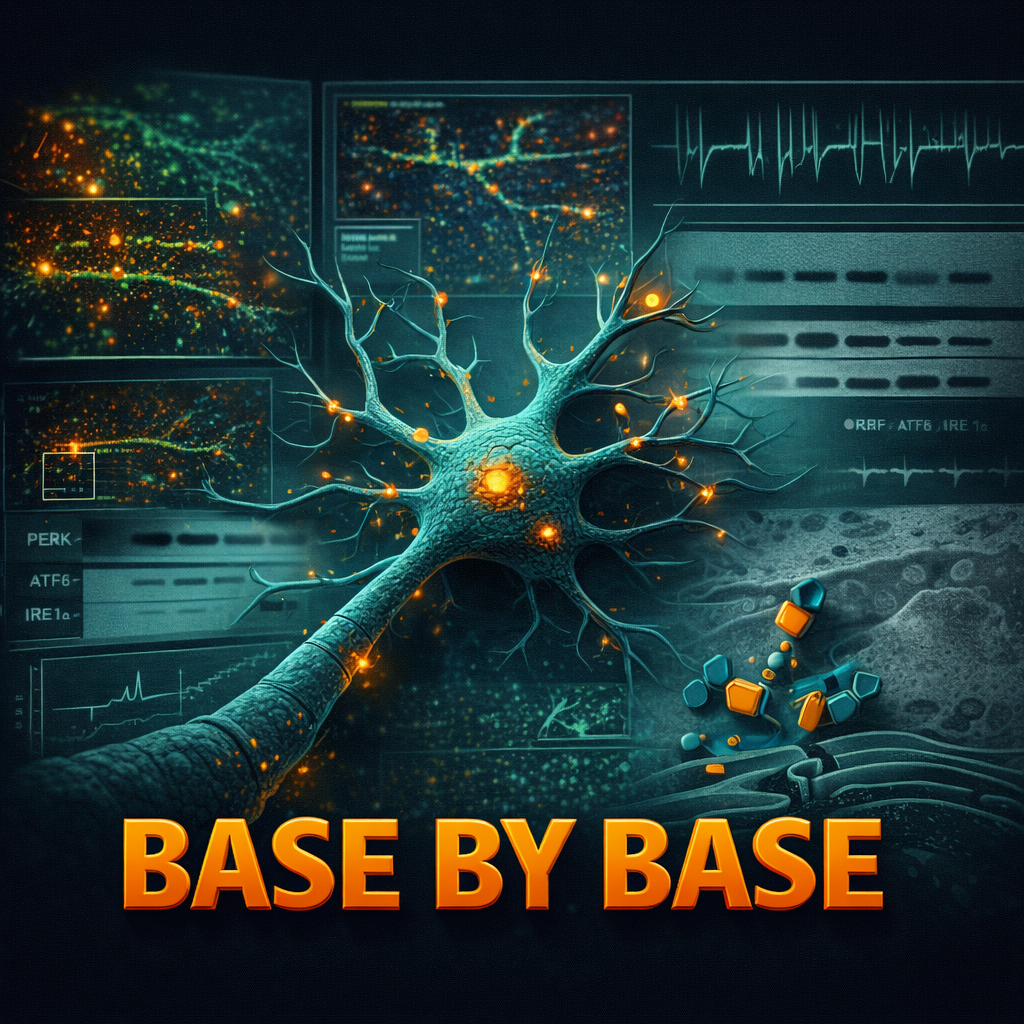
[00:10:18] Speaker B: It is. Specifically, it activates the PRK pathway. When the cell senses that proteins aren't being handled correctly, PRK gets activated. It phosphorylates a factor called EIF2alpha, which essentially screams to the nucleus to stop making new proteins until they fix the mess.
[00:10:33] Speaker A: Okay, so the lack of the tag causes a traffic jam. The cell panics, pulls the emergency brake via peer, shuts down production, and as a result, the neuron just never grows up.
[00:10:44] Speaker B: That is the exact mechanism for UFM1 loss. The brake is on. Permanently.
[00:10:49] Speaker A: But remember the R81C mutation? The patient variant?
[00:10:53] Speaker B: Right, the broken label maker.
[00:10:54] Speaker A: The researchers found something really nuanced here. R81C is a hypomorph, meaning it works, but barely.
[00:11:01] Speaker B: It's highly inefficient. They found that the E1 enzyme, UBA5, struggles to charge or activate this mutant UFM1. It takes much, much longer than the wild type.
[00:11:10] Speaker A: So the relay race is happening in slow motion.
[00:11:12] Speaker B: Yes, and when they tried to rescue the knockout neurons with this R81C mutant, it only partially worked. It didn't fix the shape of the neurons effectively at all. But here's the real twist. R81C isn't just slow. It might actually be toxic.
[00:11:25] Speaker A: Toxic how?
[00:11:26] Speaker B: Well, when they stress the cells chemically, they used a compound called thapsygargin to induce, er stress. The neurons with the RA1C mutation had a hyperactive stress response. They panicked more than the neurons that had no UFM one at all.
[00:11:38] Speaker A: Whoa. So having a broken part is somehow worse than having no part? At least when things get tough.
[00:11:43] Speaker B: In terms of the stress response, yes.
It suggests that the mutant protein is gumming up the works.
Perhaps it's trapping enzymes. Or confusing the signaling pathways Leading to an aggravated pure response. It's not just that the brake is on. It's like the driver is standing on the brake with both feet.
[00:11:59] Speaker A: Okay, so we have a clear picture of the disaster.
No UFM1 or broken UFM1 leads to a traffic jam in the ER the cell pulls the emergency brake via the P. Rec pathway.
Protein production stops, the neuron stays tiny and unconnected, and brain function suffers.
[00:12:18] Speaker B: That is the summary. It's a cascade of failure starting from one single missing tag.
[00:12:23] Speaker A: So if the problem is that the cell is panicking and pulling the emergency brake, can we just tell the cell to chill out, like, can we just cut the brake line?
[00:12:30] Speaker B: That is exactly what the researchers ask next. They look for a way to inhibit that pirarc pathway, because if the ribosomes are stalling, maybe we can force the cell to ignore it and keep building anyway. And they found a candidate in trazodone.
[00:12:41] Speaker A: Trazodone? The antidepressant?
[00:12:43] Speaker B: The very same. It is a clinically used drug chemically unrelated to SSRIs, but known to inhibit the perky UPR pathway.
It's been shown to boost protein synthesis in other models of neurodegeneration, like Alzheimer's and prion disease.
[00:12:58] Speaker A: So they gave the neuronal cultures some trazodone. What actually happened?
[00:13:02] Speaker B: The results were striking. In the neurons expressing that Re1C mutant, the patient variant trazodone treatment, fully restored protein translation.
[00:13:10] Speaker A: Wait.
[00:13:11] Speaker B: Fully back to control levels. The F1 macat signal lit right up. The factory started running again.
[00:13:17] Speaker A: That is incredible. Did the neurons grow back? Did the tree fill out?
[00:13:21] Speaker B: Well, this is where we have to be scientific and nuanced. Trazodone significantly increased the number of synapses. The connectivity came back.
[00:13:28] Speaker A: But. I hear a but.
[00:13:29] Speaker B: But it did not fix the dendritic branching complexity. The trees were still small, even though they had more leaves, so to speak. The actual skeleton of the neuron remained stunted.
[00:13:39] Speaker A: That's fascinating. So the drug could fix the connection count, but the physical stunting of the skeleton was irreversible.
[00:13:45] Speaker B: It suggests that some defects are structural and perhaps locked in early in development.
Once the tree is grown, you can't easily change the trunk. But others, like synapse number, are plastic. They can be modified much later.
[00:13:58] Speaker A: Still, increasing synapse numbers in a condition defined by a lack of connections. That's a huge win, isn't it?
[00:14:04] Speaker B: It is a major proof of concept. It identifies the UPR and PRK pathway as a druggable target.
We can't easily go in and fix the genetic mutation in every neuron of a human brain. Yet.
Gene therapy is still very difficult for these global brain conditions. But if we can treat the consequence of the mutation, the stress response, we might be able to restore a lot of function.
[00:14:27] Speaker A: It's like we can't fix the broken label maker, but we can tell the foreman to stop shutting down the factory every time he sees a mistake and
[00:14:33] Speaker B: just keep production moving.
Exactly. Just bypass the panic.
[00:14:37] Speaker A: So what does this mean for the big picture, for you listening right now? Why does this really matter?
[00:14:42] Speaker B: If we connect this to the bigger picture, it reinforces a major shifting paradigm in treating genetic diseases. For a long time we thought broken gene equals broken organism. Fix a gene or you're out of luck.
[00:14:54] Speaker A: But this deep dive shows that the pathway from gene to disease has steps. And those steps can be hacked.
[00:15:01] Speaker B: Precisely. The UFM1 tag is a quality control manager. When it's gone, the ribosome stalls, but the major damage is largely caused by the cell's reaction to that stall. If we can modulate the reaction, we can salvage the system.
[00:15:14] Speaker A: It turns a genetic dead end into a manageable condition.
[00:15:17] Speaker B: It's really helpful, and it highlights the absolute importance of basic biology. Without understanding UF myelation and the Perrier pathway, without doing that fundamental how does this work? Research with we never would have guessed that an old antidepressant could help a rare genetic microcephaly.
[00:15:33] Speaker A: It really makes you wonder what other drugs are sitting on our shelves right now just waiting for us to understand the biology well enough to use them in a totally new way?
[00:15:39] Speaker B: That is always the dream of drug repurposing. It speeds up the timeline for therapy from decades to years.
[00:15:46] Speaker A: So here is the take home message I'm getting this tiny protein tag, UFM1 acts as a safeguard for the engine room of the neuron.
Without it, or with a faulty version like R81C, the factory shuts down in a massive panic. But that panic is a biological switch we can actually flip.
[00:16:04] Speaker B: That's a great summary of the mechanism.
[00:16:06] Speaker A: And here is a thought I want to leave you.
If we can restore synaptic numbers with a drug like tresodone, even without fixing the core shape of the neuron, how much structure does a brain actually need to function?
[00:16:19] Speaker B: That raises a really fascinating question. We always assume form follows function, that you need the big complex tree to have the complex thought. But if function synaptic firing can be restored in a stunted neuron, maybe the brain is far more adaptable than we give it credit for.
[00:16:34] Speaker A: Can a small factory produce just as much as a big one? If you just keep the lights on
[00:16:38] Speaker B: and the line moving, that is definitely something to mull over.
[00:16:41] Speaker A: This episode was based on an Open Access article under the CCBY 4.0 license. You can find a direct link to the paper and the license in our episode Description if you enjoyed this, follow or subscribe in your podcast app and leave a five star rating. If you'd like to support our work, use the donation link in the description now. Stay with us for an original track created especially for this episode and inspired by the article you've just heard about. Thanks for listening and join us next time as we explore more science. Bass by bass.
[00:17:29] Speaker C: Long nights under fluorescent hum cells keep time in quiet rooms.
Something small goes missing where the the folding river flows the makers slow their hands. The message thins and fades Branches shrink.
The city of the new on becomes a softer maze.
Now whisper scolded warnings A kines in this its head translation stalls like halted trains on tracks of thread.
Tension coils inside the cell before the
[00:18:34] Speaker A: tr
[00:18:37] Speaker C: but we found a pulse to steady the line away, prime the light, a molecule that eases heavy rooms and brings the makers back to life.
Where once the signals dim the synopsis fell apart, now hands rebuild the bridge between Between a heart and its own spark.
Without the small USM1 guide, the outpost lost their reach. Fewer sparks across the branches, quieter the words they teach. A hypermorphic shadow makes the burden worse when challenged near. Yet when the strain is softened the fragile circuits reappear.
Let the piano count the breaths Let the circuits wake and try a steady rise a patient swell. The cell learns how to fly from folded stress to rising time.
Now we give the makers back their rhythm Light through golden w.
Synapses multiply like stars that answer morning calls.
Cautious hope becomes a chorus, urgent, warm and bright.
He mended the unfinished song and sent it home into the night.
Sam.