Episode Transcript
[00:00:20] Welcome to Base by Bass, the papercast that brings genomics to you wherever you are. Thanks for listening and don't forget to follow and rate us in your podcast app. Bass by Bass is now on YouTube too, at base by Base, where every episode gets a video with chapters and the full description. Come subscribe.
[00:00:44] Imagine two people on the same weight loss drug. After a few months, the scale shows the same number for both of them, but inside the stories are different.
[00:00:54] One lost mostly fat, the other lost fat and a good share of muscle along with it.
[00:01:00] Same number on the scale, very different bodies. Underneath that gap is one of the quiet problems of the new era of obesity medicine.
[00:01:11] The drugs at the center of that era are called GLP1 receptor agonists, and semaglutide is the best known. They work mainly by turning down appetite, and they produce weight loss that older treatments never came close to, but they come with three catches.
[00:01:28] Part of the weight lost is lean mass. The body tends to burn less energy as weight drops. And when people stop the drug, the weight often comes back mostly as fat.
[00:01:41] So here is a different what if, instead of only eating less, the body also burned more? We carry a kind of fat whose job is not to store energy, but to burn it as heat. What if a drug could switch that furnace on in ordinary fat and run it alongside a GLP1 drug? Could you lose more fat while keeping your muscle? That is the question behind today's episode.
[00:02:12] Today we celebrate the work of Annika Thorne, Joseph Bass and colleagues from the Feinberg School of Medicine at Northwestern University, with partners at Ionis Pharmaceuticals, Duke University and the University of Michigan who have advanced our understanding of how heat producing fat could be used to treat obesity.
[00:02:30] Their paper, an RNA Thermogenic Therapy to Preserve Lean Mass and enhance metabolic health during GLP1 weight loss, was published in the Proceedings of the National Academy of Sciences in September 2026.
[00:02:48] Let's start with the problem itself.
[00:02:51] Obesity is a chronic disease of energy imbalance.
[00:02:55] More energy comes in than goes out, and the body defends its stored fat. When weight drops, hunger ris and energy expenditure falls, as if the body were trying to win back what it lost.
[00:03:08] An excess fat is not harmless storage. It is tied to insulin resistance, fatty liver disease, heart disease, stroke and cancer. So the goal of treatment is not just a lower number, it is a healthier metabolism.
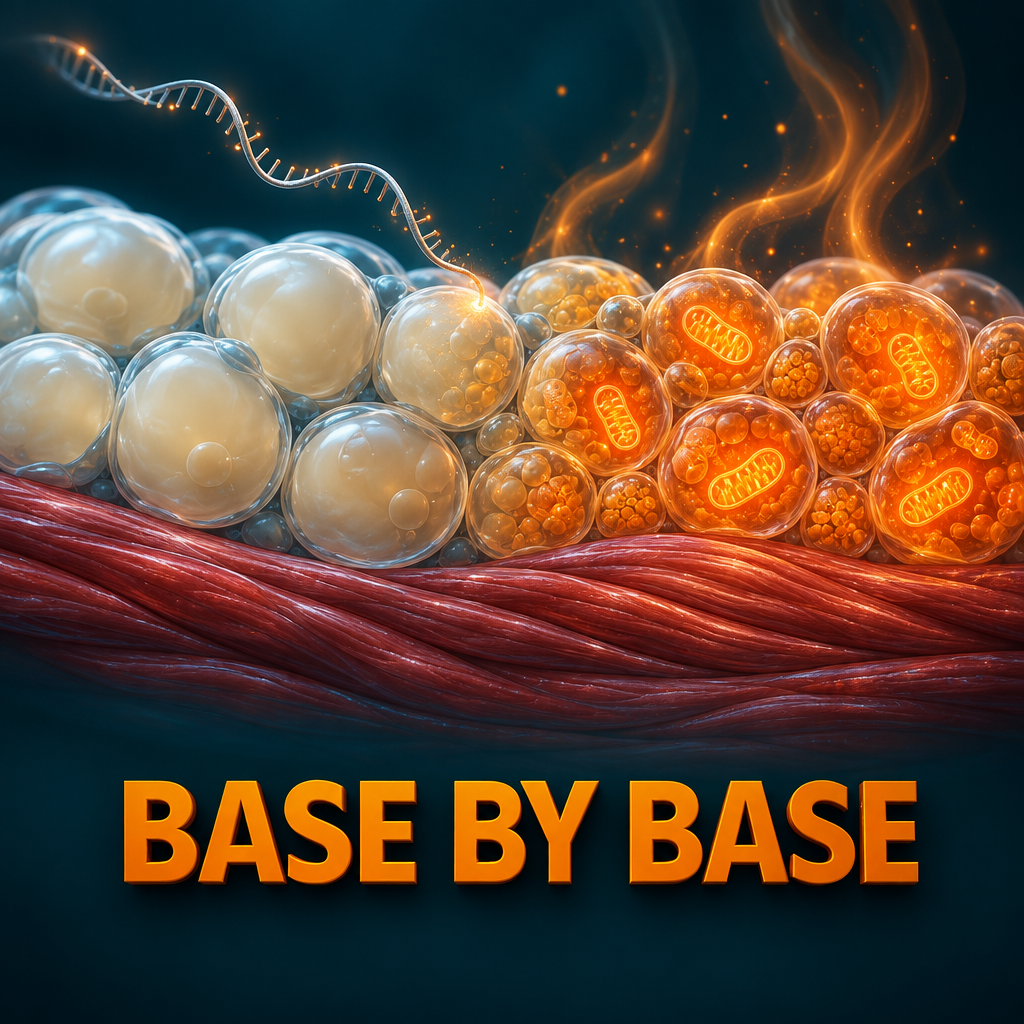
[00:03:25] Now fat comes in more than one kind. White fat stores energy in big droplets.
[00:03:31] Brown fat and its close relative, beige fat, does the opposite. Its cells are packed with mitochondria and a protein called UCP1 lets them burn fuel to make heat instead of storing it. People with more active heat producing fat tend to have better metabolic health and less visceral fat. Turning that program on has long been a dream of obesity research.
[00:03:54] The hard part has been doing it safely and only in fat.
[00:04:00] This team came at it from an unusual the body clock. In earlier work, they found that eating at the wrong time of day during the period when mice normally rest made them gain weight. But mice lacking a protein called ZFP423 were protected. They stayed healthy no matter when they ate. ZFP423 is a transcriptional repressor, a break that keeps fat cells from taking on a brown or beige identity. Take the brake off and white F can start to burn.
[00:04:33] Genetic studies in mice had already shown that suppressing this break in white fat raises heat producing capacity and protects against weight gain on a rich diet. But deleting a gene from birth is not a treatment. You cannot do that to a person. The question was whether a drug given to adult animals could do the same thing and whether it could do it only in fat, leaving the rest of the body alone.
[00:04:59] Why look at timing at all? Because when you eat turns out to shape how much energy you burn. Studies of time restricted feeding, where eating is confined to the active part of the day, found that mice burn more energy and stay metabolically healthier, independent of how much they eat or how much lean mass they have.
[00:05:20] Part of that boost comes from heat producing food fat working harder during the active period.
[00:05:25] In people, sleep loss and a misaligned body clock are linked to lower energy expenditure and to obesity. ZFP423 sits right at that crossroads.
[00:05:41] The tool they chose is called an antisense oligonucleotide, or aso.
[00:05:47] Think of it as a short, custom made strip of genetic code that sticks to one specific message inside a cel.
[00:05:54] When it binds, the cell's own machinery cuts that message so the protein never gets made.
[00:05:59] Here, the target was the message for ZFP423.
[00:06:04] To steer the drug toward fat, the team attached it to palmitic acid, a fatty acid that fat tissue readily takes up.
[00:06:13] They designed 12 candidate molecules against the gene and screened them in mice. Each one was judged on two how strongly it silenced the gene in fat and whether it caused any harm.
[00:06:25] Blood markers of liver and kidney damage weeded out a few.
[00:06:29] Two candidates, called ASO 3, 7 and ASO 44, gave strong knockdown without signs of toxicity. Those two went forward, along with two a salt solution and an untargeted ASO that does not bind any known message.
[00:06:47] To see what was changing inside the fat, the team also read the genes. They sequenced the RNA of whole fat tissue and then went one level deeper, reading the RNA of individual cell nuclei from the fat of obese mice. After quality filtering, they kept 17,067 nuclei, including 7,707 from fat cells. That let them ask not just whether heat making genes went up overall, but which kinds of fat cells were switching programs and how many cells had changed.
[00:07:22] The experiments that then moved in steps. First, lean mice on normal food got weekly injections for 10 weeks. Then the team turned to obese mice fed a high fat diet for six weeks before treatment. They measured energy use in metabolic cages, body temperature with thermal cameras and body composition, fat and lean. Separately, they tested how mitochondria from the fat burned fuel.
[00:07:47] Finally, they combined the drug with daily semaglutide to see whether the two approaches add up.
[00:07:58] So what happened in lean mice? Within four weeks, both ASO drugs improved glucose tolerance and insulin sensitivity, even though total body weight did not change. That is a striking pattern. The mice weighed the same, but their composition shifted. Fat mass went down and lean mass went up.
[00:08:18] Under the microscope, white fat under the skin had turned beige, full of small multi chambered cells that look like heat producing fat.
[00:08:29] Other organs followed. Fat around the reproductive organs, which did not turn beige, still shrank and its cells became smaller, a pattern linked to healthier fat. Serum leptin, a hormone that rises with fat mass, fell.
[00:08:44] The liver got lighter relative to body weight. And liver fat showed a trend toward lower levels. None of this came from eating less. If anything, these mice ate more. The change came from how their bodies handled the energy they took in.
[00:09:01] Here's the part that surprised the team. The treated mice actually ate more during their active period at night. Yet they did not gain weight. Where did the extra energy go? Into heat. Oxygen consumption rose, especially at night. And thermal cameras showed a warmer body surface. Their physical activity did not change. So this was not mice running around more. It was fat burning fuel.
[00:09:30] The genes told the same story in the fat. ZFP423 was switched down and UCP1, the heat making protein went up. Just as important were the things that did not change.
[00:09:42] Muscle looked normal under the microscope and grip strength was the same. Heart function measured by ultrasound was unchanged. And in obese mice, the gene's activity was unchanged in the thalamus and the hypothalamus brain regions where it is highly active, which points to an effect in the body, not the brain.
[00:10:02] Next came obese mice, a tougher and more realistic test. A single dose cut the gene's activity in fat by roughly 70%.
[00:10:12] Repeated doses brought the benefits.
[00:10:14] After two doses, fasting triglycerides fell. After three, fasting glucose and body weight fell too. At 50 milligrams per kilogram, the drug suppressed the gene by more than 75%. And the heat making gene was switched on most strongly at that dose.
[00:10:33] The obese mice also had a heart problem on the high fat diet. Ultrasound of the control mice showed weaker pumping and signs of a thickening heart after treatment with ASO 37. The ejection fraction, a measure of how much blood the heart pushes out with each beat, improved along with the size of the left ventricle when it contracts. In other words, the drug did not just leave the heart alone in obese animals, it seemed to help it.
[00:11:02] How exactly was the fat making heat? The team isolated mitochondria from the fat and measured how fast they used oxygen. Mitochondria from treated mice burned oxygen more than three times faster than the salt solution controls and more than twice as fast as the untargeted controls. Blocking UCP1 cut that burn by 39% and adding creatine raised it by 50%, a sign of a second heat making route called the futile creatine cycle.
[00:11:35] Put another way, the beige fat had two furnaces. One runs on UCP1, which lets protons leak across the mitochondrial membrane and releases energy and heat. The other burns energy by building and breaking creatine in an endless loop. Single cell sequencing later showed that these two programs sit mostly in different fat cells. Of 607 UCP1 positive nuclei and 495 creatine cycle nuclei, only 66 had both.
[00:12:08] The single cell data also showed how the fat reorganized in obese mice. The drug repressed the gene more than 16 fold and heat making genes such as UCP1 and DIO2 rose along with genes for burning fatty acids. The fat cells fell into six distinct groups. Two of them were enriched after treatment, and one of those was defined by UCP1. Pathways for thyroid hormone signaling, fatty acid breakdown and AMPK, a cellular fuel sensor, were switched up, while insulin signaling and fat storage were switched down.
[00:12:45] Now the main event, obese mice, were split into four an untargeted control, the ASO drug alone, semaglutide alone, and the two together.
[00:12:57] Semaglutide was given daily at 3 nanomoles per kilogram and the ASO weekly.
[00:13:03] After three weeks the combination produced 9.2 grams of weight loss. Either drug alone produced 6.6 grams, so the two together did more than either one and they did it through different routes.
[00:13:19] What kind of weight was lost? Body fat at the end was 7.9 grams with semaglutide alone, 6.4 grams with the ASO alone and just 4.2 grams with the combination.
[00:13:31] And here is the number that matters most. Mice on semaglutide alone lost about 10% of their starting lean mass. Mice on the combination lost only 5.5%, roughly half the muscle loss. With more fat gone, did the muscle that was kept actually work in obese mice? Four weeks of the ASO alone improved grip strength both in absolute terms and relative to body weight. And mice on the combination were stronger relative to their weight than mice on semaglutide alone. At the end of the study, the thigh muscles weighed more relative to body weight after dual therapy and they looked normal under the microscope. So this was not just more tissue on the scale, it was strong, stronger muscle.
[00:14:21] There was also a difference in energy use. Semaglutide alone lowered oxygen consumption by 13% compared with controls. That is the familiar slowdown that comes with weight loss. Adding the ASO raised oxygen consumption by 4.8% relative to semaglutide alone.
[00:14:40] Glucose tolerance improved in every treated group and fat in the liver fell the most. With the combination, fat cells shrank and beige cells appeared in the fat.
[00:14:56] Why does this matter?
[00:14:57] GLP1 drugs have changed obesity care, but they work mostly by reducing appetite. This study points to a complementary lever raising energy expenditure in fat itself.
[00:15:10] Because the drug acts in fat and spares muscle, it could in principle help people keep strength while losing weight.
[00:15:17] And the fat targeted delivery worked in these mice without signs of liver, kidney or heart toxicity.
[00:15:26] Why is losing muscle such a concern?
[00:15:29] The authors point out that GLP1 based therapies reduce muscle mass in both animal and human studies and can decouple muscle size from function, weakening the force that muscle can produce.
[00:15:42] Muscle is not just about strength. It burns energy at rest and helps control blood sugar. A treatment that removes fat while sparing muscle would make weight loss metabolically healthier and perhaps more durable.
[00:15:56] That is the promise this study is reaching. For now, the limits, and they are substantial. Everything here was done in mice. The ASO drugs target the mouse version of the gene, not the human gene, which is called ZNF423 and the authors have not tested human fat cells. The combination study lasted only three weeks, with groups of four to eight mice.
[00:16:22] Long term questions such as fatty liver disease or what happens after the drugs stop were not examined.
[00:16:31] There is one more thing listeners should know. Several authors are employees of Ionis Pharmaceuticals, the company that makes antisense drugs, and Northwestern University has filed a provisional patent on targeting this gene with antisense drugs, with two authors listed as inventors. That does not make the results wrong, but it is exactly the kind of interest that independent replication should test.
[00:16:59] So here is where this leaves us in mice, an RNA drug that switches off a single break in fat cells turned white fat beige, raised energy use and improved metabolism without changing activity. Paired with semaglutide, it removed more fat and roughly halved the loss of lean mass. The scale moved further and the body underneath looked healthier.
[00:17:24] Remember our two people with the same number on the scale? The hope behind this work is that the next generation of obesity treatment will care not only about how much weight is lost, but about what kind.
[00:17:36] What does this mean for the future of weight loss medicine? If burning fat can one day join the drugs that help us eat less?
[00:17:48] This episode was based on an Open Access article under the CC BY 4.0 license. You can find a direct link to the paper and the license in our episode description. If you enjoyed this, follow or subscribe in your podcast app and leave a five star rating. If you'd like to support our work, use the donation link in the description. Thanks for listening and join us next time as we explore more science base by base. Facebook.