Show Notes
Bošković F et al., Proceedings of the National Academy of Sciences - This study introduces RUNA, a reversible chemistry that selectively labels uridine/thymidine to map nucleic acids across membranes, and uses it to show that most exosomal DNA is surface-exposed, increases after PARP inhibitor treatment, and alters macrophage uptake and activation. Key terms: RUNA, exosomes, surface DNA, macrophage polarization, PARP inhibitor.
Study Highlights:
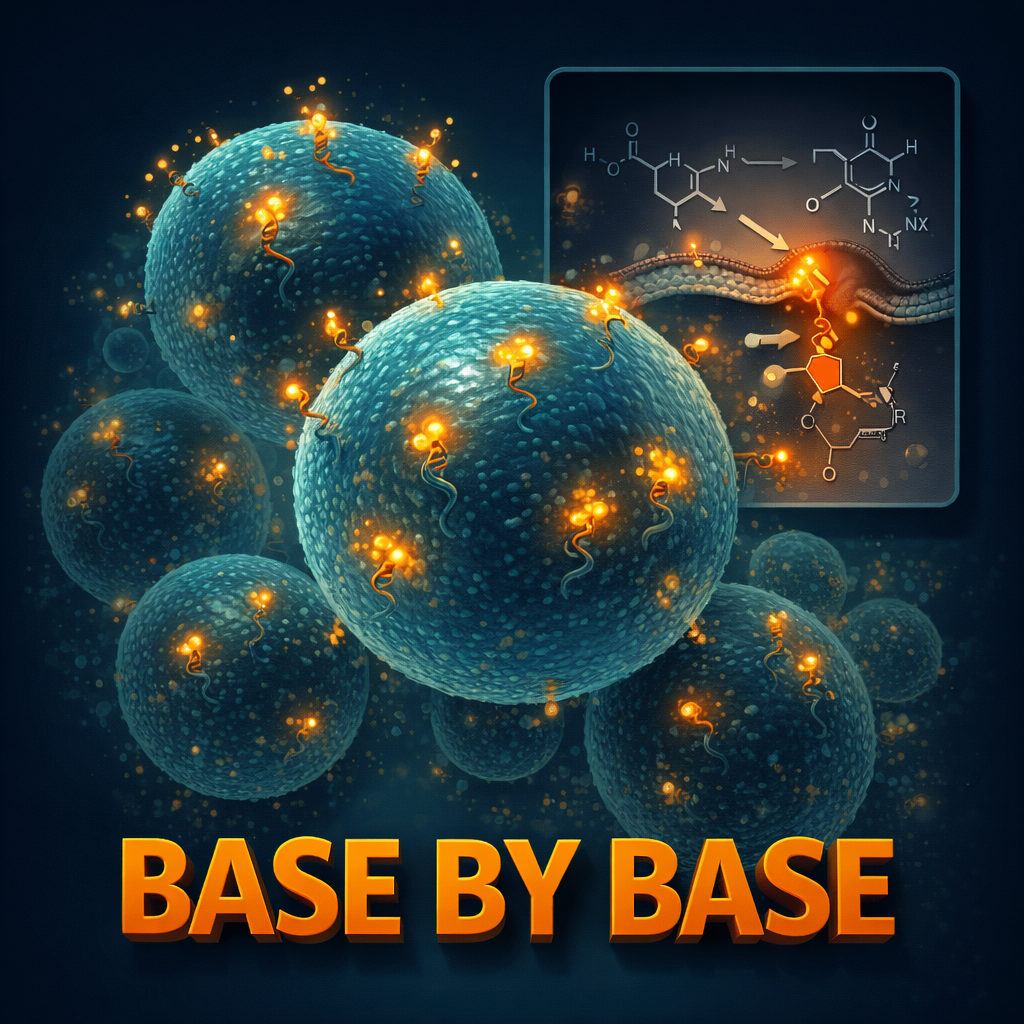
The authors developed Reversible Uridine Nitrilium-mediated Addition (RUNA), which selectively and reversibly modifies the N3 of uridine and thymidine via an in situ nitrilium ion. By varying aldehyde membrane permeability, RUNA distinguishes intra-vesicular from extravesicular nucleic acids. Applied to exosomes from MyC-CaP prostate cancer cells, RUNA shows most exosomal DNA is surface-exposed and nearly doubles after rucaparib (PARP inhibitor) treatment. Surface DNA promotes uptake by M2 macrophages through scavenger receptors and shifts them toward an M1-like proinflammatory profile.
Conclusion:
RUNA is a modular, reversible chemical tool to map nucleic acid accessibility across membranes; using it the authors reveal exosomal surface DNA as a dynamic, damage-responsive determinant of macrophage uptake and immune modulation with implications for tumor–immune interactions.
Music:
Enjoy the music based on this article at the end of the episode.
Article title:
A nucleic acid labeling chemistry reveals surface DNA on exosomes
First author:
Bošković F
Journal:
Proceedings of the National Academy of Sciences
DOI:
10.1073/pnas.2532281123
Reference:
Bošković F, Dutta Gupta P, Zhang J, Szostak JW, Krishnan Y. A nucleic acid labeling chemistry reveals surface DNA on exosomes. Proc Natl Acad Sci U S A. 2026;123(27):e2532281123. doi:10.1073/pnas.2532281123
License:
This episode is based on an open-access article published under the Creative Commons Attribution 4.0 International License (CC BY 4.0) – https://creativecommons.org/licenses/by/4.0/
Support:
Base by Base – Stripe donations: https://donate.stripe.com/7sY4gz71B2sN3RWac5gEg00
Official website https://basebybase.com
On PaperCast Base by Base you'll discover the latest in genomics, functional genomics, structural genomics, and proteomics.
Episode link: https://basebybase.com/episodes/runa-surface-dna-on-exosomes
QC:
This episode was checked against the original article PDF and publication metadata for the episode release published on 2026-06-30.
QC Scope:
- article metadata and core scientific claims from the narration
- excludes analogies, intro/outro, and music
- transcript coverage: Audited sections describing RUNA mechanism, membrane-permeability tuning, exosome surface DNA, PARP-inhibitor effects on surface DNA, exosome uptake by M2 macrophages, macrophage polarization to an M1-like state, and study limitations.
- transcript topics: RUNA mechanism and reversibility; Membrane permeability tuning to distinguish exRNA vs vesicular RNA; Exosome DNA topology: surface-exposed vs luminal; PARP inhibitor (rucaparib) effects on surface DNA; Exosome uptake by M2 macrophages via scavenger receptors; Macrophage polarization to M1-like state and cytokine changes
QC Summary:
- factual score: 10/10
- metadata score: 10/10
- supported core claims: 6
- claims flagged for review: 0
- metadata checks passed: 4
- metadata issues found: 0
Metadata Audited:
- article_doi
- article_title
- article_journal
- license
Factual Items Audited:
- RUNA selectively labels uridine and thymidine at N3 to form a reversible covalent adduct.
- The RUNA adduct is thermally reversible by heating (e.g., 95 C for 15 minutes).
- Membrane-permeable vs membrane-impermeable aldehydes distinguish total vs extravesicular nucleic acids.
- Exosomes carry DNA on their outer surface; surface DNA abundance increases with PARP inhibitor treatment.
- Surface DNA drives uptake of exosomes by M2 macrophages via scavenger receptors.
- Uptake of surface-DNA–bearing exosomes shifts macrophages toward an M1-like pro-inflammatory state (IL-12, TNF-α, iNOS, CCL2 up; arginase-1 down).
QC result: Pass.