Show Notes
Zhou Z et al., Nature Communications - This study develops a Lorentzian deconvolution model of cfDNA fragment length distributions across bodily fluids, identifies a ~159 bp component that demarcates intra- vs inter-nucleosomal fragments, and shows that intra-nucleosomal fragmentation entropy distinguishes tumor-derived ctDNA from non-tumor shortening. Key terms: cell-free DNA, fragmentomics, nucleosome, ctDNA, size deconvolution.
Study Highlights:
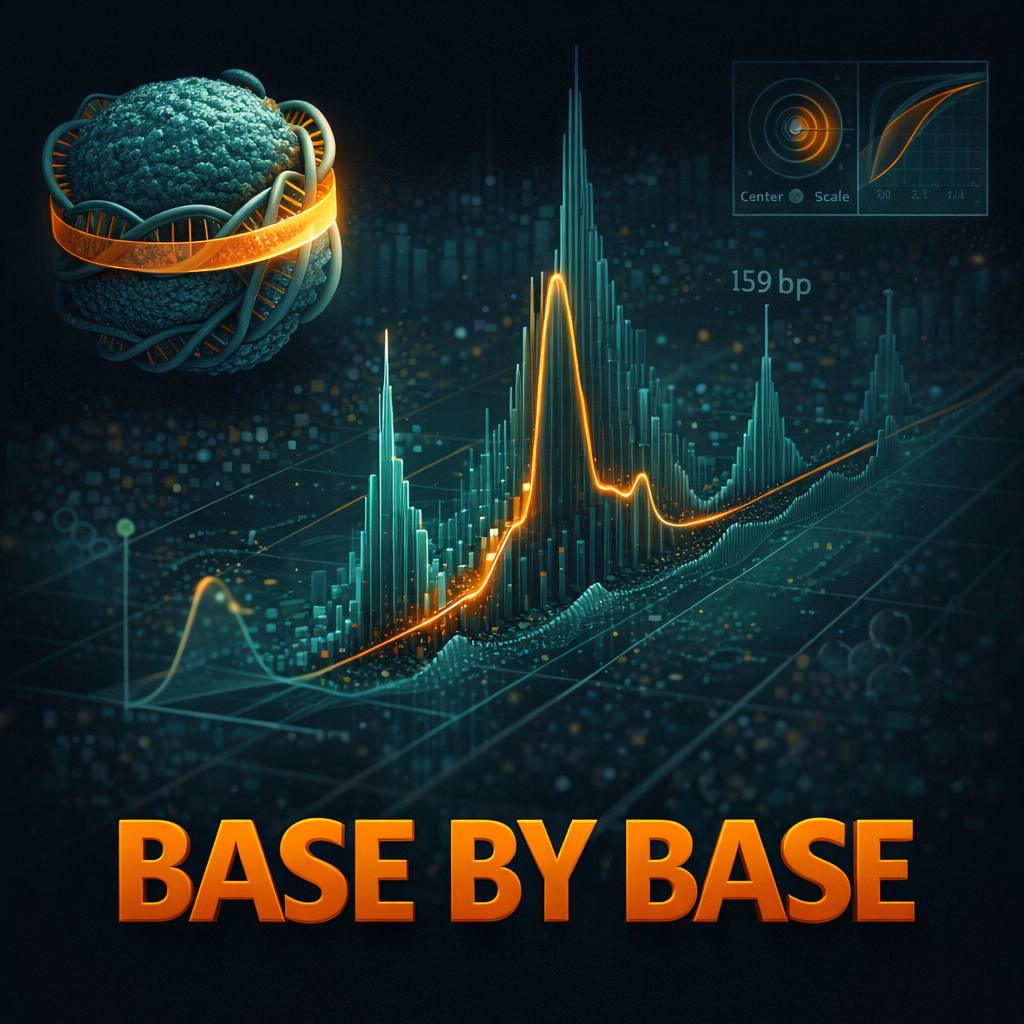
The authors modeled cfDNA size profiles as sums of Cauchy–Lorentz distributions with ~10 bp periodicity and applied deconvolution across plasma, saliva, urine, CSF and lymphatic fluid. A distinct ~159 bp component emerged as a pivot between intra- and inter-nucleosomal fragments. Tumor-derived ctDNA shows increased intra-nucleosomal fragmentation entropy and inverse amplitude changes across the 159 bp boundary, whereas phagocytosis-associated shortening increases intra-nucleosomal amplitude without raising entropy. The intra/inter-nucleosomal entropy ratio improved cancer detection performance relative to standard size-ratio metrics across multiple cohorts.
Conclusion:
Size deconvolution using Lorentzian components reveals nucleosomal structure in cfDNA, identifies a 159 bp demarcation between fragmentation regimes, and provides an entropy-based metric that enhances ctDNA detection while separating tumor-associated fragmentation from phagocyte-related signals.
Music:
Enjoy the music based on this article at the end of the episode.
Article title:
Cell-free DNA size deconvolution resolves nucleosomal origins and reveals tumor-associated fragmentomic alterations
First author:
Zhou Z
Journal:
Nature Communications
DOI:
10.1038/s41467-026-72925-4
Reference:
Zhou Z, Cooper WN, Cheng Z, et al. Cell-free DNA size deconvolution resolves nucleosomal origins and reveals tumor-associated fragmentomic alterations. Nat Commun (2026). https://doi.org/10.1038/s41467-026-72925-4
License:
This episode is based on an open-access article published under the Creative Commons Attribution 4.0 International License (CC BY 4.0) – https://creativecommons.org/licenses/by/4.0/
Support:
Base by Base – Stripe donations: https://donate.stripe.com/7sY4gz71B2sN3RWac5gEg00
Official website https://basebybase.com
On PaperCast Base by Base you'll discover the latest in genomics, functional genomics, structural genomics, and proteomics.
Episode link: https://basebybase.com/episodes/cfdna-size-deconvolution-nucleosomal-origins
QC:
This episode was checked against the original article PDF and publication metadata for the episode release published on 2026-05-09.
QC Scope:
- article metadata and core scientific claims from the narration
- excludes analogies, intro/outro, and music
- transcript coverage: Substantive auditing of the transcript's discussion of cfDNA fragmentology, Lorentzian deconvolution, the 159 bp pivot, entropy vs amplitude distinctions, Li-Fraumeni context, phagocytosis vs tumor fragmentation, and diagnostic performance metrics.
- transcript topics: cfDNA fragmentomics basics; Lorentzian size deconvolution and nucleosome structure; 159 bp boundary between intra- and inter-nucleosomal cfDNA; intra-/inter-nucleosomal amplitude and entropy ratios; ctDNA fragmentation entropy as cancer signature; phagocytosis vs tumor-derived fragmentation
QC Summary:
- factual score: 10/10
- metadata score: 10/10
- supported core claims: 7
- claims flagged for review: 0
- metadata checks passed: 4
- metadata issues found: 0
Metadata Audited:
- article_doi
- article_title
- article_journal
- license
Factual Items Audited:
- cfDNA size profiles deconvoluted into Lorentzian components across multiple fluids with ~10 bp periodicity
- a ~159 bp component demarcates intra- vs inter-nucleosomal cfDNA
- intra-nucleosomal fragmentation entropy is elevated in ctDNA; phagocytosis-associated shortening increases amplitude but not entropy
- intra-/inter-nucleosomal entropy ratio improves cancer detection performance (gastric cancer AUC ~0.87; multi-cancer AUC ~0.81–0.85; stage-specific AUCs up to ~0.91)
- radiotherapy and organ transplantation contexts show short-fragment enrichment with amplitude changes but entropy changes are not increased in non-tumor scenarios
- dd-cfDNA analyses show differences in amplitude but not entropy between high vs low donor-derived DNA groups
QC result: Pass.