Episode Transcript
[00:00:00] Speaker A: Foreign.
[00:00:14] Speaker B: Welcome to Base by Bass, the papercast that brings genomics to you wherever you are. Thanks for listening, and don't forget to follow and rate us in your podcast app. You know, we often attribute who we are, our health, our longevity, even how we react to medicine, to this. Well, this really clear split. It's either genetics or it's our environment.
And that seems to cover everything, doesn't it? It feels like a complete explanation.
[00:00:38] Speaker A: For the most part, yes, it accounts for the vast majority of variation. But if you talk to cell biologists or developmental geneticists, they'll bring up this really challenging paradox. Intrinsic biological variation.
[00:00:50] Speaker B: Right? The third component, the one we rarely discuss. I mean, you can imagine two mice, right, genetically identical. They're in the exact same cage, eating the same food under perfectly controlled conditions, and yet one might develop two years before the other, or one reacts powerfully to a drug and the other, well, barely responds at all.
[00:01:07] Speaker A: And that is the critical insight here. Even with zero genetic difference and absolutely zero environmental difference, you still see these vast, measurable variations, this variability. It comes down to a kind of molecular coin flip, a random epigenetic decision.
[00:01:24] Speaker B: A decision that dictates whether a gene is turned on or off in a line of cells.
[00:01:28] Speaker A: Exactly.
[00:01:28] Speaker B: And the stakes for that, that random choice, couldn't be higher for our health. Think about dominant genetic diseases, the difference between someone who suffers from a condition and a family member who carries the exact same mutation but is totally fine. It can come down to the single intrinsic choice made way back in early.
[00:01:47] Speaker A: Development, a process called autosomal random mono allelic expression, or rmae.
[00:01:53] Speaker B: And that's what we're getting into today.
[00:01:55] Speaker A: Right? Our deep dive today explores this groundbreaking work that figured out the developmental pathway controlling that biological choice, and specifically, how it's all regulated by factors inherited from the mother right at the dawn of life.
[00:02:08] Speaker B: Okay, so let's get into the paper itself.
[00:02:10] Speaker A: We are focusing on the deep dive into the work published in Nature Communications titled maternal histone methyltransferases antagonistically regulate autosomal random monoallic expression in C. Elegans.
[00:02:24] Speaker B: That title alone tells you we're dealing with some really fundamental biology here.
[00:02:29] Speaker A: Absolutely. And we have to give special recognition to the researchers who define this mechanism. The team was led by Brian Sands, Sue Aryeon, Junko Oshima, and Alexander R. Mendenhall, mostly out of the University of Washington in Seattle. Their work has given us this. This incredibly clear developmental pathway that governs a core aspect of what makes us individuals.
[00:02:50] Speaker B: So let's start with the Basics, rmae. We all know genes come in pairs, one allele from each parent. Normally you'd think both copies are active. That's biallelic expression or bae.
[00:02:59] Speaker A: Right.
[00:02:59] Speaker B: So if we strip away the jargon, what really is rmae?
[00:03:02] Speaker A: It's a process where pretty much by chance, one of those two gene copies gets silenced. It's probabilistic and it's persistent in that cell line.
[00:03:11] Speaker B: So once the decision is made, it sticks.
[00:03:13] Speaker A: It sticks for that entire tissue, like the gut or part of the brain.
The key is that it's on the autosomes, the non sex chromosomes.
And crucially, it's not passed down to the next generation. It's a temporary, single generation kind of epigenetic decision.
[00:03:29] Speaker B: And the clinical significance of that is it's just enormous. When you hear about genetic diseases with incomplete penetrance, you know, a patient has the bad gene but doesn't get sick.
RMAE could be the missing link there.
[00:03:43] Speaker A: It absolutely can be. The paper actually highlights a classic case study. It was a family with a mutation in the PIT1 gene, which affects growth. The grandmother and the father both carry this pathological allele, but were completely healthy. Okay, but the daughter who had the very same mutation was profoundly affected.
[00:03:59] Speaker B: So what was the difference?
[00:04:00] Speaker A: The investigation showed that in the unaffected family members, the bad allele was randomly silenced. RMAE essentially rendered it harmless.
[00:04:07] Speaker B: But in the daughter, it was expressed.
[00:04:09] Speaker A: In the daughter, it was expressed. And that resulted in the disease. That one random decision determined her entire health outcome.
[00:04:16] Speaker B: Wow. So what kinds of genes are prone to this? Is it just anything?
[00:04:21] Speaker A: That's a great question. They found that genes subject to RMAE are highly enriched for roles in aging and chronic diseases, especially things related to immunity and cancer.
[00:04:31] Speaker B: And that's already having real world implications for treatment. In cancer, for example.
[00:04:36] Speaker A: Yes. In oncology, the silencing status of genes like BRCA1 or BRCA2 is already a huge deal for therapy. So for ovarian cancer, if you have a patient with a normal wild type copy of a BRCA gene, but that copy has been randomly silenced by this.
[00:04:51] Speaker B: Process, by mae, Right.
[00:04:53] Speaker A: Then that patient actually responds really well to PRP inhibitors. Their cells act as if they have the genetic defect that the drug targets.
[00:04:59] Speaker B: Whereas a patient who expresses both copies doesn't respond.
[00:05:03] Speaker A: Exactly. So if you can figure out how that silencing is established, you open the door to therapies that could, you know, enforce or reverse it.
[00:05:10] Speaker B: And that need to understand the mechanism is what brought them to the humble worm. Okay, so let's talk about their model system, C. Elegans. It's such an elegant setup. The worm is transparent, and most importantly, it has a completely fixed mitotic cell lineage.
[00:05:27] Speaker A: That fixed lineage is so key. You know where every single adult cell comes from. You can trace its history right back to a single progenitor cell in the.
[00:05:36] Speaker B: Early embryo, which is perfect for tracking a decision made early in life.
[00:05:39] Speaker A: Perfect.
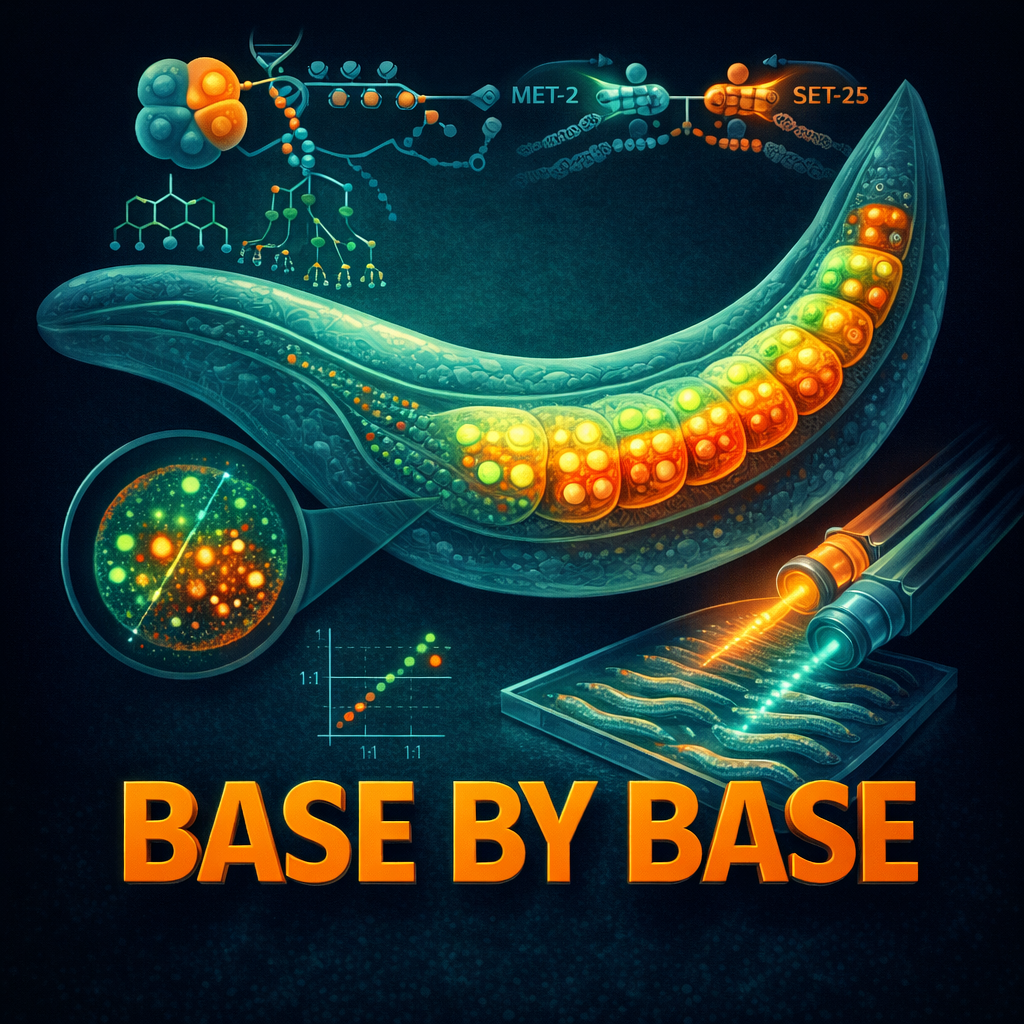
[00:05:40] Speaker B: So to see this process, which is usually invisible, they built this brilliant reporter system. They took a gene, HSP90, which they knew was prone to RMAE, and they put in two synthetic copies.
[00:05:52] Speaker A: Right. They tagged one allele with a green fluorescent protein and the other with a red one.
[00:05:56] Speaker B: So you get a direct visual.
[00:05:57] Speaker A: A direct visual. If a cell expresses both copies, you get biallelic expression, or bae, the red and green mix, and the cell nucleus just looks yellow.
[00:06:05] Speaker B: But if one allele gets silenced, then.
[00:06:07] Speaker A: The cell will only glow red or only green. You are literally seeing the molecular coin flip happen in the worm's intestine.
[00:06:14] Speaker B: That's amazing. But seeing it is one thing they needed. To quantify it, they used a metric called intrinsic noise. How does that work?
[00:06:21] Speaker A: So intrinsic noise is a mathematical way to measure how much the expression deviates from that perfect one to one yellow signal. If every cell is yellow, the intrinsic.
[00:06:32] Speaker B: Noise is very low because there's no randomness.
[00:06:34] Speaker A: No randomness. But if you see a ton of variation, lots of red only and green only cells, that means strong monolic expression is happening and your intrinsic noise score is high. It's a really clean way to measure the randomness.
[00:06:48] Speaker B: So high intrinsic noise means a strong RAE event.
[00:06:51] Speaker A: Exactly. And with that tool, they could finally do their screen. They used RNA interference to knock down genes they suspected were involved with chromatin. They focused on histone methyltransferases, the enzymes that write epigenetic marks.
[00:07:05] Speaker B: And right away, the results pointed to two major players working against each other.
[00:07:09] Speaker A: The first one they found was a protein called ME2. It's the worm version of a human protein called SETB1. And what was so unexpected was its job. When they got rid of MET2, RM80 was significantly promoted.
[00:07:21] Speaker B: Wait, so getting rid of it made the silencing more likely?
So its normal job is to prevent the silencing. It's actually a negative regulator pushing for that normal bilelic expression.
[00:07:30] Speaker A: That is the crucial distinction. Yes. Loss of Met2 caused this huge spike in intrinsic.
So then they looked for what could reverse that spike, and they found the antagonist set25.
[00:07:42] Speaker B: The molecular yin and yang.
[00:07:43] Speaker A: Pretty much.
Set25 is the worms version of the mammalian SUV39 and G9A proteins. And losing set25 had the exact opposite effect. It strongly prevented Rae. It pushed expression to extreme biallelic, very low intrinsic noise.
[00:08:01] Speaker B: So you have met two promoting the two color state bae and set 25 promoting the one color silencing state rme a perfect antagonist. And they confirmed it was a real competition, right?
[00:08:12] Speaker A: They did beautifully. If you take a worm that's missing Met 2, which should have extreme RME.
[00:08:17] Speaker B: All red and green cells, Right?
[00:08:19] Speaker A: And then you also knock down CET25, the whole phenotype just vanishes.
[00:08:23] Speaker B: Then it's back to yellow.
[00:08:24] Speaker A: It goes right back to the calm bialic state. It's a definitive proof of a tug of war.
[00:08:28] Speaker B: And they're not acting alone, are they? They have partners.
[00:08:30] Speaker A: They do. They identified smaller protein complexes. Met2 works with cofactors like LN65 and Set25 works with partners like HPL2. They're competing teams.
[00:08:42] Speaker B: And it's not just about them being physically present, it's about what they do. The actual chemistry.
[00:08:46] Speaker A: Exactly. The whole thing depends on their ability to write. Those epigenetic marks. They used CRISPR to make tiny point mutations in the catalytic set domains of both enzymes.
[00:08:58] Speaker B: The part that does the work.
[00:08:59] Speaker A: The part that does the work. And changing just a single amino acid was enough to completely break the enzyme's function. Which proves the mechanism isn't structural. It's truly about actively competing to modify the histones.
[00:09:11] Speaker B: This brings us to the timing. The title said maternal. So how early is this battle decided?
[00:09:16] Speaker A: Extremely early. Through some clever reciprocal cross experiments, they figured out it's all controlled by the proteins the mother deposits into the egg.
[00:09:24] Speaker B: Not the DNA from the father.
[00:09:25] Speaker A: Not the DNA. It's the maternal protein contribution. And this critical competition between BT2 and set 25 happens in a single cell.
[00:09:33] Speaker B: Which one?
[00:09:34] Speaker A: The E cell. The progenitor for the entire adult intestine. And this is when the embryo is just eight cells.
[00:09:39] Speaker B: Big eight cells. That's incredible. So the mother's stored proteins are deciding the fate for that entire adult tissue.
[00:09:47] Speaker A: Right. So even if the embryo inherits a perfectly good Met2 gene from its father, it if the maternal method protein wasn't there early enough.
[00:09:55] Speaker B: The damage is already done.
[00:09:56] Speaker A: The damage is done. CET25 has already won and enforced the silencing.
[00:10:01] Speaker B: And that decision gets passed down through cell division.
[00:10:03] Speaker A: Mitotically. Yes, it creates this persistent locked in pattern in the adult tissues. But, and this is so important, it's not passed to the next generation. It's persistent, but it's not heritable.
[00:10:16] Speaker B: That distinction is so critical for understanding how this variation pops up new in every single generation. But was this MT2 versus SET20 battle a kind of universal switch for all RME genes?
[00:10:27] Speaker A: No. And that's a key point. They found it was gene specific. So Getting rid of Met2 increased RMAE for their HSP90 reporter and for another gene. But it had zero effect on other genes like Vit2.
[00:10:38] Speaker B: So there must be other pathways, other tugs of war happening for different genes.
[00:10:42] Speaker A: Exactly. This HMT competition is one critical module, but not the only one.
[00:10:47] Speaker B: Okay, let's unpack the model. The actual molecular competition happening on the histone in that single E cell.
How are these two complexes using epigenetic marks to fight each other?
[00:10:59] Speaker A: So the model they proposed, which really synthesizes all the data nicely, is based on the different flavors of H3K9 methylation marks. Mete 2 and its complex, they act as a transcriptional silencing repressor.
[00:11:12] Speaker B: Okay, break that down.
[00:11:13] Speaker A: It primarily deposits H3K9 me1 or me2 marks, mono or dimethylation. And these marks, while they are modifications, are often linked with permissive chromatin. And they essentially license the gene for expression for bae.
[00:11:27] Speaker B: And they block the other guy.
[00:11:28] Speaker A: And they actively inhibit the recruitment of the more powerful silencer set in 25. So Met 2 is like putting down a sign that says transcription allowed here. Heavy duty silencers stay out.
[00:11:37] Speaker B: So set T25 is the heavy duty silencer.
[00:11:39] Speaker A: That's its function. If set 25 gets recruited first, or if it manages to kick met off, it adds the fully repressive Ace 3K9ME3 Mark Trimethy.
[00:11:47] Speaker B: And that's the stop sign.
[00:11:48] Speaker A: That is a hard stop. It's a powerful blockade that physically stops transcription factors from binding. That's what gives you the silencing, the rmae.
[00:11:57] Speaker B: So the randomness, the actual coin flip, is just about who wins the race to the gene promoter in that one cell at that one moment.
[00:12:04] Speaker A: Precisely. If the net two complex wins, you get biallelic expression. If Sed25 wins, you get mono allelic expression.
[00:12:11] Speaker B: And that outcome once it's set in, the E cell is just locked in.
[00:12:15] Speaker A: It's locked in by mitosis. That's why they saw some animals lacking MET two with almost their entire intestine glowing one color. The decision was fixed at the eight cell stage.
[00:12:25] Speaker B: The implications here go way beyond the worm. I mean, these genes, SCDb1 and SUV39, are conserved in humans.
[00:12:32] Speaker A: They are, which strongly suggests this antagonistic mechanism is a key part of how random monolic expression works in mammals too.
[00:12:40] Speaker B: It gives the whole field a new framework to work with.
[00:12:42] Speaker A: It really does. By finding one clear regulatory module, researchers can now hunt for the regulators of other rme prone genes much more efficiently. It shifts the work from just observing to actually understanding the mechanism.
[00:12:55] Speaker B: And the translational outlook is just huge. Understanding how these silencing states are naturally controlled is a massive step towards allele specific therapies.
[00:13:04] Speaker A: Yes. I mean, imagine you have a patient with a silenced healthy allele and an expressed pathological one.
[00:13:09] Speaker B: The goal would be to flip that exactly.
[00:13:11] Speaker A: The holy grail would be a drug that can specifically inhibit ST25 at that location, letting Met2 come in and turn on the healthy copy. Or the reverse silencing an overactive cancer.
[00:13:23] Speaker B: Gene the ability to manipulate the outcome of that intrinsic early life coin flip. That really does feel like the future of personalized medicine.
[00:13:32] Speaker A: So to just summarize the central insight, the unpredictable part of our biological individuality is basically governed by an epigenetic tug of war. It's a competition between two maternal histone metal transferases and set 25. They battle it out in a single progenitor cell in the very early embryo. And the winner of that battle sets a gene expression pattern that lasts for life. It defines cellular identity, functional variability, and potentially your long term disease risk.
[00:14:01] Speaker B: And that leaves us with a pretty provocative final thought.
[00:14:03] Speaker A: It does.
If your ultimate risk for a chronic disease can be decided randomly by maternal proteins in the first few cell divisions, how can we possibly develop early stage diagnostics or maybe even interventions that can assess and maybe influence those crucial initial epigenetic decisions before the body is even fully formed?
[00:14:23] Speaker B: That developmental window, it's clearly where all the action is. This episode was based on an Open Access article under the CC BY 4.0 license. You can find a direct link to the paper and the license in our episode description. If you enjoyed this, follow or subscribe on your podcast app and leave a five star rating. If you'd like to support our work, use the donation link in the description Now. Stay with us for an original track created especially for this episode and inspired by the article you've just heard about. Thanks for listening and join us next time as we explore more science. Bass by bass.
[00:15:04] Speaker C: Two names on the same door One key in the rain Flip flop fade but it don't feel random when it stains.
One side speaks up one side gets erased A quiet little ride in a microphone Microscopic play sake count Heartbeat first lights in the room Somebody's voice drops out too soon I can feel the ink set I can feel the lock click Like a trust me fast with a slow heavy stick Two hands on the dial Pulling opposite ways and I'm stuck in the middle of the pattern it makes 1 mark, 1 switch Cut the sound, let it live 1 mark, 1 switch Take it back, don't forgive how the story goes dark and the story story stays not in the bloodline but it rides our days One mark, one switch Hit a silence Hit One mark, one switch now we're built from it now we're built from it now we rise our days Steel toe drums and a tie wire groove A city hum under every move A mother may signal A fork in the line A corn flip hush and a cellular sign it holds like a scar it won't pass like a name still it shapes who we are all the same I can feel the ink set I can feel the lock click Like a choice made fast With a slow heavy stick Two hands on the dial Pulling opposite ways and I'm stuck in the middle of the pattern it makes 1 mark, 1 switch Cut the sound, let it live 1 mark, 1 switch Take it back, don't forgive Half the story goes dark Half the story stays not in the bloodline but it rides our days One mark, one switch Here the silence Hit One mark, one switch now we build from it now we're built from it now rise our day.
I hate doing minimal I split to them Scare the moments I can't undo if a whisper can decide what I get to be Then teach me the edge where the lock turns free Let the sirens fade Let the rails run smooth Give me breath in the dropout Give me truth in the groove One mark, one switch Cut the sound let it live One mark, one switch Take it back, don't forgive Half the story goes dark Half the story stays not in the bloodline One mark, one switch Cut the sound, let it live One mark, one switch Take it back, don't forgive how the story goes dark Half the story stays not in the bloodline but it rides our days One mark, one switch now it fell from it now it fell from it.