Episode Transcript
[00:00:00] Speaker A: Foreign.
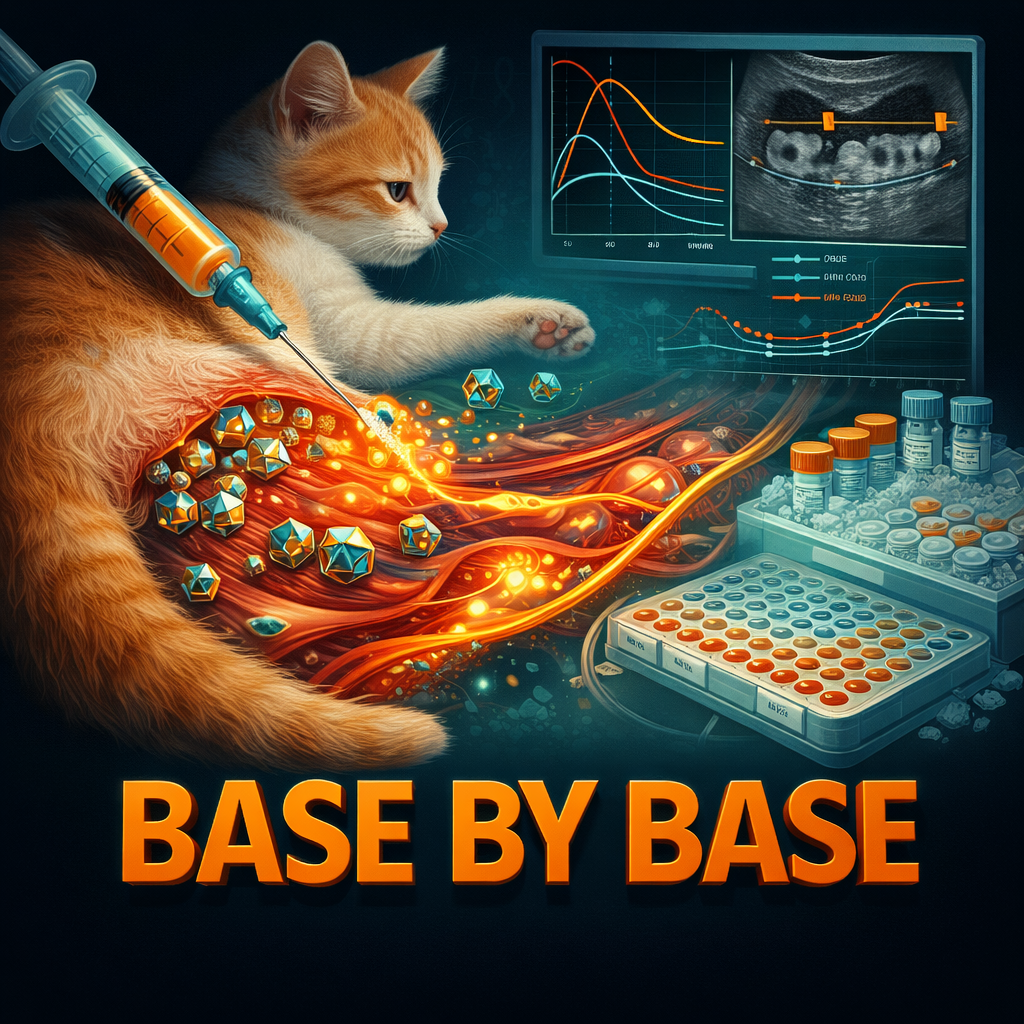
[00:00:14] Speaker B: Welcome to Base by Base, the papercast that brings genomics to you wherever you are. Thanks for listening and don't forget to follow and rate us in your podcast app.
[00:00:23] Speaker A: Okay, let's unpack this.
Imagine trying to solve a global crisis involving what, hundreds of millions of animals. A crisis that, you know, burdens welfare, strains resources, and really impacts fragile ecosystems.
[00:00:36] Speaker B: Right?
[00:00:37] Speaker A: We're talking about free roaming domestic cats.
Surgical sterilization works. I mean, it's the gold standard.
[00:00:44] Speaker B: It is, but it just can't scale to meet the demand.
[00:00:47] Speaker A: Not even close.
[00:00:48] Speaker B: So what if we could achieve safe, long term, maybe even lifetime sterilization with just one single injection?
[00:00:56] Speaker A: Not a traditional vaccine.
[00:00:57] Speaker B: No, not a vaccine. A gene therapy that permanently ultra alters the reproductive function of female kittens before they even hit puberty.
[00:01:05] Speaker A: And this is where it gets really, really interesting.
[00:01:07] Speaker B: It does, because the results show 100% prevention pregnancy even after mating, and, well, a surprising change in mating behavior.
[00:01:14] Speaker A: The logistics problem is just huge. The global population of intact free roaming cats is immense.
[00:01:20] Speaker B: It's staggering. And trap, neuter, return programs, tnr, they are absolutely essential. But they are so constrained by logistics, by economics, and, you know, the need for trained vets.
[00:01:32] Speaker A: So the central question becomes how could gene therapy, I mean, this is a technology usually we think of for severe human diseases. How could it be used to create a non surgical, single shot, scalable solution for population control that is safe and effective for life?
[00:01:49] Speaker B: Before we get into the nuts and bolts of the science, let's give a nod to the incredible team that made this happen. This was not a small effort, not at all.
[00:01:56] Speaker A: It required a really unique mix of expertise.
[00:01:59] Speaker B: Today we celebrate the work of a collaboration between the Pediatric Surgical Research Lab at Massachusetts General Hospital, the Cincinnati Zoo and Botanical Gardens, crw an amazing group, the University of Massachusetts Chan Medical School and the Mickelson Found Animals Foundation.
[00:02:14] Speaker A: And it's their work that has really advanced our understanding of how targeted gene delivery can create these long term contraceptive proteins. It's quite brilliant.
[00:02:23] Speaker B: So let's ground this in the reality of the crisis. Why is this so necessary?
[00:02:27] Speaker A: Well, domestic cats are, to put it mildly, highly prolific. They're incredibly efficient reproducers.
[00:02:34] Speaker B: Right. They can reach puberty before they're even.
[00:02:35] Speaker A: A year old and they can often raise two litters a year. We're talking three to five kittens per litter.
[00:02:41] Speaker B: So the numbers just explode.
[00:02:43] Speaker A: They explode, yeah. And this uncontrolled reproduction, it perpetuates the stray and feral cat overpopulation, which leads to shorter, harder lives for them. And Huge negative ecological impacts on native species.
[00:02:56] Speaker B: Okay, so the problem demands a solution that's both super effective and easy to deploy at scale. Yes, and that brings us to the core strategy. They used vectored contraception.
What exactly does that mean?
[00:03:08] Speaker A: It sounds a bit complex, I know, but the idea is actually, you know, elegantly simple.
[00:03:12] Speaker B: Okay.
[00:03:12] Speaker A: Vectored contraception uses a parenteral. So an injectable delivery of a nucleic acid based transgene.
[00:03:19] Speaker B: A transgene being the therapeutic gene.
[00:03:21] Speaker A: Precisely. And the genius part is that the body's own cells become a kind of biofactory that produces the contraceptive protein long term.
[00:03:29] Speaker B: So the body makes its own contraceptive drug for life. Potentially.
[00:03:33] Speaker A: That's the idea.
[00:03:34] Speaker B: So which protein did they choose? And why is it so good at, you know, shutting down reproduction?
[00:03:39] Speaker A: The target is a protein called anti mullerian hormone or amh. It's a glycoprotein that the body makes naturally.
[00:03:47] Speaker B: And it's involved in ovarian processes.
[00:03:49] Speaker A: Yes, it's a key regulator. Think of it as a natural off switch or a break for follicle activation in the ovaries.
[00:03:56] Speaker B: So if you have more amh, you're hitting the brakes harder.
[00:03:59] Speaker A: You're hitting those brakes permanently.
Previous work had already shown AMH gene delivery could suppress follicle development in adult cats and mice.
[00:04:08] Speaker B: So what was the big leap here?
[00:04:09] Speaker A: The leap was testing this in prepubertal animals. Kittens, you know, just two or three months old.
[00:04:16] Speaker B: To get ahead of the problem.
[00:04:17] Speaker A: Exactly. If it works on kittens, you can sterilize them before they ever reach their first heat cycle. You shut down the problem before it even begins.
[00:04:24] Speaker B: Let's dive into the methodology then. Getting the gene into the right cells is everything. They used a virus for delivery, right? An aav?
[00:04:31] Speaker A: That's right. They used an Adeno associated virus, specifically the AAV9 vector. And these AAVs are perfect for the job.
[00:04:38] Speaker B: Why is that?
[00:04:39] Speaker A: Well, for one, they're small, they're non pathogenic, they don't make you sick, and they're replication defective. They are basically just tiny delivery trucks engineered to carry the gene. In this case, the feline AMH transgene, which they called FCMISV2.
[00:04:54] Speaker B: And why AAV9 specifically? What makes it the right delivery truck for this job?
[00:04:59] Speaker A: It's all about its tropism, its affinity. AAV9 has a very high preference for skeletal muscle cells.
[00:05:07] Speaker B: Okay, and why is that so important for durability?
[00:05:09] Speaker A: Because muscle cells are long lived and they're terminally differentiated.
[00:05:13] Speaker B: Meaning they don't divide.
[00:05:14] Speaker A: Exactly. They don't divide rapidly and flush out the gene. So they become these incredibly stable permanent production centers for the AMH protein, just constantly pumping it into the bloodstream.
[00:05:25] Speaker B: It basically turns the thigh muscle into a lifelong AMH factory.
[00:05:29] Speaker A: That's the perfect way to put it.
[00:05:30] Speaker B: So walk us through the actual trial. What did the setup look like?
[00:05:33] Speaker A: They took 12 kittens, all two to three months old. So prepubertal.
[00:05:37] Speaker B: Right.
[00:05:37] Speaker A: Each one got a single intramuscular injection in the thigh. They tested a low dose and a high dose.
[00:05:42] Speaker B: And they monitored them for a long.
[00:05:44] Speaker A: Time, A very long time. Up to 21 months for the females and around 9 or 10 for the males. They were checking everything. Growth, viral shedding, which was low and cleared fast, hormone levels, general health.
[00:05:57] Speaker B: But the real proof wasn't in the blood tests, was it?
[00:06:00] Speaker A: No, absolutely not. The ultimate test, a year after the injection, was a four month long mating trial with proven breeder males.
[00:06:08] Speaker B: Because cats are induced ovulators.
[00:06:10] Speaker A: Precisely. The act of mating is what triggers ovulation.
So this was the definitive test of whether the AMH was truly blocking that whole process.
[00:06:19] Speaker B: Okay, let's get to the key findings. First, was it safe? And did the muscle factories actually work as planned?
[00:06:24] Speaker A: It was incredibly safe and very well tolerated. The kittens grew normally, no signs of systemic inflammation. And critically, they didn't develop anti AMH antibodies.
[00:06:34] Speaker B: So their immune systems didn't reject the.
[00:06:35] Speaker A: Therapy, which is key for any long term treat. But what's really fascinating is the effect of that prepubertal timing.
[00:06:42] Speaker B: What happened?
[00:06:42] Speaker A: The kittens developed higher sustained AMH concentrations in their blood. Much higher than what had been seen when adult cats were treated.
[00:06:50] Speaker B: So treating them early makes the biofactory more efficient.
[00:06:53] Speaker A: It seems so. It suggests that hitting those muscle cells early leads to a much more robust and quite possibly a more durable sterilization.
[00:07:03] Speaker B: That's a huge insight. Now, what about the big practical question for field use?
What happens if you accidentally give this to a male kitten?
[00:07:11] Speaker A: A critical safety check. And the results were clear. In the male kittens, the injection had no negative impact.
[00:07:18] Speaker B: None at all?
[00:07:18] Speaker A: None. No impact on their sexual development, testicular function, puberty, timing. Even their sperm was perfectly capable of fertilizing eggs in vitro.
[00:07:27] Speaker B: So it's benign if misadministered. That's vital.
[00:07:30] Speaker A: It is.
[00:07:31] Speaker B: Okay, now for the biggest result of all.
Female sterility. Did it work?
[00:07:36] Speaker A: It did. The result was 100% efficacy.
[00:07:39] Speaker B: Wow.
[00:07:39] Speaker A: During that entire four month mating trial, not a single one of the seven treated females became pregnant. Both of the control females did, of course.
[00:07:47] Speaker B: That's definitive. So how did the AMH do it? What was the mechanism?
[00:07:50] Speaker A: It completely abrogated ovulation. Basically, the females developed normally. They cycled. They had the urge to mate, but.
[00:07:56] Speaker B: No eggs were released.
[00:07:57] Speaker A: No eggs were released. And by blocking that one crucial step, it also prevented the hormonal shift that follows. Specifically.
Forget that rise in progesterone that defines the luteal phase.
[00:08:08] Speaker B: The reproductive chain was just permanently broken at that length.
[00:08:11] Speaker A: Exactly.
[00:08:12] Speaker B: So this means the whole hormonal environment of the cat shifted. The paper mentions they showed signs of mild hypergonadotropic hypogonadism. Can you translate that for us?
[00:08:23] Speaker A: Yeah, that is a mouthful in plain English. Hydrogonadism just means the ovaries. The gonads are underactive.
[00:08:30] Speaker B: Okay?
[00:08:30] Speaker A: And hypergonadotropic means the brain, specifically the pituitary gland, is compensating. It's pumping out higher levels of luteinizing hormone, or lh, trying to kick start those underperforming ovaries.
[00:08:43] Speaker B: So the brain is shouting, but the ovaries, because of the high amh, just aren't listening.
[00:08:48] Speaker A: That's a perfect analogy. The ovaries aren't responding with the usual production of estrogen and progesterone.
[00:08:53] Speaker B: So besides the hormones, there was another unexpected find. One with potential long term health benefits.
[00:08:58] Speaker A: Yes, this was a big one. They found that the treated females had significantly smaller uterine horn diameters after puberty than the controls.
[00:09:06] Speaker B: And why is that so important?
[00:09:08] Speaker A: Well, a major reason for spaying is that it protects against serious uterine issues later in life, like pyometra, which are driven by repeated exposure to progesterone during that luteal phase.
[00:09:18] Speaker B: But this treatment prevents the luteal phase entirely.
[00:09:21] Speaker A: Exactly. So the smaller uterus strongly suggests this gene therapy offers a similar protective health benefit. It's not just a contraceptive, it's a health positive intervention.
[00:09:31] Speaker B: Okay, this is where it gets really, really, really fascinating for me. The behavior. They were sterile, but they bred more often. Way more often.
Why this paradox?
[00:09:41] Speaker A: This is a major behavioral breakthrough. And the hormonal picture we just painted explains it completely. Normally, a female cat's receptivity, her heat, is ended by that surge of progesterone that happens after ovulation.
[00:09:53] Speaker B: It's the off switch.
[00:09:54] Speaker A: It is the off switch. It tells the body to stop seeking a mate. But since the AMH treatment prevented ovulation.
[00:10:00] Speaker B: The off switch never gets flipped.
[00:10:02] Speaker A: It never gets flipped. So their receptive state just lasts longer or it cycles back more frequently. They're mature, they're cycling. They have all the mating behaviors, but the one final step, ovulation, is permanently blocked.
[00:10:15] Speaker B: The implication for population control is massive. If a sterile female stays hyper receptive, what does that do in a colony?
[00:10:24] Speaker A: It creates what you could call a sterile wingman effect.
A sterile treated female could effectively divert the attention of intact males away from the fertile untreated females.
[00:10:35] Speaker B: So the males are wasting their time and energy on a cat that can't conceive?
[00:10:38] Speaker A: Yes, it reduces the overall breeding pressure on the fertile population. This is a huge potential bonus over traditional spaying, which just removes the cat from that social mating structure entirely.
[00:10:49] Speaker B: That is a very compelling argument. Now, no study is perfect. What were the limitations here? What are the next steps?
[00:10:55] Speaker A: Well, one limitation is they couldn't do a full histological assessment of the ovaries, which you'd need to really pin down the exact cellular mechanism. Like the changes in follicle populations. That's important for confirming long term durability.
[00:11:07] Speaker B: And what about the behavior?
[00:11:08] Speaker A: Right, that's the other crucial step. This mating trial was in a lab setting. We need to confirm that this hyperreceptivity holds true in a less structured setting like a home or or more importantly, a real feral colony.
[00:11:22] Speaker B: So summarizing the whole thing, what's the central take home message for you?
[00:11:25] Speaker A: For me, it's that a single intramuscular injection of this AAV 9:amh vector given to a kitten provides a safe long term and 100% effective sterilization by blocking ovulation.
[00:11:38] Speaker B: And it works better when they're young.
[00:11:39] Speaker A: It works better prepubertally, it's safe for males, and it even introduces this beneficial behavioral change that could help reduce breeding pressure in the entire colony. It's just a really promising, practical, non surgical tool to complement global TNR efforts.
[00:11:53] Speaker B: Considering this gene therapy successfully uses the body's own muscle cells as biofactories for contraception, what does this mean for the future of managing other invasive or overpopulated animal species around the world?
This episode was based on an Open Access article under the CCBY 4.0 license. You can find a direct link to the paper and the license in our episode description if you enjoyed this, follow or subscribe in your podcast app and leave a five star rating. If you'd like to support our work, use the donation link in the description now. Stay with us for an original track created especially for this episode and inspired by the article you just heard about. Thanks for listening and join us next time as we explore more science base by base.
[00:12:53] Speaker C: On A cold street under porch light halos Small footsteps trace the edges of the night we count the seasons in paper cups and shelters Trying to be gentle Trying to do what's right.
[00:13:12] Speaker A: A.
[00:13:13] Speaker C: Promise in the quiet of a needle no sirens, no steel no harsh goodbye Just a whisper place where muscles keep the rhythm and time turns the page without a cry A little code In a small strong place A lighthouse signal in a moving Let the tide remember how to soften Let the future breathe Signal the stillness Steady and slow One small spark where the wild winds blow Let the moon pull but don't let it rise Keep the door of the cycle closed tonight Signal to stillness presence hold the light can mouth for a crowded sky no storm in the blood no broken trust Just quiet love that lasts.
Months roll on like trains through interstations street lights blur in the rain on the glass desire still dances Circles still But the old red drum beat doesn't catch no hidden swell no turning of the hour no sudden crown of heat no change of fate and on the other side the boys keep their fire unchanged by the wave they never have to chase A little cold In a small strong place A lighthouse signal in a moving se Let the tide remember how to soften Let the future breathe Signal to stillness Steady and slow One small spark where the wild winds blow Let the moon pour but don't let it rise Keep the door of the cycle closed tonight Signal to stillness hold.
[00:15:45] Speaker A: The.
[00:15:48] Speaker C: Kind mad for a crowded sky no storm in the blood no broken trust Just quiet love that last oh and if the world is loud with numbers Let mercy be a measurable thing A hush you can hear in the morning A safer song the alley ways can sing we don't erase the pulse of living we learn where to place A calmer hand Some futures don't need more beginnings to finally understand Signal to stillness Steady and slow One small spark where the wild winds blow Let the moon but don't let it rise Keep the door of the cycle closed tonight Signal to stillness hold the line Call your love for a crowding sky no storm in the blood no broken trust Just quiet love that last.
Sa.