Episode Transcript
[00:00:20] Speaker A: Welcome to Base by Bass, the papercast that brings genomics to you wherever you are. Thanks for listening, and don't forget to follow and rate us in your podcast app.
What really happens when the tiny molecular building blocks our cells use to write messages become oxidized or, well, essentially rusted from stress?
[00:00:38] Speaker B: Yeah, that's a really great way to
[00:00:39] Speaker A: picture it because, you know, we hear about oxidative stress all the time. Right. It's this persistent physical threat. Every time you breathe, your mitochondria generate reactive oxygen species.
[00:00:51] Speaker B: Exactly. And every time you step into the sun, UV radiation is just bombarding your skin.
[00:00:55] Speaker A: Right. And basic inflammation. Normal cellular metabolism. They all do the same thing. They create these highly reactive, unstable molecules that threaten your DNA and your rna. But I want you to imagine you were trying to build this really complex Lego castle, Okay?
[00:01:10] Speaker B: A Lego castle.
[00:01:11] Speaker A: Yeah. And you have thousands of pieces, but some of the bricks have been slightly, slightly warped or maybe melted by the sun.
If you force those warped bricks into the wall, what happens to the entire structure?
[00:01:22] Speaker B: Well, it's compromised. I mean, the wall becomes brittle.
[00:01:25] Speaker A: Exactly. The shape is thrown off, and the whole castle is suddenly at risk of collapse.
So how do these warped, melted pieces secretly slip past our incredibly strict cellular spell checkers, embedding errors directly into our biology and driving things like aging and disease?
[00:01:41] Speaker B: That is exactly the molecular mystery we are unraveling in this deep dive. We're looking at a fundamental mechanism of science, cellular aging.
[00:01:48] Speaker A: Right.
[00:01:48] Speaker B: Specifically, how these rusted building blocks hijack the machinery that reads our genetic code. And doing that requires looking at a massive blind spot in how we traditionally think about cellular damage.
[00:02:00] Speaker A: Today, we celebrate the work of Penny Hun, Julie Jenny Chong, Zhu Tae Kia, and Dong Wang for UC San Diego and Kyunghee University, who have advanced our understanding of how oxidized ribonucleotides cause transcription coupled RNA damage.
[00:02:14] Speaker B: It's an incredible piece of work.
[00:02:15] Speaker A: It really is. And this brilliant work was published in the Proceedings of the National Academy of Sciences on April 14, 2026.
So, to understand the stakes here, consider where we usually focus when talking about mutations.
[00:02:27] Speaker B: Right. For decades, the spotlight has heavily been on DNA damage. I mean, DNA is the master blueprint.
[00:02:32] Speaker A: It's locked away in the nucleus. Right?
[00:02:33] Speaker B: Exactly. Tightly schooled around his stone proteins, heavily guarded by dedicated repair enzymes. If the archive itself gets damaged, the cell devotes just massive resources to fixing
[00:02:44] Speaker A: it, because DNA is the permanent record.
But our cells also rely on a massive, free floating pool of raw RNA
[00:02:52] Speaker B: nucleotides, the loose bricks waiting to Be used.
[00:02:55] Speaker A: Right. The loose bricks for building those temporary MRNA messages.
And those aren't locked in a vault at all. They are swimming right out in the open. And the cytosol on the mitochondria right
[00:03:05] Speaker B: next to the metabolic engines that are churning out those reactive oxygen species. So the exposure is just staggering.
[00:03:11] Speaker A: Wow. Yeah.
[00:03:12] Speaker B: Under moderate oxidative stress, up to 2 to 5% of the cell's entire guanine nucleotide pool can become oxidized. The main culprit they focus on is an oxidized guanine molecule called 8oxo rgtp.
[00:03:25] Speaker A: Okay, so we'll just refer to it as 8oxyge to keep it simple.
[00:03:28] Speaker B: Yeah. 8oxyg. And when you think about the sheer volume of RNA transcripts a cell produces every minute, a 2 to 5% contamination rate in your raw materials is a logistical nightmare.
[00:03:40] Speaker A: Okay, let's unpack this.
Why is 8 oxygen specifically so dangerous compared to other types of molecular damage?
[00:03:46] Speaker B: Well, it comes down to its ability to act as a chemical shapeshifter.
[00:03:51] Speaker A: A shapeshifter?
[00:03:52] Speaker B: Yeah. Normally, the base guanine pairs beautifully with cytosine to form a standard Watson Crick base pair.
[00:03:58] Speaker A: Right, the standard pair.
[00:03:59] Speaker B: But when guanine becomes oxidized into 8 oxyge, it gains this dangerous dual identity. It can adopt what we call an anti conformation.
[00:04:08] Speaker A: Okay.
[00:04:09] Speaker B: And in this state, it still behaves mostly normally. It presents the correct hydrogen bonding face to pair with cytosine.
[00:04:16] Speaker A: So it blends in.
[00:04:17] Speaker B: Exactly. But the oxidation allows it to physically rotate around its glycosidic bond, flipping into a syn conformation.
[00:04:24] Speaker A: So it's a piece that can fit into the wall where it's supposed to. Or it can rotate itself completely upside down.
[00:04:29] Speaker B: Yes, exactly.
[00:04:30] Speaker A: And from what I understand, when it flips into that syn conformation, it. Its hydrogen bonding face perfectly mimics the bonding face needed to pair with adenine.
[00:04:39] Speaker B: Instead, it creates a Hoogstein pair with adenine. So it's essentially a structural illusion.
RNA polymerase ii, which is the enzyme responsible for reading DNA and building the RNA message, relies heavily on the physical geometry of the base pair to ensure accuracy. So when 8 oxygen flips, it fits into the enzyme's active site opposite an adenine. Almost as if it belongs there.
[00:05:02] Speaker A: Writing that typo into the instructions for the cell's machinery, which. Which sets the stage for widespread transcriptional dysregulation.
[00:05:09] Speaker B: Precise.
[00:05:10] Speaker A: Which brings us to the core problem the researchers had to solve. If this shape shifting molecule operates on a microscopic scale in fractions of A millisecond. How do you actually catch it in the act?
[00:05:21] Speaker B: Yeah, it's not easy. You can't just look at the finished RNA strand.
[00:05:24] Speaker A: Right. You need to see the sabotage happening in real time.
[00:05:26] Speaker B: So they engineered a highly sophisticated two pronged trap for yeast RNA polymerase. The same second.
First they employed pre steady state single turnover kinetics.
[00:05:38] Speaker A: Okay, that's a mouthful.
[00:05:39] Speaker B: And second, they utilized high resolution X ray crystallography.
[00:05:44] Speaker A: Okay, let's break down that first trap. The pre steady state kinetics.
[00:05:48] Speaker B: Yeah.
[00:05:48] Speaker A: Because that is a dense concept.
Usually when we measure enzymes, we look at steady state kinetics.
[00:05:54] Speaker B: Right, right. Which is basically looking at a factory over an entire day to see how many widgets it produced on average.
[00:06:01] Speaker A: Exactly. But pre steady state is entirely different. It's like isolating a single factory worker, handing them one single rusted widget and measuring the exact fraction of a second it takes them to snap it onto
[00:06:13] Speaker B: the assembly line before they even have a chance to reach for the next one.
[00:06:16] Speaker A: Yes.
[00:06:16] Speaker B: And that isolating factor is crucial. By restricting the reaction to a single turnover event, they eliminate the background noise of the enzyme resetting itself.
[00:06:25] Speaker A: Oh, that makes sense.
[00:06:26] Speaker B: Yeah. They get a pure measurement of how readily the polymerase exists, accepts the damaged 8 oxygen.
[00:06:32] Speaker A: And to complement those precise timing measurements, they use the X ray crystallography to Capture atomic level 3D snapshots of the enzyme's posture.
[00:06:43] Speaker B: Right. Right before the chemical bond forms and immediately after.
[00:06:46] Speaker A: I see how they fit together. Now it's like studying an elite sprinter.
[00:06:49] Speaker B: A sprinter?
[00:06:50] Speaker A: Yeah. The pre steady state kinetics act as the high precision stopwatches, timing the exact millisecond the runner crosses the finish line.
Meanwhile, the crystallography is the high speed camera. Oh.
[00:07:02] Speaker B: Snapping a freeze frame of the runner's physical posture right before their foot strikes the line and right after. I love that.
[00:07:10] Speaker A: Right. And getting that structural snapshot before the chemical reaction must be notoriously difficult.
[00:07:17] Speaker B: It is. Normally, a mismatched nucleotide hovering in the active site is highly unstable.
[00:07:22] Speaker A: So how did they do it?
[00:07:23] Speaker B: To capture it, they had to use specially modified RNA primers that lacked the necessary chemical group to finalize the bond.
[00:07:30] Speaker A: Oh. Effectively freezing the Adox CG shapeshifter in mid air right before it strikes.
[00:07:34] Speaker B: Exactly.
[00:07:35] Speaker A: Here's where it gets really interesting. So what did the stopwatch and the high speed camera actually reveal? Because the numbers from the kinetic data are wild.
[00:07:45] Speaker B: Let's look at the speed of the mistake. First. The stopwatch data showed that when RNA polymerase II encounters a cytosine Template or where a guanine is naturally supposed to go. It incorporates the damaged 8 oxygen almost as efficiently as a normal healthy GTP.
[00:08:00] Speaker A: Wow. So the enzyme's active site is almost completely blind to the fact that it's grabbing a rusted piece.
[00:08:07] Speaker B: It just blindly grabs the warped brick and throws it into the wall.
[00:08:10] Speaker A: But the real danger is the shapeshifting. What happens when the enzyme encounters an adenine template?
[00:08:15] Speaker B: Well, a normal guanine would be rejected aggressively. The geometry is wrong, and the enzyme would stall. Right, but when the enzyme tries to incorporate the oxidized 8 oxyge opposite an adenine, the pre steady state kinetics revealed it does so roughly 150 times more efficiently than it would with a normal guanine mismatch.
[00:08:33] Speaker A: Wait, 150 times?
[00:08:35] Speaker B: Yeah, the oxidation vastly accelerates the rate of error prone incorporation.
[00:08:39] Speaker A: But wait, our cells have a spell checker, right? A proofreading mechanism. If I type the wrong letter on my keyboard, autocorrect flags it or I hit backspace and fix it.
[00:08:48] Speaker B: That's true.
[00:08:49] Speaker A: Why doesn't the enzyme just chop out the mistake once it realizes the geometry is slightly off?
[00:08:53] Speaker B: Well, it attempts to. RNA polymerase II does have an internal proofreading mechanism. When it senses a structural distortion from a mistake, the entire enzyme physically reverses direction along the DNA. It's a process called backtracking.
[00:09:08] Speaker A: Backtracking. Got it.
[00:09:09] Speaker B: And this backtracking exposes the mistake. And a transcript transcription factor called TFII comes in.
[00:09:15] Speaker A: Okay, so TFIS is the spell checker.
[00:09:18] Speaker B: Exactly. TFIs stimulates the polymerase to literally cleave or chop off the end of the RNA containing the error so it can try again.
[00:09:27] Speaker A: So they must have tested if TFIs could catch the eight oxyge errors.
[00:09:31] Speaker B: They did. And the results depend entirely on the shapeshift. When the damaged adoxyg is incorporated opposite a cytosine. The spellchecker does catch it. Eventually. Yeah. It's a sluggish process, but TFIS manages to chop out about 70% of those mistakes within 30 minutes.
[00:09:48] Speaker A: Okay, 70% in 30 minutes. Not perfect. And definitely slower than fixing a normal mistake. But the surveillance system is functioning. But what about the dangerous scenario? What happens when 8 Oxyge flips into that sin conformation and pairs with the adenine?
[00:10:02] Speaker B: The spell checker is completely paralyzed.
[00:10:04] Speaker A: Wait, really?
[00:10:05] Speaker B: You? Yeah. When 8 oxygen pairs with adenine, it becomes highly resistant to the proofreading mechanism. Less than 10% of those errors get cleaved.
[00:10:14] Speaker A: Less than 10%? How is that mechanically Possible. If the enzyme can recognize the other mistake and physically backtrack to fix it, why is this specific adenine mismatch suddenly invisible to the machinery?
[00:10:27] Speaker B: What's fascinating here is that the answer lies in the high speed camera data.
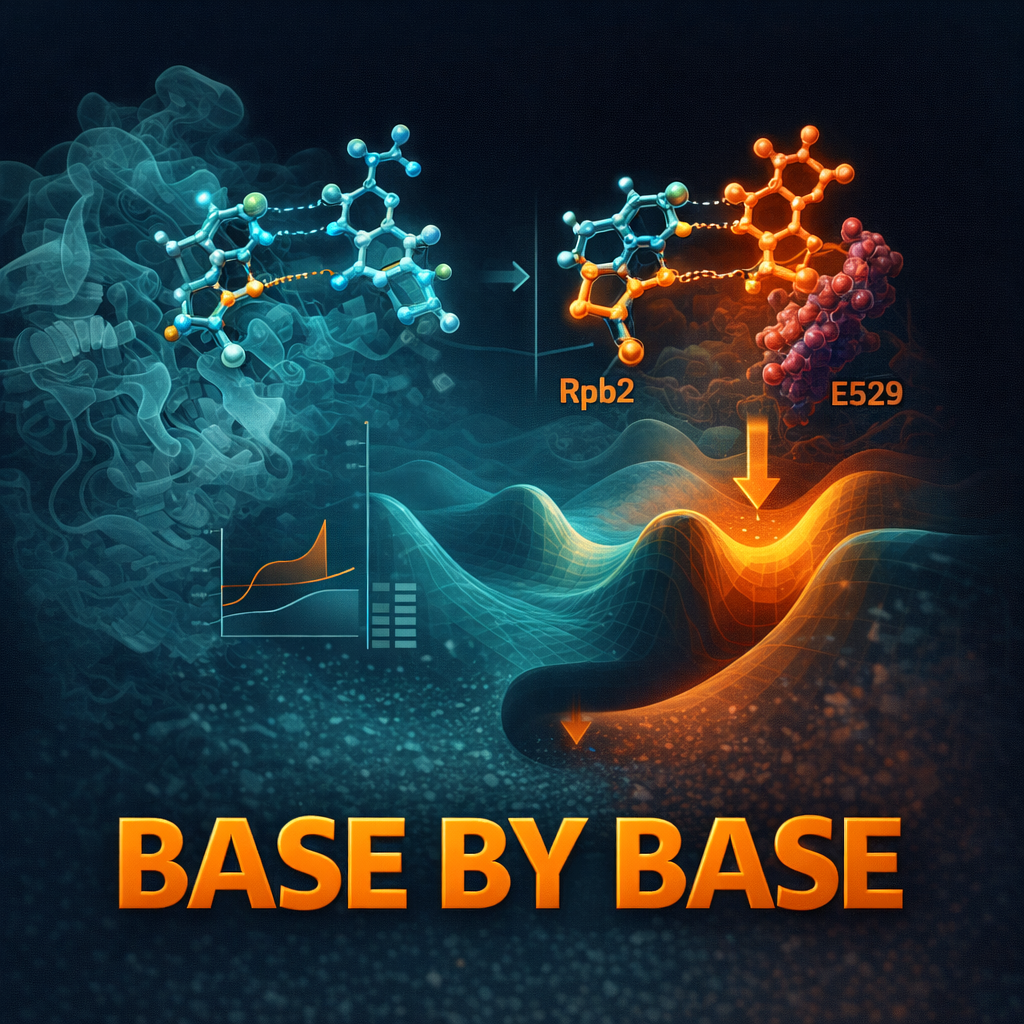
The X ray crystallography revealed the structural aha moment of the entire paper. When 8oxyge is being incorporated opposite an adenine, it starts off in the enzyme's E site or entry site.
[00:10:43] Speaker A: Okay.
[00:10:43] Speaker B: In this pre incorporation phase, it's actually sitting awkwardly far away from the template,
[00:10:48] Speaker A: completely open, like it's hesitating at the door, trying to figure out how to fit in.
[00:10:51] Speaker B: But the moment the chemical bond is forged and it gets incorporated, the base physically flips into that syn conformation. And as it flips to form the Hoogstein pair with adenine, it. Its new geometry places it in the perfect position to form an unintended, highly specific hydrogen bond with a single amino acid on the polymerase enzyme itself.
[00:11:11] Speaker A: Which amino acid?
[00:11:12] Speaker B: Specifically an amino acid called RPB2E529, which sits on a movable flexible part of the enzyme called Fork Loop 2.
[00:11:21] Speaker A: Hold on, let me push back on that. A hydrogen bond.
[00:11:23] Speaker B: Yeah, a hydrogen bond.
[00:11:24] Speaker A: But hydrogen bonds are what hold water molecules together.
They are notoriously weak transient bonds compared to the strong covalent bonds holding the RNA backbone together.
[00:11:34] Speaker B: That's a fair point.
[00:11:36] Speaker A: So how can one single weak hydrogen bond paralyze a massive multi subunit cellular machine like RNA polymerase?
[00:11:44] Speaker B: In the macroscopic world of a glass of water? You're right. But you have to consider the physical environment inside the active site of an enzyme.
[00:11:51] Speaker A: Okay, how is it different?
[00:11:52] Speaker B: The active site is a tight, highly specific, largely dehydrated pocket. In that constrained microenvironment, a single hydrogen bond acts like molecular superglue. The researchers ran thermodynamic energy calculations and found that this specific bond stabilizes the entire complex by about 2.5 kilocalories per mole.
[00:12:13] Speaker A: Which doesn't sound like a lot to us. But on a molecular scale where thermal background energy is only about 0.6 kilocalories per mole, an energy barrier of 2.5 is a massive thermodynamic wall.
[00:12:26] Speaker B: It's an insurmountable anchor. And to understand why it paralyzes the enzyme, we have to look at how RNA polymerase actually moves.
[00:12:34] Speaker A: Right. It operates like a mechanical ratchet.
[00:12:36] Speaker B: Exactly. After it adds a letter, a structure called the bridge helix has to shift and the whole enzyme slides forward exactly one base pair along the DNA.
[00:12:45] Speaker A: That sliding motion is Called translocation.
[00:12:47] Speaker B: Yep.
[00:12:47] Speaker A: So it clicks for one deer tooth at a time to open up the slot for the next letter.
[00:12:51] Speaker B: But that unintended hydrogen bond with the E529amino acid physically jams the gear. It locks the enzyme in what structural biologists call a pre translocation state.
[00:13:01] Speaker A: Oh, so you push the warped Lego brick into the wall, and a piece of the warped plastic accidentally clicks perfectly into the scaffolding you are standing on. You can't slide your scaffolding forward to build the next section of the wall.
[00:13:13] Speaker B: And crucially, because that emergency brake is pulled tight, the enzyme also cannot backtrack. So it's stuck completely. It can't go into reverse to expose the mistake to the TFIS spellchecker. The enzyme is jammed there in the pre translocation state until it eventually, slowly
[00:13:29] Speaker A: forces its way forward, burying the mistake deep inside the RNA transcript. Permanently.
[00:13:34] Speaker B: Yes. The structural geometry of the damaged molecule actively uses the enzyme's own anatomy against it.
[00:13:41] Speaker A: The rusted brick forms a chemical lock.
But how does this scale up? We are talking about a microscopic jam on a single RNA transcript. How does a single microscopic molecular break lead to macroscopic disease?
[00:13:54] Speaker B: If we connect this to the bigger picture, the scale of the problem is the domino effect. Remember, under high oxidative stress, up to 5% of the available building blocks can be oxidized.
[00:14:04] Speaker A: So that means millions of these rusted 8 oxog molecules are flooding this system.
[00:14:09] Speaker B: Exactly. Because they're incorporated so efficiently and because they form this molecular lock that evades proofreading, the cell is constantly churning out thousands of defective RNA messages.
[00:14:20] Speaker A: The blueprints being sent from the nucleus to the factory floor are absolutely covered in typos.
[00:14:25] Speaker B: And when the cell tries to execute those blueprints, everything starts to break down. This widespread transcriptional dysregulation has severe clinical relevance.
[00:14:34] Speaker A: Like what?
What happens to the cell?
[00:14:36] Speaker B: Well, the damaged RNA instructions don't splice together correctly. When the ribosomes, the cellular factories that read the RNA to build proteins, encounter these typos, they physically stall.
[00:14:46] Speaker A: Oh, and the stalled ribosome often produces a truncated or severely misfolded protein.
[00:14:52] Speaker B: Precisely.
[00:14:52] Speaker A: And misfolded proteins are the absolute hallmark of some of the most devastating human conditions.
[00:14:57] Speaker B: Yeah. This provides a crystal clear structural explanation. Explanation for why oxidative stress is a direct driver of aging and neurodegenerative disorders. Take Alzheimer's disease or Parkinson's disease.
[00:15:09] Speaker A: Alzheimer's is characterized by rampant protein aggregation, right?
[00:15:12] Speaker B: Yeah.
[00:15:13] Speaker A: Like the buildup of misfolded amyloid plaques and tau Tangles.
[00:15:16] Speaker B: Right. If the neurons in your brain are under chronic oxidative stress from aging or environmental factors, their free floating nucleotide pools become heavily oxidized.
[00:15:27] Speaker A: So the RNA polymerase constantly embeds these typos.
[00:15:29] Speaker B: The errors escaped the spell checker via that molecular lock, and the cell is flooded with defective proteins that eventually clump together and cause the neuron to undergo apoptosis or cell death.
[00:15:41] Speaker A: That is a terrifying cascade, but it's also incredibly illuminating from a medical perspective. It kind of shifts where we should be looking. It really does, because so much research looks at the plaques in Alzheimer's and tries to figure out how to clean up the misfolded proteins after they've already aggregated. But this deep dive is showing us that the problem starts way earlier. It starts with the actual ink being used to write the instructions, which opens
[00:16:05] Speaker B: up totally new avenues for therapeutic intervention. The researchers themselves point out the next logical steps for investigation.
[00:16:13] Speaker A: Okay, what are they looking at next?
[00:16:14] Speaker B: Now that we know the exact structural mechanism, the exact amino acid involved in the lockdown, what if we could intervene right there?
[00:16:22] Speaker A: Right. What if we target that specific RPB2E529amino acid on the polymerase enzyme?
[00:16:28] Speaker B: Exactly.
[00:16:29] Speaker A: If you could design a small molecule drug that slightly weakens that specific hydrogen bond or maybe alters the flexibility of Fork Loop 2, you might be able to release the molecular emergency brake.
[00:16:41] Speaker B: Yeah. You wouldn't be preventing the initial oxidative damage from happening. I mean, that's incredibly difficult to do in a living system.
[00:16:47] Speaker A: Right. The oxidative stress is always going to
[00:16:48] Speaker B: be there, but you would be fixing the spell checker. You would allow the enzyme to backtrack again. So tfir can actually catch the 8oxog shape shifter before the typos become permanent.
[00:16:58] Speaker A: That is wild. It presents a totally new therapeutic target for neurodegenerative diseases that had been notoriously stubborn in clinical trials.
[00:17:07] Speaker B: Absolutely.
[00:17:07] Speaker A: So what does this all mean? Let's distill the sheer complexity of this mechanism down.
Oxidative stress doesn't just threaten your permanent DNA archive. It heavily oxidizes the unprotected, free floating pool of raw RNA building blocks.
[00:17:23] Speaker B: Which is a huge vulnerability.
[00:17:24] Speaker A: Yeah. And the enzyme responsible for writing RNA messages readily grabs these rusted pieces and forces them into the code. Because these shapeshifting, oxidized bases form unique thermodynamic locks with the enzyme itself, they paralyze the cellular spell checker. This embeds widespread, permanent errors directly into our biology, driving the cascade of misfolded proteins we see in aging and severe neurodegeneration?
[00:17:49] Speaker B: What does this mean for our understanding of neurodegenerative diseases? Could the key to fighting them lie not in fixing the proteins after the fact, but in sanitizing the microscopic Alphabet soup our cells use to communicate?
[00:18:00] Speaker A: This episode was based on an Open Access article under the CCBY 4.0 license. You can find a direct link to the paper and the license in our episode description.
If you enjoyed this, follow or subscribe in your podcast app and leave a five star rating. If you'd like to support our work, use the donation link in the description now. Stay with us for an original track created especially for this episode and inspired by the article you've just heard about. Thanks for listening and join us next time as we explore more science. Bass by bass.
[00:18:48] Speaker C: Late in the lab the lights hum low A clean blue track where letters should go but oxygen whispers sharp and unseen Turns a small token into a living machine One wrong sparkle in the nucleotide rain slips through the gate like a hidden refrain the scribe keeps moving steady and bold Writing new stories from molecules old oh it slides in clean then it won't step back A twist in the bond On a forward only track Watson Creek straight 16 turn when the pool runs rusty the messages burn.
Facing a seat it fits like it's true Fast as the real thing faithful in view Facing an A it takes a side door glide Flips to sea in and it locks inside Proofreading calls But the wheels don't stall Backtrack and fades in the echoing hall A single contact holds tight at the seam and the pace slows down in the middle of the dream.
It slides in clean then it won't step back A twist in the bond On a forward only track Watson Creek straight or a hoogsteen turn when the pool runs rusty the messages burn.