Episode Transcript
[00:00:00] Speaker A: Foreign.
Numbers on a glowing screen.
10 year lines where the past has been.
[00:00:20] Speaker B: Welcome to Bass by Bass, the papercast that brings genomics to you wherever you are. Thanks for listening and don't forget to follow and rate us in your podcast. Appreciate it.
[00:00:28] Speaker C: Glad to be here for another deep dive.
[00:00:30] Speaker B: So, eat less meat, eat more plants. I mean, it's basically the golden rule of healthy aging, right?
[00:00:35] Speaker C: Oh, absolutely. It is everywhere.
[00:00:36] Speaker B: Yeah. Like swap the steak for a lentil bowl and your brain and your body will thank you. That is the consensus. But what if your specific unique DNA sees that lentil bowl not as a health food, but as starvation?
[00:00:51] Speaker C: Right. It is a concept that completely upends our standard approach to nutrition. I mean, we have been conditioned for decades to view dietary advice as this universal one size fits all prescription.
[00:01:04] Speaker B: Like a checklist everyone has to follow.
[00:01:06] Speaker C: Exactly. But human genetics are layered. They are highly individualized, and they carry the biological echoes of millions of years of evolution.
[00:01:15] Speaker B: Which brings us to a massive paradigm shift. Today we celebrate the work of researcher Jacob Norgren and his colleagues who have advanced our understanding of cognitive health and genetics.
[00:01:25] Speaker C: Yes. Their study was published in March 2026 in JMA Network Open, and it is truly fascinating.
[00:01:30] Speaker B: It really is. Our mission for this deep dive is to explore how a specific, heavily researched genetic risk factor for Alzheimer's disease might actually be, well, an ancient marker.
[00:01:42] Speaker C: Right. A biological flag that completely rewrites the rules on what you should be eating to protect your brain.
[00:01:47] Speaker B: Okay, let's unpack this. To really get what's going on, we need to understand the underlying biology. So bring us up to speed on the APOE gene. What are we actually talking about here?
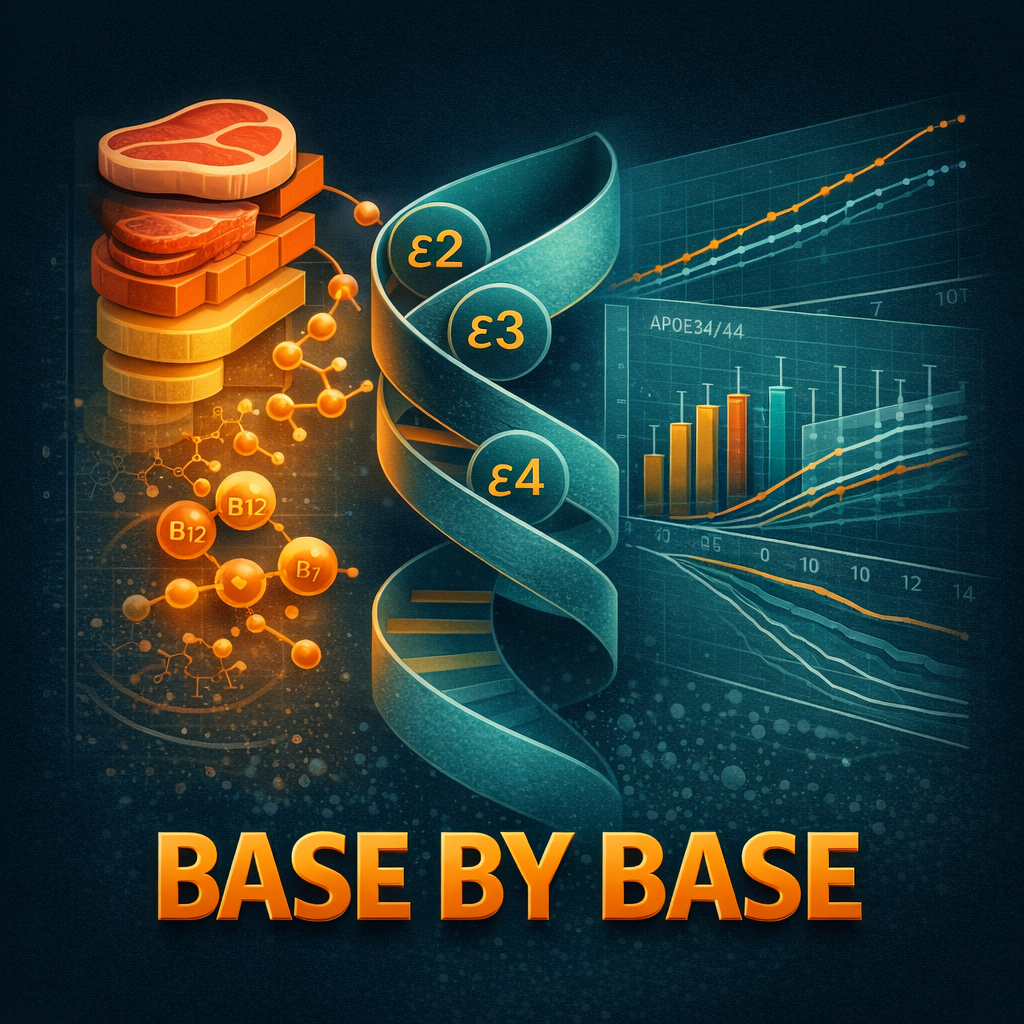
[00:01:57] Speaker C: Well, the APOE gene, epilipoprotein E, is essentially the predominant genetic risk modifier for Alzheimer's disease. And, you know, every single person listening to this right now has it.
[00:02:07] Speaker B: Okay, so we all have it. It's not just a mutation that some people get.
[00:02:10] Speaker C: No, not at all. But it comes in a few different variants which biologists call alleles. You can think of an allele simply as a different flavor or version of the exact same gene.
[00:02:19] Speaker B: Okay. Flavors like that.
[00:02:20] Speaker C: Yeah. And the main ones we look at are Apoe 2, Apoe 3, and Apo 4. Now, Apoe 3 is basically the baseline. It's the most common version found in over 50% of the global population.
[00:02:31] Speaker B: But that's not the one that gets all the scary headlines, right?
[00:02:34] Speaker C: Right. No, the variant that gets all the ominous press in the medical world is APOE 4, because carrying that specific variant Gives you the highest known genetic risk for developing late onset Alzheimer's.
[00:02:46] Speaker B: Yeah. That is the one people are absolutely terrified to find out they have when they, you know, mail in those at home DNA test kits.
[00:02:53] Speaker C: Unquestionably. I mean, if you inherit one copy, your risk goes up significantly. But if you inherit two copies of Apoe 4, your risk of Alzheimer's is exponentially magnified compared to someone with the standard Apoe 3 variant.
[00:03:05] Speaker B: Wow. But what's fascinating here is that these genes didn't just appear out of nowhere in the modern era just to cause cognitive decline. Right?
[00:03:13] Speaker C: Exactly. They are ancient. They evolved alongside primitive human diets and prehistoric environments over vast stretches of time.
[00:03:20] Speaker B: So to understand why this gene exists, we have to look backward. We basically have to treat this like an evolutionary time machine.
[00:03:27] Speaker C: That's a great way to put it.
[00:03:28] Speaker B: Think of these APOE variants like operating systems on a smartphone.
Apoe 4 is actually version 1.0. It's the ancestral human baseline that emerged somewhere between 1 and 6 million years ago.
[00:03:41] Speaker C: Right. It is the original hardware.
[00:03:43] Speaker B: Yeah. And then you have APOE 3, which is version 2.0. And that software, software update didn't drop until about 200,000 years ago.
[00:03:50] Speaker C: And that timeline is the crucial foundation of the entire study. Norgren's team anchors their research in something called the Ben Door J Shape hypothesis.
[00:03:59] Speaker B: The J Shape hypothesis. What does that mean for the ancient human diet?
[00:04:03] Speaker C: Well, if you trace the prehistoric human diet, it wasn't a steady, consistent balance of macros like we think of today. Around two and a half million years ago, our early ancestors shifted into what anthropologists call a hypercarnivorous period.
[00:04:16] Speaker B: Hypercarnivorous, meaning what? They were hunting massive game and meat just became the absolute overwhelming staple of their daily calories.
[00:04:25] Speaker C: Precisely.
For a very long time, animal tissue was the primary fuel source for the human body and the human brain.
And this hyper carnivorous period perfectly coincides with the evolutionary timeline for when APOE 4 version 1.0 emerged and became the standard.
[00:04:43] Speaker B: Okay, so the version 1.0 software was basically coded for a heavy meat diet.
[00:04:46] Speaker C: Yes, but then as we move forward hundreds of thousands of years, the climate changed, the megafauna and large game started to disappear, and humans had to adapt to survive.
[00:04:58] Speaker B: Right. They couldn't just rely on hunting woolly mammoths anymore.
[00:05:01] Speaker C: Exactly. So we shifted away from hypercarnivary and back to a much more varied plant, heavy omnivorous diet.
[00:05:06] Speaker B: Wait, so you're saying our DNA essentially adapted to a prehistoric carnivore diet millions of years ago, and a huge chunk of the population still carries that exact same hardware today.
[00:05:15] Speaker C: That is the core premise. Yeah, that shift back to gathering plants and having diverse food sources coincides perfectly with the emergence of the APOE3 gene.
[00:05:23] Speaker B: Ah, version 2.0.
[00:05:25] Speaker C: Right. The newer variant, version 2.0 provided metabolic flexibility. It allowed the human body to thrive on a highly varied plant heavy diet.
[00:05:33] Speaker B: But Apoe 4, the ancient variant, never got that software update.
[00:05:37] Speaker C: Exactly. The researchers hypothesized that people carrying the APOE4 gene might actually need more meat to maintain their cognitive health.
Simply it is. And the most important baseline metric here is that absolutely none of these people had dementia when the study started.
[00:05:53] Speaker B: Think about that for a second. If you're listening to this on your commute or at the gym, look at the four people closest to you.
Statistically, one of you is walking around with this ancient version 1.0 DNA.
[00:06:05] Speaker C: Yeah, that's a wild way to visualize it. In this Swedish study, about 26.4% of the participants had the APOE 34 or 44 genotypes.
[00:06:14] Speaker B: Meaning they carried at least one copy of that high risk APOE 4 variant.
[00:06:19] Speaker C: Exactly. And over the next decade and a half, the researchers tracked everything they ate, mapped their cognitive decline, and watched for the onset of dementia.
[00:06:27] Speaker B: And I'm assuming measuring cognitive decline wasn't just like a simple questionnaire they filled out once a year?
[00:06:33] Speaker C: Oh, no. They were rigorously testing perceptual speed, episodic memory, and global cognition over decades. It was highly detailed.
[00:06:42] Speaker B: Wait, I need to push back on that before we get to the actual results. Are we absolutely sure it was the meat affecting their brains?
[00:06:47] Speaker C: What do you mean?
[00:06:48] Speaker B: Well, could it be that the people eating more meat in Sweden were simply wealthier or exercising more or had better access to healthcare? And maybe that's what protected their cognition, not the meat itself?
[00:07:00] Speaker C: That is a vital question. And it is exactly why the SNAK cohort is so respected. The researchers rigorously adjusted for all of those confounding variables.
[00:07:09] Speaker B: Okay, so they controlled for all that noise? Yes.
[00:07:12] Speaker C: They factored in education level, socioeconomic status, physical activity, smoking, cardiovascular health, and even total caloric intake.
The data isolates the dietary impact as much as statistically possible.
[00:07:25] Speaker B: Okay, here's where it gets really interesting. The results of those 15 years are a massive plot twist for the participants who had that high risk APOE 4 variant. The ones who ate the most meat, like the top 20% of meat consumers in the study, did not get worse.
[00:07:40] Speaker C: No, they didn't.
[00:07:41] Speaker B: They actually had significantly better cognitive trajectories. And a massively reduced risk of dementia.
[00:07:45] Speaker C: The statistical outcomes are staggering. Honestly, for the Apoe 4 carriers in that highest quintile of meat consumption, their sub distribution hazard ratio for dementia was 0.45.
[00:07:57] Speaker B: Wait, hold on. A sub distribution hazard ratio of 0.45? Translate that into everyday terms for us. Are we saying their risk was literally cut in half just by the food food on their plate?
[00:08:08] Speaker C: That is exactly what it means. Their risk of developing dementia was slashed by 55% compared to the people with the exact same high risk genetics who eat the least amount of meat.
[00:08:18] Speaker B: That is unbelievable.
[00:08:19] Speaker C: And it gets better. Carrying the APOE4 gene typically comes with a well documented cognitive disadvantage. You fully expect those individuals to lose memory and perceptual speed much faster than the rest of the population.
[00:08:31] Speaker B: Right, that's why it's the Alzheimer's gene.
[00:08:33] Speaker C: Exactly.
But for the APOE 4 carriers eating the most meat, that expected genetic disadvantage completely vanished.
Their cognitive aging mirrored the low risk participants.
[00:08:45] Speaker B: That is mind blowing. The meat essentially neutralized the highest known genetic risk factor for Alzheimer's.
But we have to highlight the crucial contrast here. What about the other people in this study?
[00:08:57] Speaker C: Right, so for the 70% of people in the study who did not have the APOE4 gene, the folks with the more modern version 2.0 genetics eating more meat showed zero cognitive association.
[00:09:09] Speaker B: So it didn't speed up their cognitive decline, but it didn't protect them either.
[00:09:13] Speaker C: Correct. It was totally neutral.
[00:09:14] Speaker B: Right.
[00:09:15] Speaker C: Which proves this isn't just a general property of meat being brain food for everyone.
[00:09:19] Speaker B: Right? It's not a universal superfood.
[00:09:21] Speaker C: No, it demonstrates a highly specific gene diet interaction. The benefit only unlocked for the individuals carrying the ancient genetics.
[00:09:29] Speaker B: Okay, I have to jump in and play devil's advocate here because I can hear the gears turning for some people listening. If I take a DNA test tomorrow and I find out I am in that 26% with the ancient APOE4 gene, do I just start eating a mountain of bacon, hot dogs and salami every single day to save my brain?
[00:09:46] Speaker C: Categorically, no.
And the researchers were meticulous in breaking this down. They didn't just dump all animal protein into one giant meat bucket.
[00:09:54] Speaker B: Thank goodness.
[00:09:55] Speaker C: Yeah. They analyzed the ratio of processed to total meat, and the data drew a very hard line.
A higher ratio of processed meat, meaning meat altered through salting, curing, fermentation or smoking, was actually associated with a hazard ratio for dementia of 1.14, meaning a
[00:10:15] Speaker B: 14% increase in the risk of developing dementia. And let me guess, that Applied to everyone.
[00:10:21] Speaker C: Everyone. There was no genetic interaction there at all. The detrimental effects of heavy processing apply to your brain, whether you have the ancient version 1.0 gene or the modern version 2.0 gene.
[00:10:31] Speaker B: So the hot dogs and the cold cuts are definitely out.
[00:10:34] Speaker C: They are completely out. The true heroes driving those incredible cognitive benefits for the APOE 4 carriers were strictly unprocessed red meat and unprocessed poultry.
[00:10:43] Speaker B: Okay, unprocessed is the key word.
[00:10:45] Speaker C: Very much so. Norgren's team even ran some post hoc analyses, meaning they went back into the data after the main study to look for secondary patterns.
[00:10:53] Speaker B: And what did they find?
[00:10:53] Speaker C: They found that higher consumption of unprocessed meat was actually linked to reduce all cause mortality.
[00:10:59] Speaker B: Meaning a lower risk of dying from literally anything.
[00:11:03] Speaker C: Yes, but again, that survival benefit existed strictly within the APOE 4 group.
[00:11:08] Speaker B: Wow. So it's almost like putting diesel fuel into an unleaded engine. It doesn't matter if the diesel is incredibly high quality. The the version 1.0 engine just doesn't have the biological spark plugs to ignite it if it's the wrong fuel.
[00:11:22] Speaker C: That is a brilliant analogy.
[00:11:23] Speaker B: But how is this happening biologically? Why does the APOE4 gene care so deeply about the physical source of the nutrients?
[00:11:30] Speaker C: This brings us to a critical biological concept called the food matrix. We tend to view food just as a list of ingredients on a nutrition label, right?
[00:11:39] Speaker B: Yeah. Like a certain amount of protein, some fats, a list of vitamins.
[00:11:42] Speaker C: Exactly.
But in nature, nutrients don't exist in isolation. The food matrix refers to the complex physical and chemical structure in which those nutrients are bound together.
[00:11:53] Speaker B: So like a vitamin inside a piece of steak is physically packaged differently than that same vitamin fortified into a bowl of breakfast cereal?
[00:12:00] Speaker C: Precisely. And to understand how this connects to the ancient gene, the researchers looked for a proxy to measure nutrient absorption. They focused heavily on vitamin B12, which is vital for neurological function.
[00:12:12] Speaker B: Okay, B12. And what did they see?
[00:12:14] Speaker C: They found a unique biological lock and key interaction.
Individuals with the APOE 4 variant appear to absorb vitamin B12 significantly better when it is delivered inside the physical matrix of animal tissue, compared to when it comes from other sources.
[00:12:29] Speaker B: Ah, I see. So the ancient ApoE4 protein structure struggles to unlock the grain version because evolutionarily, it never had to learn how to break down plant walls to get those specific nutrients.
[00:12:40] Speaker C: That is exactly it. The Apoe 3 carrier with that version 2.0 software has the metabolic flexibility to efficiently extract B12 from fortified grains, dairy or supplements.
[00:12:51] Speaker B: But the Apoe 4 carrier is biologically optimized to extract it almost exclusively from meat.
[00:12:56] Speaker C: Yes. So if you replace the meat in an ApoE4 carrier's diet with legumes and cereals, their body might actually struggle to extract what it needs to maintain the brain. Even if the nutrition label promises the
[00:13:07] Speaker B: vitamins are there, that is wild, the physical structure of the food dictates whether the ancient gene can actually use it.
[00:13:14] Speaker C: Exactly. It's not just about what you eat, it's about what your specific body can actually absorb.
[00:13:19] Speaker B: Man. If version 1.0 truly needs animal tissue to function, we are looking at a massive collision with modern public health.
[00:13:27] Speaker C: Oh, absolutely.
If we connect this to the bigger picture, the implications are genuinely staggering. We really have to grasp the sheer scale of the population we are talking about here.
[00:13:38] Speaker B: How big is it?
[00:13:38] Speaker C: The APOE4 genotype is implicated in roughly 70% of all Alzheimer's disease cases in Northern Europe and North America. We are talking about tens of millions
[00:13:49] Speaker B: of people and we need to pause here and make something explicitly clear to you. Listening. We are not taking a side in the global meat versus plant debate, nor are we endorsing one policy over another. Right?
[00:13:59] Speaker C: Definitely not.
[00:14:00] Speaker B: Our job today is purely to report on the friction that Norgren's data creates with current guidelines. Right now, as we all know, there is a coordinated global push for standardized, highly plant based diets.
[00:14:11] Speaker C: Yes. You look at initiatives like the Eat Lancet Commission or the planetary health diets. They are heavily promoted for human and environmental health, which you know are vital global goals.
[00:14:22] Speaker B: Right. They are designed to sustainably feed 10 billion people, which is a monumental challenge. This is a massive challenge, but mathematically, those planetary diets recommend drastically low meat consumption, sometimes as little as 14 grams of red meat a day.
What this Swedish study is suggesting, alongside deeply underappreciated data they cite from the massive UK Biobank and the Nurses Health Study, is that at those low levels of meat consumption, APOE 4 carriers experience accelerated cognitive decline.
[00:14:53] Speaker C: And that is the profound blind spot Norgren's team is illuminating. Broad public health guidelines are inherently written for the mathematical majority.
[00:15:01] Speaker B: Right. They are designed for the metabolic flexibility of the Apoe 3 carriers. We might be actively, albeit unintentionally, starving the brains of the APOE 4 minority.
We are basically telling the exact population at the highest genetic risk for for Alzheimer's to drastically reduce the very food matrix their specific DNA requires to stave off the disease.
[00:15:24] Speaker C: This raises an important question, arguably the most critical question in modern epidemiology. Are we doing more harm than good by issuing blanket dietary recommendations.
[00:15:33] Speaker B: Yeah, it really makes you wonder.
[00:15:35] Speaker C: This data makes an incredibly compelling case that the future of medicine must be precision nutrition.
We were looking at a genetically defined subgroup making up roughly a quarter of the global population, who may require significantly higher consumption of unprocessed meat than is conventionally recommended just to maintain their cognitive baseline.
[00:15:53] Speaker B: The bottom line is there simply is no universal diet.
[00:15:56] Speaker C: No, there isn't.
[00:15:57] Speaker B: So what does this all mean for you? It means the era of the one size fits all diet is coming to an end. The future of human health is highly personalized. What works perfectly for your neighbor, or your favorite fitness influencer, or even the official government food pyramid might be entirely wrong for your specific DNA.
[00:16:17] Speaker C: You really have to know your own hardware.
[00:16:18] Speaker B: Yeah, exactly.
[00:16:19] Speaker C: And honestly, it should be incredibly empowering. It shifts the narrative entirely away from, you know, you're just not doing the healthy diet right. You just haven't found the right fuel for your specific engine.
[00:16:31] Speaker B: It's not a failure of willpower, it's a mismatch of evolutionary biology. And it leaves us with something really fascinating to mull over. If our optimal diet might actually be dictated by the specific era of human history in which our genes evolved, what other universal modern health advice are we blindly following today that is completely mismatched with our ancient DNA?
[00:16:51] Speaker C: Oh, it makes you reconsider everything from how we sleep to how we exercise to how we interact with daylight.
[00:16:57] Speaker B: It really does. There is so much more to explore here. This episode was based on an Open Access article under the CC BY 4.0 license.
You can find a direct link to the paper and the license in our episode description. If you enjoyed this, follow or subscribe in your podcast app and leave a five star rating. If you'd like to support our work, use the donation link in the description now. Stay with us for an original track created especially for this episode and inspired by the article you've just heard about. Thanks for listening and join us next time as we explore more science based by Bass.
[00:17:37] Speaker A: Late life numbers on a glowing screen 10 year lines where the past has been Same old meals but the curves don't agree Turns out the code in you changes the recipe Somebody's read the menu like a man Some missed out message in the micro not Ching I keep it steady, I keep it precise Listening close to what the data implies not one play fits all not one rule for every mind in the quiet of the years different gears unwind if the pattern says slow down we follow that sign choose what feeds the future one measured by it at a time time.
For certain care is higher Meat on the scale tracked with steadier thinking along the trail but flip to process in the wrist climbs a ratio that can't be sweet talk by time post hoc whispers maybe B12 in the mix maybe the matrix how the nutrients stick we don't crown a certainty we name what we see Precision in the question is the start of therapy not one plate fits all Let the evidence lead Keep it cautious keep it real keep it centered on need unprocessed over shortcuts Let the long ear shine choose what feeds the future one measured bite at a time.
Ram.