Episode Transcript
[00:00:00] Speaker A: Foreign.
[00:00:14] Speaker B: Welcome to Base by Bass, the papercast that brings genomics to you wherever you are. Thanks for listening, and don't forget to follow and rate us in your podcast app.
[00:00:22] Speaker C: Good to be here.
[00:00:23] Speaker B: All right, so today we're diving into a problem that.
It sounds more like it belongs in an engineering class, but it's actually a central crisis for one of the most common viruses on the planet.
[00:00:34] Speaker C: Right.
[00:00:35] Speaker B: I want you to picture a physical cable. You know, like one of those old school coiled telephone cords.
[00:00:41] Speaker C: Okay, Got it.
[00:00:42] Speaker B: Now imagine you hold both ends and you just start twisting. You're not stretching it, just twisting. And you keep twisting and twisting. Eventually, it doesn't just get tight. It starts to knot up on itself. It kinks. And if you keep cranking up that tension, eventually you snap, it fails.
[00:00:58] Speaker C: That's a classic example of torsional stress. Yeah, super coiling.
[00:01:02] Speaker B: Exactly. And here's where the biology comes in, because that isn't just a metaphor. That exact physical stress is happening inside your cells every single second. Your DNA is a double helix, two strands twisted together. And every time a cell needs to, you know, read a gene or copy its DNA, it has to pull those.
[00:01:20] Speaker C: Strands apart, which by, by definition, overwinds the DNA ahead of the machinery. You can't avoid it. The more you unzip, the tighter the knot gets down the line.
[00:01:28] Speaker B: Yeah, for a human cell, this is business as usual. We've got enzymes to handle it, but today, we're looking at this from the virus's point of view. Specifically human papillomavirus.
Hpv. Okay, so if you're hpv, you're inside a host cell, and you need to replicate like crazy. You are generating a massive amount of this torsional stress on your own little circular genome.
[00:01:50] Speaker C: And if that viral DNA snaps or gets so tangled up that the CO machine just falls off, well, that's game over for the virus.
[00:01:57] Speaker B: So the question for our deep dive today is how does HPV solve this huge physics problem? I mean, it has a tiny genome. It doesn't run its own molecular scissors. It has to steal the hosts.
[00:02:07] Speaker C: Right? But as we're about to find out, it doesn't just borrow them. It hijacks them, turns them up to, frankly, dangerous levels, and then uses them to break things on purpose.
[00:02:19] Speaker B: Which sounds completely backwards, but it turns out to be this brilliant survival strategy. To understand it, we're breaking down a paper called Differential Roles of Type I Topoisomerases in Regulating HPV Pathogenesis.
[00:02:31] Speaker C: And we should definitely give a shout out to the team Here. This is fantastic work from Arushi Vats, Connor W. Templeton, and Lemonis Lehmans, all.
[00:02:40] Speaker B: Coming out of the Department of Microbiology Immunology at Northwestern University.
[00:02:43] Speaker C: Yeah, they're a great group, really reshaping how we think about the molecular machinery behind these viruses.
[00:02:49] Speaker B: So before we get into the mechanics, let's just set the stage. HPV isn't some rare virus.
[00:02:54] Speaker C: Oh, not at all. It's responsible for about 5% of all human cancers. We're talking cervical, oropharyngeal, anal cancers. Right. It's a huge clinical problem.
[00:03:05] Speaker B: And the really tricky part is its life cycle. Right. It's not a quick in and out kind of virus.
[00:03:09] Speaker C: No, it's a squatter.
It infects what are called basal keratinocytes. Think of them as the stem cells at the bottom layer of your skin. Now, normally, as these cells move up to the surface, they differentiate, and crucially, they stop dividing, basically. Yeah. But HPV needs that replication machinery to be active so it can make copies of itself. So it forces these retiring cells to stay on the job. It shoves them back into the cell.
[00:03:35] Speaker B: Cycle, and that's where the stress comes from. A cell that should be dormant is forced to run a marathon. That's where you get all that DNA supercoiling.
[00:03:43] Speaker C: Exactly. And that's why the cell and the virus need these tools. We mentioned the topoisomerises, the untwisting enzymes. Right. And we're focusing on a specific class today, Type I topoisomerases.
[00:03:56] Speaker B: So what makes them type I?
[00:03:58] Speaker C: It all comes down to how they cut the DNA. A type I topoisomerase makes a nick in just one of the two DNA strands. It holds onto the ends, lets the other strand rotate through the break to relieve tension, and then it glues it back together.
[00:04:11] Speaker B: So it's a controlled break, clip, spin, seal.
[00:04:14] Speaker C: Perfect analogy. It's much safer than a type 2, which cuts both strands, snapping the whole chromosome. Now, we've known for a while that some viruses, like herpes, really depend on one of these, called top one alpha.
[00:04:25] Speaker B: But for hpv, it was kind of a question mark, a huge one.
[00:04:28] Speaker C: I mean, our cells have three main type I enzymes. Top 1 alpha, top 3 alpha, and top 3 beta. Right. We just didn't know which ones HPV was using or if it just grabbed whatever was around.
[00:04:41] Speaker B: And that's the mystery this Northwestern team wanted to solve.
[00:04:43] Speaker C: It is. And I really want to highlight. Highlight their methodology here, because the cell model you use is everything in this kind of research, right?
[00:04:49] Speaker B: They didn't just use standard HeLa cells.
[00:04:51] Speaker C: No. And that's so important. HeLa cells have the HPV genome actually integrated, you know, stuck into the human DNA. But that's not how a real infection works. In an active infection, the virus exists as an episome.
[00:05:05] Speaker B: A little free floating loop of DNA.
[00:05:07] Speaker C: Correct. So they use a cell line called CIN612, which comes from a real pre cancerous lesion.
And in these cells, the HPV genome is maintained as those free floating loops.
[00:05:17] Speaker B: So the physics of the problem, the twisting of a loop, is actually authentic to what's happening in a patient.
[00:05:22] Speaker C: Precisely. The model is right. So they have the right cells. How do they figure out which enzyme is the important one?
[00:05:27] Speaker B: This is where the cool tools come in.
[00:05:29] Speaker C: Yeah. First up is something called lentiviral hhrna. You can think of it like a genetic sniper rifle. It lets you specifically knock down or silence the gene for each poisonerase one by one.
[00:05:40] Speaker B: So you take away a tool and see if the virus factory grinds to a halt.
[00:05:43] Speaker C: Exactly. Then they use chin AP assays. This basically tells you where the enzyme is. Is it sitting on human DNA or is it parked on the viral DNA?
[00:05:52] Speaker B: Very cool. And they also used a couple of others to look for damage. Right.
[00:05:55] Speaker C: They did comet assays, which are just as visual as they sound. You put the cell's DNA in a gel and if it's broken, the fragments stream out like a comet's tail. A longer tail means more damage, so.
[00:06:07] Speaker B: A very direct way to see if things are breaking.
[00:06:09] Speaker C: And drip assays, which we'll get back to, because they detect a very specific kind of genomic mess called an R loop.
[00:06:16] Speaker B: Okay, so let's get to the findings. The very first thing they noticed was just the sheer quantity of these enzymes.
[00:06:20] Speaker C: Yeah, it was. It wasn't a small difference in the HPV positive cells. And they checked this in actual cervical cancer biopsies too. The levels of all three enzymes, 1 alpha, 3 alpha and 3 beta, were through the roof.
[00:06:33] Speaker B: How high are we talking?
[00:06:34] Speaker C: Up to six times higher than in normal healthy cells.
[00:06:37] Speaker B: Six times. So the virus gets in and just cranks the production of these things?
[00:06:41] Speaker C: It absolutely does. The viral oncoproteins E6 and E7 are directly responsible. They're telling the cell, flood the place with these scissors.
[00:06:49] Speaker B: So your first thought is, okay, the virus must need all three of them. Why else make so much?
[00:06:54] Speaker C: That would be the logical assumption. But when they used that genetic sniper rhizole to knock down top three alpha, nothing Happened?
[00:07:02] Speaker B: Nothing. The virus just kept going, didn't miss a beat.
[00:07:05] Speaker C: Replication was fine. And it turns out Top three Alpha mostly lives out in the cytoplasm and mitochondria. It's not even really in the nucleus where the action is.
[00:07:14] Speaker B: So it's like the virus just orders a combo meal and top three Alpha is the side dish it doesn't even eat.
[00:07:20] Speaker C: That's a great way to put it. It's just a byproduct of this blunt command to make more depoisomerases. But the other two, Top one Alpha and Top three Beta, that's a different story. A completely different story. They are absolutely essential. When the researchers knock down either of those, the whole viral lifecycle just collapsed.
[00:07:37] Speaker B: Replication stops, transcription stops, everything.
[00:07:40] Speaker C: And the QPP data showed exactly why.
They were both bound directly to the HPV genome and not just anywhere.
[00:07:47] Speaker B: They were at the urr. Right. The upstream regulatory region, which is the.
[00:07:51] Speaker C: Command center, is where the origin of replication is. It's where the major promoters are. These enzymes were sitting right at the controls.
[00:07:58] Speaker B: So we know the virus is addicted to Top one Alpha and Top three Beta. But the really cool part of this paper is that they aren't interchangeable. They do different jobs.
[00:08:07] Speaker C: This is where it gets really elegant. They started looking at what else went wrong when they removed one of them. For instance, when they took out top one alpha, they saw this huge drop in a cytokine called IL6, interleukin 6.
[00:08:20] Speaker B: That's an immune signal, right?
[00:08:21] Speaker C: It is a pro inflammatory one. And you'd think a virus would want to quiet the immune system down, but it seems like HPV needs to fine tune it. Top one alpha helps regulate that environment and it also helps manage P53 levels.
[00:08:35] Speaker B: So it's not just untwisting DNA, it's also a. A diplomat managing the cell's internal politics.
[00:08:40] Speaker C: In a way, yes.
But Top three Beta, its job is, you could argue, even more critical. It's the janitor.
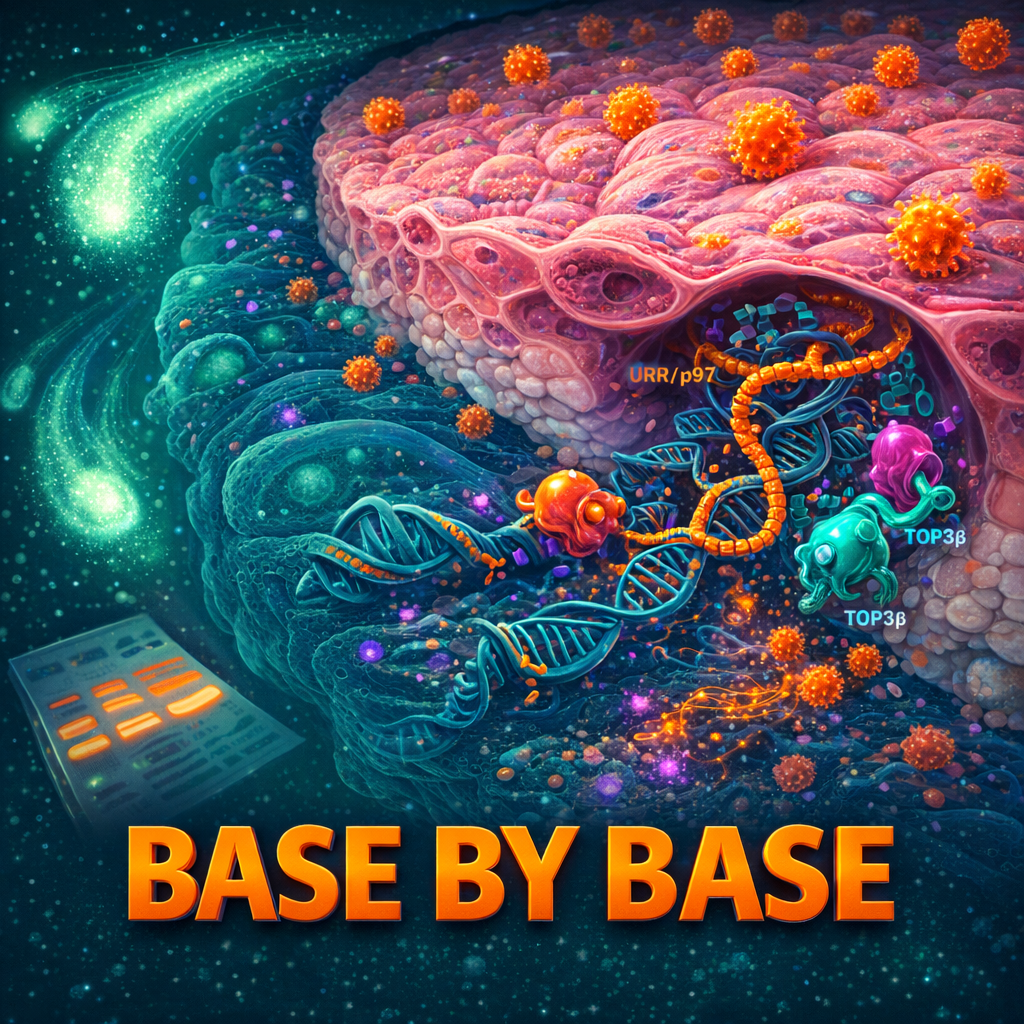
[00:08:49] Speaker B: Okay, this brings us back to that genomic mess you mentioned before. The R loops.
[00:08:53] Speaker C: The R loops, yes. So, very simply, DNA unzips, a strand of RNA is made, and then that RNA is supposed to float away. The DNA zips back up clean.
[00:09:03] Speaker B: But sometimes it's not clean.
[00:09:04] Speaker C: Not always. Sometimes that new RNA strand is a bit sticky and it actually hybridizes back with the DNA template strand it was just copied from. So you get this three stranded structure, one strand of RNA wedged into the DNA double helix.
[00:09:16] Speaker B: That sounds like a major problem.
[00:09:18] Speaker C: It's A disaster waiting to happen. It's a physical roadblock. When the replipation machinery comes racing along, it slams into that R loop on the whole thing and just collapse. You get DNA breaks. It's incredibly toxic.
[00:09:27] Speaker B: And since HPV is forcing the cell to work overtime, it must be making a ton of these R loops.
[00:09:33] Speaker C: A ton. And this paper shows that top 3 beta is this specific solution. When they knocked down top 3 beta, R loops went through the roof everywhere.
[00:09:42] Speaker B: So without it, the virus literally chokes on its own transcriptional garbage.
[00:09:46] Speaker C: Exactly. And what's fascinating is that top three beta doesn't work alone. It acts as a recruiter. It brings in other proteins like DHX9, which are helicases that specialize in physically unwinding these knots.
[00:09:58] Speaker B: So top three beta is the foreman that spots the problem and calls in the specialized crew to fix it.
[00:10:03] Speaker C: You've got it. So now you see the division of labor. Pop 1 Alpha handles the primary twisting and immune signaling. Pop 3 Beta is the R lug cleanup crew.
[00:10:12] Speaker B: But there's a paradox here we have to talk about. We said these enzymes prevent DNA from snapping, but the paper shows that having such high levels of them is actually causing more DNA breaks.
[00:10:23] Speaker C: This is the most counterintuitive and maybe the most brilliant part of the whole story. Remember, the enzyme's job is to cut, let spin and reseal, right? But if you have way too many of them working in a high speed environment, sometimes they get stuck. They get trapped in the cut phase, covalently linked to the broken DNA. These are called cleaved complexes or top 1cc. They are a form of DNA damage.
[00:10:45] Speaker B: So by cranking its own helpers up to 6x normal levels, the virus is creating more damage that seems self destructive.
[00:10:52] Speaker C: It would be, except for one thing. When a cell detects DNA damage, it activates its alarm system. The DNA damage response or DDR. Specifically pathways called ATM and atr.
[00:11:04] Speaker B: The emergency repair crew.
[00:11:05] Speaker C: The emergency repair crews. And you'd think a virus wouldn't want those crews showing up.
[00:11:09] Speaker B: That it does.
[00:11:10] Speaker C: It does. HPV hijacks those repair factors. It needs them. It recruits them to its own replication centers and uses the cell's repair machinery to help replicate its own viral DNA.
[00:11:20] Speaker B: Oh wow. So it's creating a controlled crisis. It intentionally breaks things a little bit, using these excess to poisoner just to summon the repair crew that it then enslaves to build more virus.
[00:11:32] Speaker C: That's the model. It's weaponized DNA damage. Break things just enough to get the help you need, but not so much that you kill your host cell. At least not right away.
[00:11:39] Speaker B: That is just. It's diabolical. And it totally reframes. These enzymes. They're not just maintenance tools. They're strategic weapons in this viral takeover.
[00:11:47] Speaker C: Which brings us to the clinical take home message. Because we have drugs that inhibit topoisomerasis, right?
[00:11:53] Speaker B: Some chemotherapies, but they're like sledgehammers. They hit all dividing cells.
[00:11:58] Speaker C: Incredibly toxic. But this study reveals a specific vulnerability.
These HPV driven cancers have a unique profound addiction to to Top three Beta and its R Loop cleaning service.
[00:12:10] Speaker B: Something a normal healthy cell probably isn't as desperate for.
[00:12:15] Speaker C: Exactly. So the idea is, what if you could develop a drug that doesn't just block top 3 beta itself, but maybe blocks its ability to recruit that cleanup crew, DHX9.
[00:12:25] Speaker B: You could in theory let the virus drown in its own R Loops while.
[00:12:29] Speaker C: Leaving healthy cells which are moving at a slower pace and have other backup systems relatively unharmed. You'd be targeting the virus's specific addiction.
[00:12:37] Speaker B: Moving from kill all fast growing things to exploit this virus's specific bad habit.
[00:12:43] Speaker C: And that's really the future of targeted cancer therapy.
[00:12:45] Speaker B: It's just amazing how drilling down into the basic physics of a DNA molecule can point us towards such a clever therapeutic strategy for a major cancer.
[00:12:54] Speaker C: It's why basic science is so fundamental. You have to understand the machine before you can figure out how to break it.
[00:12:59] Speaker B: A perfect place to leave it. What an incredible piece of molecular detective work.
[00:13:02] Speaker C: It really is a pleasure to walk through it.
[00:13:05] Speaker B: This episode was based on an open Access article under the CC BY 4.0 license. You can find a direct link to the paper and the license in our episode description. If you enjoyed this, follow or subscribe in your podcast app and leave a five star rating. If you'd like to support our work, use the donation link in the description. Now stay with us for an original track created especially for this episode and inspired by the article you've just heard about. Thanks for listening and join us next time as we explore more science Base by Bass.
[00:13:54] Speaker A: See seven Whisper and the cycle begins. Nuclear hands get restless Tightening the spin. Two cutters in the dark where the epistles if they lean on the urgent type Just a pedanic stack in doorway Wake the early light Single strength confession Cut and close in time keeping quiet circles turning line by line.
If the coil gets heavy, if the road gets bent they smooth the super current where the message sent but pulling from the circuit and the signal won't stay. You can feel the paper Thin genome start to fray we're dancing with the torsion we're keeping it clean Untie the loop, yeah don't dare to see don't tear the scene all loops on the lakefront Coming in the night hold the copy steady Keep the letters bright Top one in the heartbeat Top three in the groove Two different ways to make the same truth.
Turn the dials down low Watch the numbers fall E1, E2 fade out E6, E7 stall less tail in the comet Less damage in the glow Cleats complex ghosts don't have as far to go Repair crew steps softer when the cuts don't crowd but the story splits sideways when the pathways speak aloud one voice pulls IL6 from the chorus line one drop CGI three like a miss downbeat.
[00:15:38] Speaker C: Sound.
[00:15:43] Speaker A: One leans into cytokine thunder then it clears one leans into RNA weather shifting gears Same city different corners of different street like usain viral need two routes to pull it through if top one goes quiet the viral lanes get knotted first our loop stack like winter traffic when the rhythms curve Top three steps back Then I spread wide and free Violent cellular tangled harmony so listen for the difference in the way the silence lands to enzymes Two signatures into steady hand.
We're dancing with the torture we're keeping it clean Untie the loop don't tear the sea don't tear the sea all loose on the lake front Lakefront coming in the night hold the copy steady Keep the letters bright Top one in the heartbeat Top three in the groove Two different ways to make the same truth.