Episode Transcript
[00:00:03] Imagine nine children in different countries who have never met. Some are slow to walk, some are slow to talk. One has autism and seizures. Another reads well enough, but struggles with dyslexia. One needed a liver transplant as a baby.
[00:00:20] Looked at side by side, they seem to have little in common. And yet, when their genomes were read, each child carried a brand new change in the very, very same gene. A change that neither parent had.
[00:00:33] How can one gene produce children who look so different from each other?
[00:00:43] This is base by base. Every episode is built with AI tools from a real open access paper curated by a human. And every claim is checked against the paper before we publish. You'll find this episode's fact check score on our website. Now back to the story.
[00:01:03] Here is a way to picture it. Think of a film editor working on raw footage. The editor cuts out the bad takes and joins the good scenes into a finished film. Then a courier carries the reels out of the studio to the cinemas.
[00:01:18] Now imagine that editor is damaged. One version cuts in the wrong places. Another loses its pass and cannot get out of the studio.
[00:01:27] Same job, very different failures.
[00:01:30] Today's story is about a gene that does that editing and about how each child's version broke in its own way.
[00:01:42] Today we celebrate the work of Jasmine Lisfeld, Kirsten Kutcha, Friederi Harms and colleagues from the University Medical Center Hamburg, Eppendorf, Baylor College of Medicine, Gene DX and partner centers in Israel, Norway, France, the Netherlands and the United States who have advanced our understanding of how splicing factors shape human development.
[00:02:05] Their paper, de novo variants in the essential splicing factor gene SRSF3 cause variable developmental phenotypes, was published in the American Journal of human genetics in December 2020.
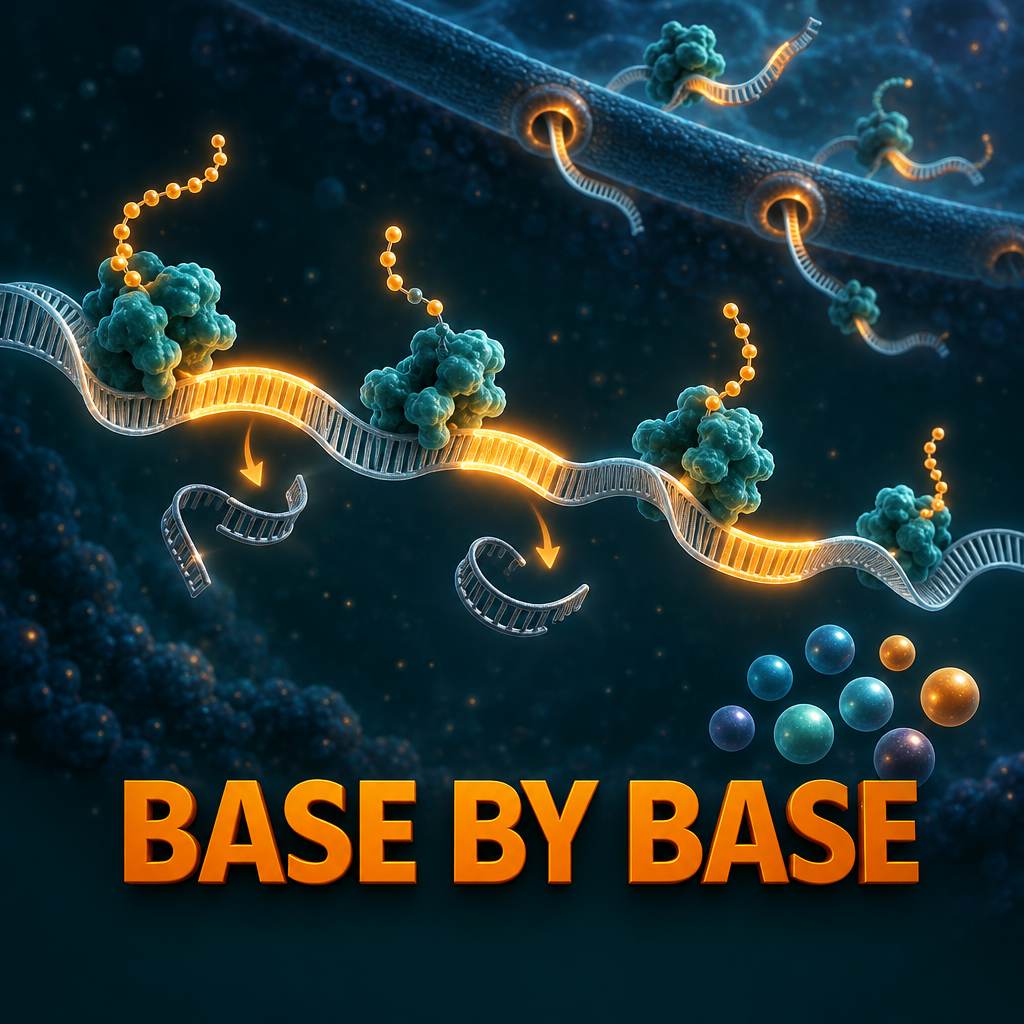
[00:02:23] Let's start with splicing. Most of our genes are written in pieces. The useful parts, called exons, are separated by stretches called introns. Before a gene's message can be used to build a protein, the introns are cut out and the exons are joined. That is splicing carried out by a large machine called the spliceosome. And the same message can be cut and joined in more than one way, which is called alternative splicing. It lets one gene produce several versions of a protein, and it is critical for the developing nervous system.
[00:02:57] The spliceosome does not work alone. It is guided by helper proteins that bind the message and tell the machine where to cut.
[00:03:06] One important family of helpers is called the SR proteins, after the serine and arginine building blocks that fill their tails. Humans have 12 of them.
[00:03:15] Each has a front end that recognizes RNA and a tail rich in serine and arginine that handles contacts with other proteins. Today's gene, SRSF3, is one of them.
[00:03:29] SRSF3 is used in every tissue, and it is essential Mice that lose it completely do not survive as embryos. The protein is small,164amino acids.
[00:03:42] Its first part, the RNA recognition motif, grips the message. Its tail, the RS domain, carries phosphate tags that are added and removed in cycles.
[00:03:52] Those tags decide where the protein goes, which partners it meets and when it helps a finished message leave the nucleus.
[00:04:03] The cycle goes roughly like in the cytoplasm. An enzyme called SRPK2 adds phosphate tags along the tail from the end inward.
[00:04:13] Fully tagged, the protein is carried back into the nucleus and joins a new round of splicing.
[00:04:20] During splicing, the tags are gradually removed in its lightly tagged form. SRSF3 can then team up with two export partners, YTH DC1 and NXF1, which help carry finished messages out of the nucleus. In our film picture, the tags are the Editor's Pass.
[00:04:41] SRSF3 even edits itself. Its gene contains a so called poison exon with an early stop signal. When enough protein is around, it pushes its own message to include that poison exon and those messages are destroyed by a quality control system called nonsense mediated decay. When protein is scarce, the poison exon is left out and full protein is made. It is a thermostat, which raises a damage to a gene like this could be harmful, but could the cell also push back?
[00:05:18] So how did the team find these children?
[00:05:21] Through GeneMatcher, an online tool that connects clinicians and researchers who find changes in the same gene.
[00:05:28] Nine individuals were recruited, each with a variant in SRSF3 that was absent in both parents, a so called de novo variant. All had genome or exome sequencing done as trios child plus both parents. None of the variants appear in the NOMAD population database and SRSF3 itself is highly intolerant to damaging changes in the general population.
[00:05:55] The variants come in three kinds of Two are missense variants, single letter changes that swap one amino acid inside the rna. Gripping part three are frameshiftssmall deletions or insertions that scramble the code from that point on and one is a nonsense variant, a premature stop called P ARG149 stop found in four unrelated children.
[00:06:20] Several of these changes cut the tail short. Put another way, some variants dent the editor's hands and others clip its pass.
[00:06:30] Then came the lab work for one child subject three skin cells called fibroblasts were available so the team could study the real gene in the child's own cells with RNA sequencing and protein measurements. For the other variants, no patient cells were available, so the team built each variant into the gene and expressed it in human cell lines. Then asked a series of Is the tail tagged? Is the protein stable? Does it grip messages? Does it travel in and out of the nucleus? Does it meet its export partners?
[00:07:05] They also added control versions with known defects one missing the RNA gripping part, one missing the tail, and others predicted to disrupt binding.
[00:07:15] These let them check that each test could detect a broken protein in our film picture. They built editors with known injuries to make sure their inspection could tell an injured editor from a healthy one.
[00:07:33] So what did they find?
[00:07:35] First, the children Developmental delay was the most consistent feature. Seven showed delayed motor or delayed speech and language development and in four global delay progressed to mild or moderate intellectual disability.
[00:07:49] Autistic behavior was reported in four, seizures in two.
[00:07:54] Facial differences, highly variable, were seen in seven others had skeletal findings, early puberty, or problems in other organs. One child had biliary atresia requiring a liver transplant, another had heart defects and Hirschsprung disease, and the variation was striking even within one variant. The four unrelated children with the same P ARG149 stop did not look the same. Two had intellectual disability, one had seizures, and each had a different combination of other features. The authors suggest that other genetic and environmental factors likely add to these differences, so variability comes from the variant and also also from the rest of each child's life and genome.
[00:08:44] Now Subject 3 this child carried a frameshift predicted to send the faulty message to the shredder nonsense mediated decay. That is exactly what the team saw. Only about 12.5% of SRSF3 reads in the child's fibroblasts carried the deletion. 259 out of 2080 the faulty messages were being destroyed on its own. That would leave the cells with about half the normal amount, but it did not. Overall, SRSF3 message levels in Subject 3's cells were similar to those of 42 control fibroblast lines. Protein levels were normal too, and the message did not last longer than usual after blocking new RNA production levels fell to about 35% after eight hours in both the child's cells and the controls. So the healthy copy seems to be making more the cell pushed back and global splicing in these cells looked largely unchanged.
[00:09:48] That leaves two possibilities, the authors say. Either this frameshift is benign, with the compensation working in every tissue or it is harmful and in some cell types that cannot compensate or that are especially sensitive during development.
[00:10:03] Subject 3's features Normal intelligence with dyslexia, liver and spleen enlargement and a small pit in front of one ear might fit the second idea. For now, they classify this variant as a variant of uncertain significance.
[00:10:20] Next, the tail tags. Normal SRS F3 appeared as two two bands on a blot, one lightly tagged and one barely tagged. Adding the enzyme SRPK2 shifted it to a heavily tagged form. The two missense variants behaved like normal, but the three variants with a shortened tail stayed as a single untagged band, and adding the enzyme barely helped. Only the shortest truncation, which loses just the last few amino acids, picked up a faint tag.
[00:10:51] The enzyme could still bind them, it just could not tag them without tags. The clipped proteins also fell apart faster compared with normal. Their levels dropped to about 46, 59 and 55%. The Missense versions were as stable as normal, and one detail supports the link. When the enzyme was added, the shortest trunk the of version recovered to normal levels. Put another way, the tags seem to protect the protein, and a clipped tail leaves it exposed.
[00:11:28] What about gripping messages? Here, every disease variant failed in part. The team pulled out finished messages, the ones with a poly A tail, and measured how much SRSF3 came with them compared with normal. Normal. The variant proteins brought along about 60% down to about 24% as much for the missense changes. Structural models suggest a direct effect on the RNA gripping part. For the clipped versions, the missing tags may stop them from being recruited to new messages at all, then travel in cells, normal SRSF3 sits in the nuclear nucleus in bright spots called nuclear speckles and shuttles out to the cytoplasm and back.
[00:12:14] The team blocked new RNA and protein production, a trick that makes shuttling proteins pile up in the cytoplasm. Normal SRSF3 and the two Missense versions piled up as expected, the three clipped versions did not or only weakly. Their shuttling was reduced, even though they still reached the speckles.
[00:12:36] Finally, the export partners with ythdc1. Two of the clipped versions formed much less complex about 27 and 44% of normal, while the shortest one was normal. With nxf1, the same two were reduced to about 40 and 57%.
[00:12:55] And here is the surprise. One missense variant, P sir 81wph, did the opposite, binding both partners about 1.8 times more than normal. Too much grip can be a problem too, so no single defect explains everything.
[00:13:14] The shortest truncation bound its export partners normally, yet still shuttled poorly. The missense variants gripped messages less, yet traveled normally and clung more tightly to their partners. Each variant had its own combination of problems. In our film picture, one editor has injured hands, another has lost its pass, and a third clings to the career and will not let go.
[00:13:44] What does this mean? The authors present SR SF3 as a new spliceosomopathy, a disorder order of the splicing machinery with a broad spectrum of features and developmental delay or intellectual disability as the most consistent ones.
[00:14:00] Using the American College of Medical Genetics and Genomics guidelines, they preliminarily classified five of the six variants as likely pathogenic or pathogenic, and the frameshift in Subject 3 as a variant of uncertain significance.
[00:14:18] It is only the second SR protein linked to a human disorder. The first, SRSF1 has been reported in 17 people from 16 families with motor and speech delay and cognitive problems ranging from learning difficulties to intellectual disability.
[00:14:34] The SRSF3 findings suggest that there too, different variants might work through different mechanisms. For families and clinicians, the practical message is that SRSF3 belongs on the list of genes to consider in children with developmental delay.
[00:14:52] There is also a lesson about assumptions. A common shortcut in genetics is to assume that a variant which shortens a protein simply removes half of it. Here, the child whose faulty messages were destroyed still had normal protein levels, and the clipped proteins that escaped destruction caused specific measurable defects. The authors argue that this is why carefully functional testing matters. It can reveal different mechanisms behind variants that look similar on paper.
[00:15:24] Now the limits nine people is a small cohort. Most functional tests used overexpressed proteins in standard cell lines, not brain or other affected tissues. The evidence against a simple half dose mechanism comes from one child and one cell type, and may not apply elsewhere. The frameshift in Subject 3 remains of uncertain significance, and any link between a variant's specific defects and a child's specific symptoms remains speculative. The author stress until a larger cohort is studied.
[00:16:02] So here is where this leaves us. Nine children with new changes in in SRSF 3, an essential splicing helper share developmental delay but differ widely in everything else.
[00:16:15] In the lab, each variant damaged the protein in its own way. Weaker grip on messages, lost tail tags, lower stability, poorer travel or unusual binding to export partners. And in one child, the cells seemed to make up for the loss altogether.
[00:16:35] Remember the film editor? One can make the wrong cuts, another can lose its pass and the finished films reach the cinemas in very different shape. If one gene can break in so many ways, what does this mean for the future of how we read a genetic diagnosis for each child?
[00:16:58] This episode was based on an Open Access article under the CC BY 4.0 license. You can find a direct link to the paper and the license in our episode description. If you enjoyed this, follow or subscribe in your podcast app and leave a five star rating. If you'd like to support our work, use the donation link in the description. Thanks for listening and join us next time as we explore more science base by base.
[00:17:24] Sam.