Episode Transcript
[00:00:00] Speaker A: Foreign.
[00:00:14] Speaker B: Welcome to Bass by Base, the papercast that brings genomics to you wherever you are. Thanks for listening and don't forget to follow and rate us in your podcast app. Today we are diving deep into chronic liver disease, which is, I mean, it's a massive global health challenge. We're talking specifically about liver fibrosis. That's the scarring that happens when the liver gets damaged over a long time from, you know, chronic injury, alcohol, or increasingly fatty liver disease. And current treatments, they mostly just aim to slow things down. But what if we could just hit an off switch on the scarring process itself? Well, here's the surprise. The key might actually be in controlling the cell's power grid, the mitochondria, with a protein we thought was busy doing something completely different. Yeah, this protein has a well known history. It was famous for managing cell division and for kicking off a major inflammatory response. But this deep dive, it reveals a totally new kind of heroic role for it. So could this radical shift from inflammation trigger to energy stabilizer be the actual key to treating liver scarring? This is where it gets really interesting.
[00:01:14] Speaker A: It's a huge pivot. The protein is 9B related kinase 7, or NEK7 for short. And if you follow cell biology, you'd know NEK7 from, well, the nucleus and the cytoplasm, its resum. Basically managing mitosis cell division, and most famously, activating the NLRP3 inflammasome.
[00:01:32] Speaker B: Ah, the NLRP3 inflammasoMe. So that's essentially a molecular alarm system, right?
[00:01:36] Speaker A: Exactly. It triggers these huge waves of destructive inflammation.
[00:01:39] Speaker B: So if NEK7 is known for setting off that fire alarm, it must have had a pretty bad reputation in the cell.
[00:01:45] Speaker A: That was absolutely the general understanding. It was a known driver of inflammation. But this work, it just completely reshuffles that we're seeing NEK7 take on a brand new identity. Specifically inside the mitochondria. It's managing how liver cells, hepatocytes produce energy. The big discovery is that NEK7 is acting as this crucial brake against the very processes that cause all that destructive scarring.
[00:02:07] Speaker B: Okay, before we get into the nuts and bolts of how that's possible, let's quickly acknowledge the researchers who brought all this to light. Today we celebrate the really comprehensive work of Zhen Zhen Sun Li sun and the whole team from the Children's Hospital of Nanjing Medical University.
Their work, published online on November 28, 2025, has really advanced our understanding of mitochondrial health and, you know, potential new treatments for fibrosis.
[00:02:32] Speaker A: To really get the impact here, we have to set the clinical stage. Liver fibrosis isn't like a simple cut that heals. It's a slow burn. It's caused by chronic stress. And at the very heart of that stress is the health of the mitochondria. A liver cell's fate really hinges on whether its mitochondria are working properly.
[00:02:48] Speaker B: So if the mitochondria are healthy, the cell is happy. But if they're damaged, you start to see cell death and then organ failure. Where exactly do things go wrong in that energy production line?
[00:02:59] Speaker A: It almost always comes down to the electron transport chain, the ETC, which is just a series of protein complexes, IT3 and 4, that are embedded in the mitochondrial membrane. They work sort of like a series of dams using electron flow to generate ATP, the cell's energy.
The problem this paper tackles is all about stability. The flow of electrons in the ETC has to be orderly. It has to move forward. If that flow gets disturbed for any reason, the whole process can short circuit. Electrons can actually start traveling backward against the current.
[00:03:31] Speaker B: Backward? That sounds like a total disaster. You call that reverse electron transport, or ret?
[00:03:36] Speaker A: Exactly, ret.
And it is a disaster. Think of it like water being forced backward through a dam. When electrons move backward, especially through complex I, they don't make useful energy. Instead, they slam into oxygen molecules and create an explosion of reactive oxygen species, or ros.
[00:03:53] Speaker B: Right, ros. So instead of a steady stream of power, you get this massive toxic spike of oxidative stress, and that's what's killing the cells and causing the liver to scar up.
[00:04:02] Speaker A: That is the technical heart of the problem.
This exact mechanism, E and the ROS spike is involved in so many degenerative diseases.
Now, remember Nek7, our protagonists with a confusing history? The researchers were looking for a totally new function, something completely separate from its known roles. They were basically giving any K7 a new job description right inside the cell's powerhouse.
[00:04:25] Speaker B: So let's follow their trail. I mean, how do they even begin to suspect that this known inflammation triumph was secretly moonlighting inside the energy machinery?
[00:04:34] Speaker A: It started with a big systematic approach.
They used omics. They created what are called hepatocyte specific knockout mice. So they deleted NEK7, but only in the liver cells. And then they just watched the genomic chaos unfold using RNA sequencing.
[00:04:47] Speaker B: And what happened when the liver cells lost their NEK7?
[00:04:50] Speaker A: The data was like a giant flashing arrow pointing straight at the mitochondria. The genes that were downregulated, the ones that sort of shut down when Nek7 was missing were overwhelmingly part of the oxidative phosphorylation pathway, oxphos.
[00:05:03] Speaker B: And oxphos is the mitochondrial energy production process. So that must have been the first huge clue.
[00:05:08] Speaker A: It was the first major clue that Nek7 wasn't just a nuclear protein. It was deeply affecting the cell's entire energy budget.
[00:05:17] Speaker B: Okay, so that's a genetic clue, but how big of a leap is it from there to saying NEK7 is physically in the mitochondria?
[00:05:24] Speaker A: It's a leap that needs proof. So they did colocalization staining, which is kind of like a molecular address check. They stained for Nek 7, and then they stained for standard mitochondrial markers like mitotracker and tom20. And the images were clear. Nek7 was right there, physically inside the mitochondria of the hepatocytes.
[00:05:43] Speaker B: That's fascinating. So if it's going into the mitochondria, there must be a system for that, a kind of molecular shipping label.
[00:05:49] Speaker A: There is, and they found it. They pinpointed two specific sequences of amino acids called mitochondrial target signal peptides. These little sequences are what guide any K7 across the cell and pull it right into the mitochondrial matrix. So once they knew it was physically there, the next question was obvious. What is it doing? What's it touching?
[00:06:07] Speaker B: And for that, I imagine they needed some pretty sophisticated molecular detective work. Who is the binding partner?
[00:06:13] Speaker A: They used a technique called coimmunoprecipitation, or COIP. With mass spectrometry, you basically pull any K7 out of the cell and. And see what else is stuck to it. And the main protein that came out with it was succinate dehydrogenase complex iron sulfur subunit B, or SDHB for short.
[00:06:31] Speaker B: Sdhb. That's a bit of a mouthful, but its function is absolutely critical, right?
[00:06:35] Speaker A: It is. STHB is a core part of complex 2 in that electron transport chain. So NEK7, the old inflammation trigger, is physically binding to a crucial piece of the cell's energy assembly line.
[00:06:47] Speaker B: Okay, a structural link. But what does NEK 7 do when it binds? Does it turn complex 2 on or off or something else?
[00:06:53] Speaker A: Something else entirely. It's about structural integrity. They use molecular docking and simulations. These are like digital models that show how proteins fit together. And these simulations confirmed a really strong direct binding between any K7 and STHP. And crucially, this binding stabilizes the whole 3D shape of complex tube stabilization.
[00:07:11] Speaker B: That's the key word. They even use this very technical metric, a Decreased radius of gyration to prove it. What does that actually mean for us?
[00:07:19] Speaker A: It sounds complex, but it just means the protein complex literally tightens up. Think of complex two as this finely tuned engine part. A large radius of gyration means the parts are wobbly and loose, inefficient.
When any K7 binds, it's like a molecular scaffold. It locks the structure into a tighter, more solid shape. And that sturdiness is what makes sure the electrons flow efficiently and forward.
[00:07:45] Speaker B: So NEK 7 is the structural support that keeps the power plant from shaking itself apart.
[00:07:49] Speaker A: Okay, now let's look at the key findings. What happens when you take that support away?
[00:07:53] Speaker B: Exactly. We go back to those knockout mice, and without NEK7, the results were just devastating. Using electron microscopy, they saw severe mitochondrial damage. The mitochondria were swollen, they had vacuoles. The internal folds, called cristae, were disappearing.
[00:08:06] Speaker A: It sounds like an engine that's completely breaking down, getting bloated. And just perfect analogy, the whole energy grid was dysfunctional. The oxygen consumption rate, a measure of respiration, just plummeted. At the same time, mitochondrial ROS and the membrane potential shot up. These are the textbook signs that the system is unstable. And reverse electron transport is kicking into high gear.
[00:08:28] Speaker B: It's a vicious cycle. Then NEK 7 is lost. The complex becomes unstable, and that triggers this huge toxic energen spike.
You mentioned that the activity of complex 2 was actually abnormally high when NEK 7 was gone. Why would it be hyperactive if the system is failing?
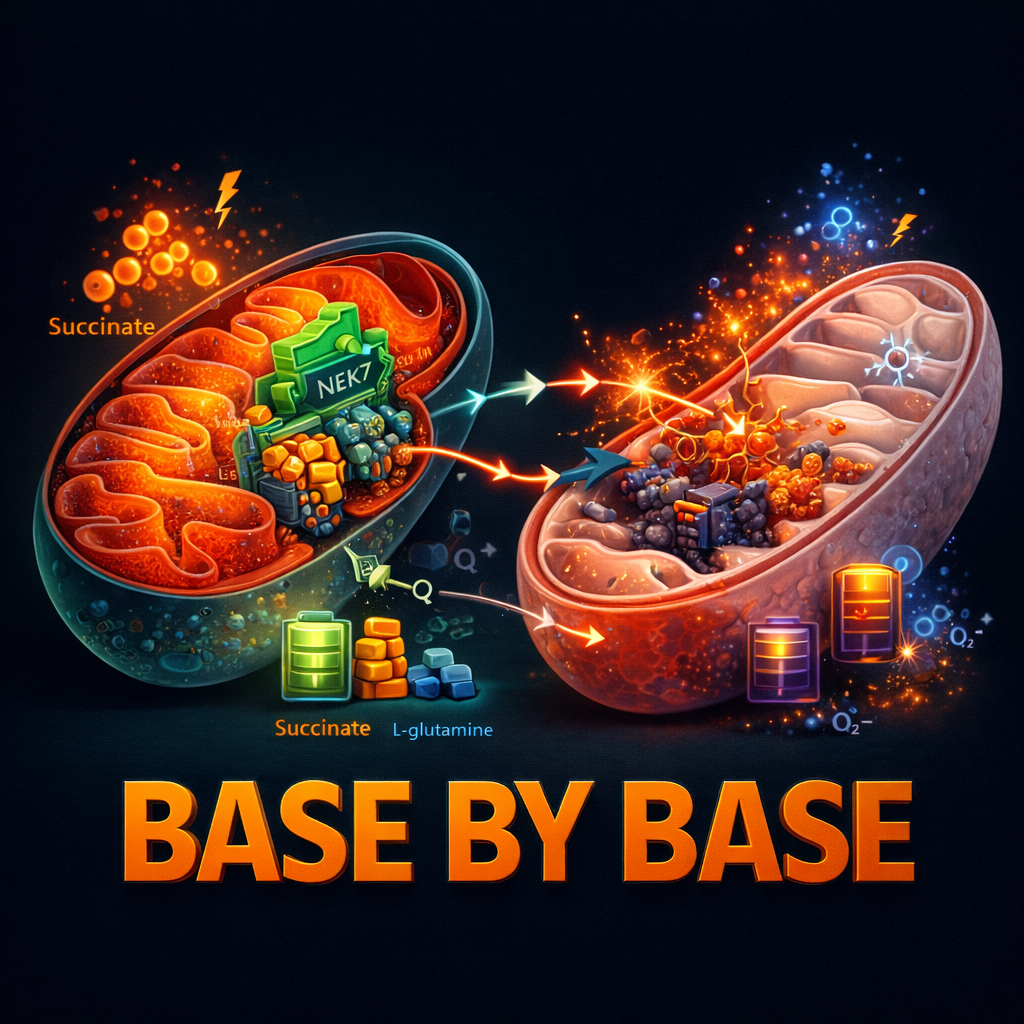
[00:08:45] Speaker A: That high activity suggests it's uncoupled, the complex is unstable, so it's just spinning its wheels frantically and inefficiently, which actually promotes RET instead of making ATP. And they found the chemical proof for this, too. Metabolite analysis showed that levels of succinate and L glutamine were way up.
[00:09:01] Speaker B: Why are those two important?
[00:09:03] Speaker A: Well, succinate is the direct fuel for complex too. High levels of it are known to literally push the machinery backward and drive ret.
L glutamine is also involved in pathways that promote oxidative stress. Seeing both of them spiked confirms the chemical environment was just perfect for that destructive backward flow.
[00:09:20] Speaker B: And all of this molecular chaos led to actual severe liver disease in the mice spontaneously.
[00:09:26] Speaker A: Yes. By just five months old, the mice without any K7 in their liver develop severe dysfunction and. And full blown fibrosis. All their liver function markers in the blood were through the roof. And the damage to the litter cells, the hepatocytes, was basically sending out Alarm signals that activated another cell type, the hepatic stellate cells. And those are the cells that actually produce the scar tissue.
[00:09:47] Speaker B: Okay, so there's conclusive evidence that losing NEK7 causes fibrosis through this mitochondrial instability. But the real test, the gold standard, is whether putting NEK7 back can stop the disease.
Did they pull off a rescue?
[00:09:59] Speaker A: They did exactly that. When they overexpressed NEK7 using gene therapy vectors to deliver extra copies, it significantly reduced liver fibrosis. And this worked in two different, very powerful disease models.
[00:10:11] Speaker B: So it wasn't a fluke. They showed it could work against a chemical toxin and against a diet that mimics human fatty liver disease. And was this protection tied back to the mitochondria directly?
[00:10:24] Speaker A: The rescue was linked to restoring the normal mitochondrial shape, getting rid of all that swelling and dramatically cutting down the oxidative damage. Basically boosting NEK 7 put the stabilizer back in, stopped the short circuit, and saved the liver.
[00:10:37] Speaker B: Now, you mentioned earlier that NEK7 is famous for activating the NLRP3 inflammasome. So you'd think maybe the inflammation is what's really driving the fibrosis here. Did they check that?
[00:10:47] Speaker A: A crucial point. And, yes, they checked it carefully. They found that Nek7's protective role in the mitochondria was completely independent of the NLRP3 inflammasome pathway in these cells. It means NEK7 really has two distinct one is inflammatory, the other is structural. And in this context, it's the structural job inside the mitochondria that's preventing the scarring.
[00:11:07] Speaker B: And just to nail it down, to prove RET was the real villain, they used inhibitors.
[00:11:11] Speaker A: Yes, they used drugs that are known to block ret, like dimethylmalonate or even metformin. And using these drugs successfully stopped the fibrosis from getting worse in the mice the that lacked NEK7. This verifies the whole chain of events. NEK7 loss leads to complex 2 instability, which triggers RET, which causes a ROS spike, which drives fibrosis. If you stop RET, you stop the disease.
[00:11:36] Speaker B: Okay, let's zoom out and unpack this. What does this all really mean? Nek7 is acting like a structural guardrail for the energy machinery. It's a protein from outside the ETC that's controlling the stability of a core ETC component.
[00:11:49] Speaker A: It's a fundamental shift in how we might look at this. We often think about the ETC in terms of its chemical function, but this study shows that its physical stability is just as important when Eddy K7 is gone. The unstable complex 2 triggers RET, which generates so much more destructive ROS than normal forward electron flow.
[00:12:05] Speaker B: So the structural integrity is what dictates the direction of the flow.
And connecting this to the bigger picture, this study proves a brand new mechanism, a new checkpoint for mitochondrial health.
[00:12:17] Speaker A: And the clinical implication for you, the listener, is huge. It suggests that for chronic liver diseases, we shouldn't just be treating symptoms like inflammation. Instead, targeting NDK7, maybe with drugs that mimic its stabilizing effect, could fix the root cause of the oxidative stress that drives the whole disease. We're talking about moving beyond just managing the damage to actually stabilizing the cell's internal machinery to prevent the failure in the first place. It's an incredibly precise idea.
[00:12:45] Speaker B: So to sum up the main insight, NEK7 binds directly to the SDHB subunit of mitochondrial complex 2, and it acts as a critical structural stabilizer.
[00:12:54] Speaker A: That's its job, and that stability is essential for efficient forward electron transport. It prevents the damaging reverse electron transport and the huge ROS production that follows. It shows Nek7 is a pivotal guardian of mitochondrial health and a powerful shield against liver fibrosis.
[00:13:11] Speaker B: This has massive implications beyond just the liver. What does this mean for other diseases driven by mitochondrial dysfunction? You know, things like certain neurodegenerative disorders or heart disease where we already know RET and oxidative stress are major players. If a structural stabilizer can protect the liver, could it also protect the brain or the heart? That's something we'll leave for you to think about.
[00:13:32] Speaker A: This episode was based on an Open Access article under the CC BY 4.0 license. You can find a direct link to the paper and the license in our episode description. If you enjoyed this, follow or subscribe in your podcast app and leave a five star rating. If you'd like to support our work, use the donation link in the description now. Stay with us for an original track created especially for this episode and inspired by the article you've just heard about. Thanks for listening and join us next time as we explore more science Base by Bass.
[00:14:14] Speaker C: In the Dark where the engines reload there's engine motion steady, Two hands meeting the heat and the glow keeping every small lightning bolt ready if the current runs away, it was made the night stays calm, the walls don't harden but a wrong way tide can raise a blade and leave a mad of scars in a garden don't let the power turn back on itself don't let the pulse forget its direction hold the line in the Quiet bel before the spark becomes a confession Keep it moving forward, forward Let the quiet spark stay quiet no more burning Backward, backward, lay the smoke down if you couple heart to rhythm if you guy the breath through the storm you can stop the stitch of shadow and the fragile tissue learns to be warm.
I can feel when the pressure climbs when the glow gets sharp around the edges A little fuel in the wrong set of lines and the miro starts making pledges the desert yet to lock in the chain unseen touch that keeps it honest when it's missing everything feels straining Even daylight starts to tarnish so I'm listening for the smallest clip for the cue this is on overreach A careful break on the backward drift A clean reset within my reach Keep it moving forward Let the quietest box stay quiet no more burning backwards.
[00:15:58] Speaker A: Smoke down.
[00:15:58] Speaker C: Soften the riot if you purple heart to rhythm if you got the breath through the storm you can stop the stitch of shadow and the fragile tissue learns to be warm.
If the night tries to flood the wires I'll trade the rush for a steady a flame Turn that glare into choir Turn the dance into a name not a cur, not a verdict just a signal I can rewrite I'll keep the symmetric to the wrong way let's go.
It.
Keep it moving forward.
Keep it moving forward, forward Stay quiet, stay quiet no more burning Backward, backward, lay the smoke down, soften the riot your double heart to rhythm if you got the breath through the storm you can stop the stitch shadow and the fragile tissue learns to be warm.