Episode Transcript
[00:00:00] Speaker A: Foreign.
[00:00:14] Speaker B: Welcome to Base by Bass, the papercast that brings genomics to you wherever you are. Thanks for listening and don't forget to follow and rate us in your podcast app.
[00:00:23] Speaker C: It's great to be here.
[00:00:24] Speaker B: So I want to start today with a kind of a mechanical paradox. I want you to imagine a high performance engine, you know, something from a race car.
[00:00:34] Speaker C: Okay, got it.
[00:00:35] Speaker B: You're watching it on the track and it is just screaming. It's generating this massive amount of power. It's overheating. It's running at a really dangerous, unsustainable rpm.
[00:00:45] Speaker C: Right? A classic picture of an engine just being pushed way past its limit.
[00:00:49] Speaker B: Exactly. But now imagine we could just freeze time, pop the hood and look inside with, I don't know, a super high speed camera. And what we see is.
It's baffling. Okay, the pistons, the actual parts driving the engine, they're moving in slow motion.
[00:01:04] Speaker C: They'Re sluggish, which, that just shouldn't make sense. If the components are slow, the output should be slow.
[00:01:10] Speaker B: It makes no sense at all. And yet this impossibility is the absolute central mystery of the heart condition we're going to be talking about today. We're looking at a heart that is clinically hypercontractile. It squeezes with this terrifying strength, and yet when you look at the tiny molecular motors that are driving that squeeze, they seem weak, lazy, incredibly slow.
[00:01:34] Speaker C: This is what we call the hypercontractility paradox. And it is a really fundamental question in the study of hypertrophic cardiomyopathy, or hcm. And this isn't just an academic puzzle. This paradox is costing lives.
[00:01:48] Speaker B: So the question is, how do you get race car performance out of a tractor engine? Or, you know, in biological terms, how does a molecul that looks inhibited in a lab dish translate to a disease of too much power in a human being?
[00:02:01] Speaker C: And that is the driving question. We're going to find out that our whole definition of strength might have been a bit too simplistic. It turns out generating power isn't just about how hard you pull.
[00:02:11] Speaker B: It's about something else.
[00:02:12] Speaker C: It's about how bad you are at letting go.
[00:02:14] Speaker B: Today we celebrate the work of Robert C. Kale and his colleagues who took on this exact puzzle.
[00:02:20] Speaker C: And this was a huge collaborative effort. We're talking about researchers from the Perelman School of Medicine at the University of Pennsylvania, Rutgers University, and also UC Davis. It's a really elegant piece of, well, heavy duty biophysics.
[00:02:35] Speaker B: And for those of you who track the literature, this work was published in pnas. That's the Proceedings of the National Academy of Sciences back in December of 2025.
[00:02:45] Speaker C: So before we get into the, you know, the lasers and the molecular traps, we really need to establish the clinical reality here. We're talking about hypertrophic cardiomyopathy.
[00:02:53] Speaker B: Let's unpack that a bit. When a cardiologist sees a patient with hcm, what are they actually looking at?
[00:02:59] Speaker C: Anatomically, the hallmark is the thickening of the heart wall, specifically the left ventricle and the septum. That's the hypertrophy part. But the structural thickening is really just the start.
[00:03:09] Speaker B: The real problem is functional.
[00:03:11] Speaker C: The functional problem is stiffness. The heart muscle becomes fibrotic and rigid.
[00:03:15] Speaker B: Which then leads to a whole cascade of other issues.
[00:03:18] Speaker C: Right. If the heart is stiff, it can't fill with blood properly.
This leads to heart failure, dangerous arrhythmias, and in some really tragic cases, often with young athletes, sudden cardiac arrest.
[00:03:31] Speaker B: And for a lot of these cases, we actually know the genetic driver in many of them.
[00:03:35] Speaker C: Yes, we're looking at the MYH7 gene. Now, this gene codes for something called beta cardiac myosin. For anyone who doesn't spend their days in a biochem lab, myosin is the motor protein.
[00:03:46] Speaker B: It's the engine.
[00:03:47] Speaker C: It's the engine. It grabs onto these actin filaments and pulls, and that's what makes the muscle contract.
[00:03:52] Speaker B: And the paper we're diving into today, it zooms in on one very specific and clinically very severe mutation in that gene, M493I.
[00:04:02] Speaker C: Oh. M493I is a nasty variant. Patients with this mutation, they suffer from really profound septal stiffening and severe physical limitations. It's a classic gain of function disease.
The heart is just doing too much work.
[00:04:15] Speaker B: But scientifically, it's fascinating.
[00:04:17] Speaker C: It's fascinating because of where it is on the protein structure.
[00:04:19] Speaker B: It's in something called the relay helix.
[00:04:21] Speaker C: And the name really gives it away. Think of the myosin protein like a mechanical transmission system in a car. You have the catalytic domain where the fuel, the ATP, is burned.
[00:04:31] Speaker B: Okay.
[00:04:31] Speaker C: And then you have the lever arm that actually moves to pull the muscle, the relay helix, it connects them.
[00:04:38] Speaker B: So it's transmitting the energy from the chemical burning to the actual mechanical movement.
[00:04:42] Speaker C: Correct. It's the communication line. And if you mess with the transmission, you're going to change how the car drives.
And this brings us to the big debate in the field, something called the head availability hypothesis.
[00:04:54] Speaker B: This is that debate over, is it quality versus quantity? Right.
[00:04:58] Speaker C: That's a great way to put it. Scientists have been arguing about this for years. Is the heart hyper contractile because individual myosin heads are pulling harder? You know, super strong motors, or is it because there are just more motors pulling on the rope?
[00:05:13] Speaker B: So it's the difference between a tug of war team with a few bodybuilders versus just having a massive mob of regular people pulling.
[00:05:19] Speaker C: And previous studies were all over the place. Some mutations seemed to make the boto stronger, some weaker. The M493I mutation, because it's sitting right in that relay helix, was the perfect test case to figure out if it's the bodybuilders or the mob.
[00:05:34] Speaker B: But to figure that out, you can't just look at an ultrasound. You need to get down to the single molecule.
And the methodology Cale and his team used is.
Wow, it's pretty mind blowing.
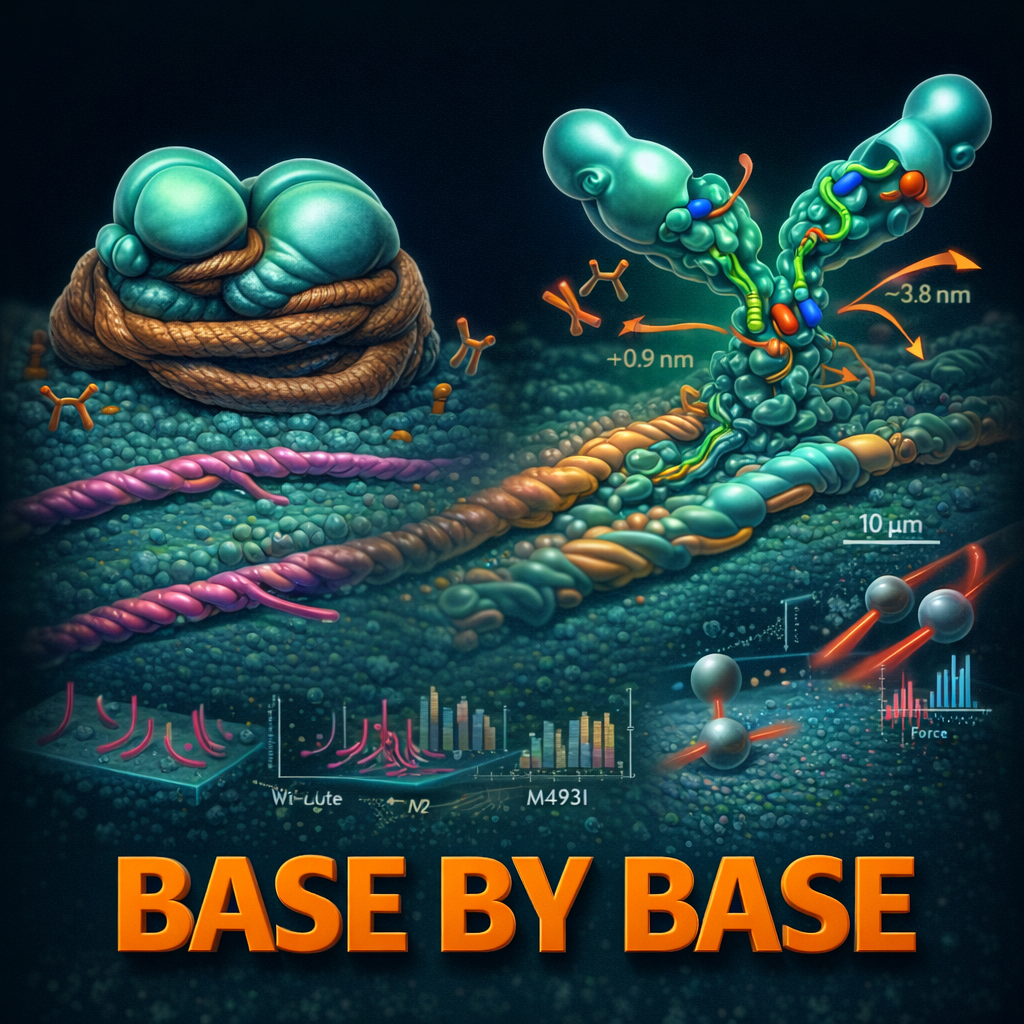
[00:05:45] Speaker C: It really is. They used a whole suite of biophysical tools, but the centerpiece is the optical trap, which people often call laser tweezers.
[00:05:52] Speaker B: I've read about this, but I think it's worth explaining. We are literally talking about using light to hold onto matter.
[00:05:58] Speaker C: Yeah. It relies on the momentum of photons. When you focus a laser beam really, really tightly, it creates a trap that can hold microscopic objects. And in this experiment, they use what's called a three bead assay.
[00:06:09] Speaker B: Walk us through that setup.
[00:06:11] Speaker C: Okay, so imagine two tiny beads held in place by laser beams. Stretched right between them is a single actin filament.
[00:06:17] Speaker B: So like a microscopic dumbbell suspended in light.
[00:06:20] Speaker C: Exactly. Then on the floor of the chamber, there's a third bead. And that one is coated with the myosin motors, in this case, the M493I mutants.
[00:06:29] Speaker B: So you've got the dumbbell floating just above the motor.
[00:06:32] Speaker C: Precisely. And they lower that dumbbell until it just touches the myosin.
And because the lasers are incredibly sensitive to position, we're talking nanometer precision. They can detect when a single myosin motor reaches up, grabs that actin dumbbell, and pulls.
[00:06:47] Speaker B: Wow. So they can actually feel the tug of one single molecule.
[00:06:51] Speaker C: They can measure the distance it pulls and the force it generates in piconewtons and lets them see the mechanics of a single power stroke.
[00:06:58] Speaker B: But they didn't just stop with force. They also had to measure speed.
[00:07:01] Speaker C: And for that, they used the in vitro motility assay. Now, that's more of a crowd level view. Imagine you're at a rock concert and the crowd is passing a person overhead, you know, crowd surfing the myosin motors.
[00:07:12] Speaker B: Are the crowd in this scenario, right?
[00:07:14] Speaker C: They're stuck to the floor. And the actin filaments are the rock stars. They use fluorescence to watch how fast the actin surfs across this bed of myosin. It's a great measure of transport speed.
[00:07:25] Speaker B: And then finally, to understand the fuel economy of this engine, they used stopped flow kinetics.
[00:07:31] Speaker C: This is all about high speed chemical timing. They mix the myosin with its fuel ATP and measure exactly how fast it burns that fuel and crucially, how fast it releases the exhaust product, which is adp.
[00:07:44] Speaker B: So they've got the trap for force, the motility assay for speed, and the kinetics for chemistry. Let's get to the findings. We started with this paradox, this slow engine. Did the data confirm that?
[00:07:54] Speaker C: Oh, it did. And starkly, in that crowd surfing, gliding assay, the M493i mutant moved the actin filaments 70% slower than the normal wild type myosin.
[00:08:06] Speaker B: 70%. That is a massive reduction. If I'm a clinician and I see a patient with a heart that's pumping furiously and you tell me their motors are running at 30% capacity, I'm struggling to connect those two facts.
[00:08:16] Speaker C: It's completely counterintuitive. But the stop flow kinetics explained why it was so slow. It wasn't slow at burning the fuel to start the cycle. It was slow at the very end of the cycle. The issue was ADP release.
[00:08:28] Speaker B: Okay, break that down for us. Why is ADP release the bottleneck?
[00:08:31] Speaker C: The myosin cycle has these distinct steps. It binds to actin, it performs the power stroke. That's the pull. And then it has to release a molecule of adp. And that release is the trigger to let go of the actin and reset for the next pull.
[00:08:45] Speaker B: And the M493I mutant, the study found.
[00:08:48] Speaker C: M493I releases that ADP molecule five times slower than normal.
[00:08:52] Speaker B: So grabs the rope, pulls, and then just hangs on.
[00:08:56] Speaker C: Essentially freezes mid cycle. It just gets stuck holding the rope.
[00:08:59] Speaker B: Okay, so back to our tug of war analogy. The mutant team pulls, but then they just refuse to let go of the rope to reach forward for another pull.
[00:09:06] Speaker C: And think about what that does.
If everyone on the team is just holding onto the rope and refusing to let go, what happens to the tension on that rope?
[00:09:15] Speaker B: The tension stays high even if they're not actively pulling anymore. Just the act of holding on keeps the force on the system.
[00:09:22] Speaker C: Precisely. The researchers call this the duty ratio. It's a percentage of the Total cycle time that the motor spends physically attached to the actin. And because M493i is so slow to release ATP, it has a massive duty ratio. It just stays attached for a really long time.
[00:09:37] Speaker B: And they measured this under isometric load in the trap experiment, right?
[00:09:42] Speaker C: Yes. Isometric just means the muscle is held still. Think of pushing against a brick wall. This mimics the part of the heartbeat where pressure is building up, but the blood hasn't been ejected yet. And under those conditions, M493 I produce these really long duration high force attachments. It just pulls and holds.
[00:09:59] Speaker B: So that explains the stiffness. If the motors won't let go, the heart physically can't relax, but is just holding on enough to explain the hypercontractility, the extra power.
[00:10:10] Speaker C: Not entirely. I mean, stiffness is one piece of the puzzle, but generating too much active force is another. The real aha moment came when they looked at the super relaxed state, or srx.
[00:10:20] Speaker B: This is a concept that has really taken in cardiac science lately. The basic idea is that our heart motors can take naps.
[00:10:26] Speaker C: It's a brilliant evolutionary trick for saving energy.
The heart is an incredibly energy hungry organ. You don't want billions of motors just idling and burning fuel when they're not needed. So in a normal heart, a huge percentage of these myosin heads actually fold back against the protein tail. They curl up and turn themselves off. That's the SRX state.
[00:10:46] Speaker B: So they're physically sequestered. They can't grab the rope even if they wanted to.
[00:10:49] Speaker C: Correct. But the M493I mutation. Yeah, it's like it gives the heart insomnia, wakes them up. It completely destabilizes that folded napping state. The study measured the equilibrium between the SRX state and the active ready to go state, the drx. And they found the equilibrium was just shifted dramatically.
[00:11:07] Speaker B: Can we put a number on that shift?
[00:11:09] Speaker C: We can. In normal wild type myosin, about 25% of the heads are awake and ready to grab actin at any given moment. With M493I, that number jumps to 35%.
[00:11:19] Speaker B: That sounds like a small shift. Going from 25 to 35%.
[00:11:22] Speaker C: It sounds small, but you have to do the math on the change. That's actually a 40% increase in the available workforce.
[00:11:28] Speaker B: Ah, I see. So relative to the baseline, you have nearly half again as many motors ready to work.
[00:11:33] Speaker C: Exactly. So now you have to put the two findings together to solve the whole paradox.
[00:11:37] Speaker B: Okay, let me try to summarize this. So fact One, the individual motors are sticky. They grab the rope and they won't let go because they can't release their ADP.
[00:11:46] Speaker C: Right. They.
[00:11:47] Speaker B: And fact two, because of this broken SRX NAP state, there are 40% more motors grabbing that rope in the first place.
[00:11:55] Speaker C: That is the solution. The engine isn't fast, it's just incredibly stubborn and overcrowded. This completely unifies the head availability hypothesis with all that kinetic data. The heart is hypercontractile because the motors are sticky. And there are simply too many of them on the job at any one time.
[00:12:12] Speaker B: That makes perfect sense. It's not a race car, it's a mob scene. But what about the implications for the patient? We mentioned that usually these patients have one good gene and one bad gene. They're heterozygous. So their hearts are a mix of normal motors and these sticky insomniac mutants.
How do they interact?
[00:12:28] Speaker C: The authors talk about this phenomenon called frictional loading. Imagine a three legged race. You pair a sprinter, that's the normal motor, with a very slow walker. That's the mutant.
[00:12:39] Speaker B: The slow walker is just going to drag the sprinter down.
[00:12:42] Speaker C: The mutant motors are so slow to detach that they actually create drag. Drag on the actin filament. They physically resist the sliding motion that's being generated by the normal motors. And this explains the diastolic dysfunction.
[00:12:54] Speaker B: The stiff heart.
[00:12:55] Speaker C: The stiff heart because to relax and fill with blood, the heart needs to slide those filaments apart. But the mutants are acting like internal brakes.
[00:13:03] Speaker B: They're creating internal friction.
[00:13:05] Speaker C: Exactly. And there was one more piece of data about force that was pretty disturbing. They measured something called the distance parameter.
[00:13:14] Speaker B: Or D. What does D represent here in a biophysical sense?
[00:13:18] Speaker C: It's basically a measure of force sensitivity.
In a healthy heart, if you pull really, really hard on a myosin motor, if you strain it past its limit, it'll pop off the actin. It's a safety release valve like a.
[00:13:29] Speaker B: Ski binding that releases when you twist your knee to prevent an injury.
[00:13:33] Speaker C: Perfect analogy. But the M493I mutation had a very low distance parameter. It's incredibly resistant to popping off even under huge amounts of tension.
[00:13:42] Speaker B: So it has no safety valve.
[00:13:44] Speaker C: Even when the heart wall is under immense strain, these motors just grip harder. And this leads to this asynchronous chaotic force generation. The muscle fibers are literally pulling against.
[00:13:54] Speaker B: Each other, which would explain the pathology they see in autopsies, the myocardial disarray. The fibers are messy and disorganized because they've been Fighting themselves for years.
[00:14:03] Speaker C: And that chaotic mechanical stress, it triggers fibrosis, scar tissue. It kills the cells and. And leaves behind these dead zones in the heart muscle.
[00:14:12] Speaker B: This research really changes how we have to think about treatment. For a long time, the strategy for HCM was just lower the blood pressure, you know, slow the heart rate with.
[00:14:21] Speaker C: Beta blockers, which can help with symptoms, but it doesn't touch the molecular root cause. This paper shows that a much more targeted approach is needed.
[00:14:29] Speaker B: Right. If the problem is stickiness and insomnia, you need drugs that specifically target those mechanisms.
[00:14:36] Speaker C: It completely validates the mechanism of newer drugs like cardiac myosin inhibitors. Movacamten is the most famous one. But how it works is the key. It doesn't just weaken the motor in.
[00:14:47] Speaker B: A general sense, it does something more specific.
[00:14:49] Speaker C: It stabilizes the SRX state. It forces the motors to take that nap.
[00:14:53] Speaker B: It puts the insomnia patients to sleep.
[00:14:55] Speaker C: Exactly. If M493I destabilizes that folded state, mavacamten restabilizes it. It brings the number of active heads back down to a safer level.
[00:15:05] Speaker B: But the paper also hints at a second potential target, doesn't it? The ADP release.
[00:15:11] Speaker C: That's the next frontier. If we could find a small molecule that specifically speeds up that ADP release step, you could potentially unstick the motor. You could fix the drag problem directly.
[00:15:20] Speaker B: That's fascinating. It shifts the entire therapeutic target from make the heart weaker to fix the specific broken gear in the transmission.
[00:15:28] Speaker C: And that's the promise of precision medicine. You can't understand the disease just by looking at the organ. You have to look at the atoms. You have to see that a single amino acid change from methane to isoleucine breaks the communication line that tells the motor when it's time to let go.
[00:15:43] Speaker B: It is just amazing that one tiny change can cascade into such a massive systemic failure.
[00:15:48] Speaker C: It's the butterfly effect on a molecular scale. One hydrogen bond is lost, the helix gets stiff, the ADP gets trapped, the head stays awake, and 20 years later, the heart fails.
[00:15:59] Speaker B: So to wrap up this deep dive, does this paper finally settle the debate? Are we on team force or team availability?
[00:16:07] Speaker C: I think it shows that the debate itself was a false dichotomy. It unifies the theories. It proves you can have a motor that is individually weaker or slower, but still cause hyper contractility because of availability.
[00:16:18] Speaker B: So it's not the speed of the sprint, it's the size of the mob.
[00:16:21] Speaker C: And how stubbornly they all hold onto the rope.
[00:16:24] Speaker B: So if we had to distill this entire very complex paper into a single take home message, what would it be?
[00:16:30] Speaker C: The M493I mutation creates a sticky motor that simply refuses to relax.
By preventing the heads from entering that energy saving, super relaxed state, and by slowing down their detachment from actin, the mutation causes the heart to generate this excessive sustained force that it just cannot turn off.
It's a failure of relaxation just as much as it's an excess of contraction.
[00:16:54] Speaker B: Which brings us to our final thought for you. We often think of heart disease as a problem of weakness, a heart that can't pump enough. But in this disease, the heart is too strong for its own good, driven by motors that just don't know when to quit. If the problem isn't just the strength of the pull, but the insomnia of the protein, perhaps the cure lies not in suppressing the muscle, but in finding a way to sing these restless proteins back to sleep. Sleep what does this mean for the future of medicine? Where your prescription might depend on exactly which atom in your heart is misbehaving.
[00:17:23] Speaker C: It is a fascinating future to contemplate.
[00:17:26] Speaker B: This episode was based on an Open Access article under the CCBY 4.0 license. You can find a direct link to the paper and the license in our episode description. If you enjoyed this, follow or subscribe in your podcast app and leave a five star rating. If you'd like to support our work, use the donation link in the description.
Now. Stay with us for an original track created especially for this episode and inspired by the article you've just heard about. Thanks for listening and join us next time as we explore more science. Bass by bass.
[00:18:11] Speaker A: I was made to drift between the beads A folded wing, a private street Quiet gears beneath the light Waiting for the signal holding tight Then a single turn so small, so near Change the way I disappear I used to to let go when the moment pass Now I stay like time can last in the hush I feel the pull A steady grip a full of P.S.
hold on, hold on Longer in the light when the quiet switch breaks we rise in the fight More hands on the line More weight in the song a song steady signal climb staying strong hold on, hold on don't fade don't slide Longer in the contact and the whole heart moves wide.
[00:19:23] Speaker B: Under.
[00:19:38] Speaker A: Under resistance I don't turn away I press through the dark like a tide that stays not faster, no just hard to release A slow goodbye that won't find peace and in the space where rest once grew more each appears More work comes through I used to sleep in a hidden room now the door won't seal the blue in the hush I feel the pull A steady grip a fuller pulse hold on hold on longer in the light when the quiet switch breaks we rise in the fight More hands on the line More weight in the song A steady signal climbing Stay strong Hold on hold on My fate don't slide longer in the contact and the whole heart moves wide.
If rest was mercy why does it slip?
If off was safety why can't it grip?
I'm learning the cost of a stronger hold A brighter force A tighter cold still in the pressure I hear it clear what stays connected can steer the year.
Hold on hold on longer in the light when the quiet switch breaks we rise in the fight More hands on the line More heat and sound A steady signal Lifting shaking ground hold on hold on Let the chorus glide longer in the contact Let the rhythm decide hold on hold on on the longer still when the quiet switch breaks the whole heart will.