Episode 424

July 23, 2026

00:12:03

424: LECA's Ancient Interactome and Modern Disease

Hosted by

Gustavo B Barra
424: LECA's Ancient Interactome and Modern Disease
Base by Base
424: LECA's Ancient Interactome and Modern Disease

Jul 23 2026 | 00:12:03

/

Show Notes

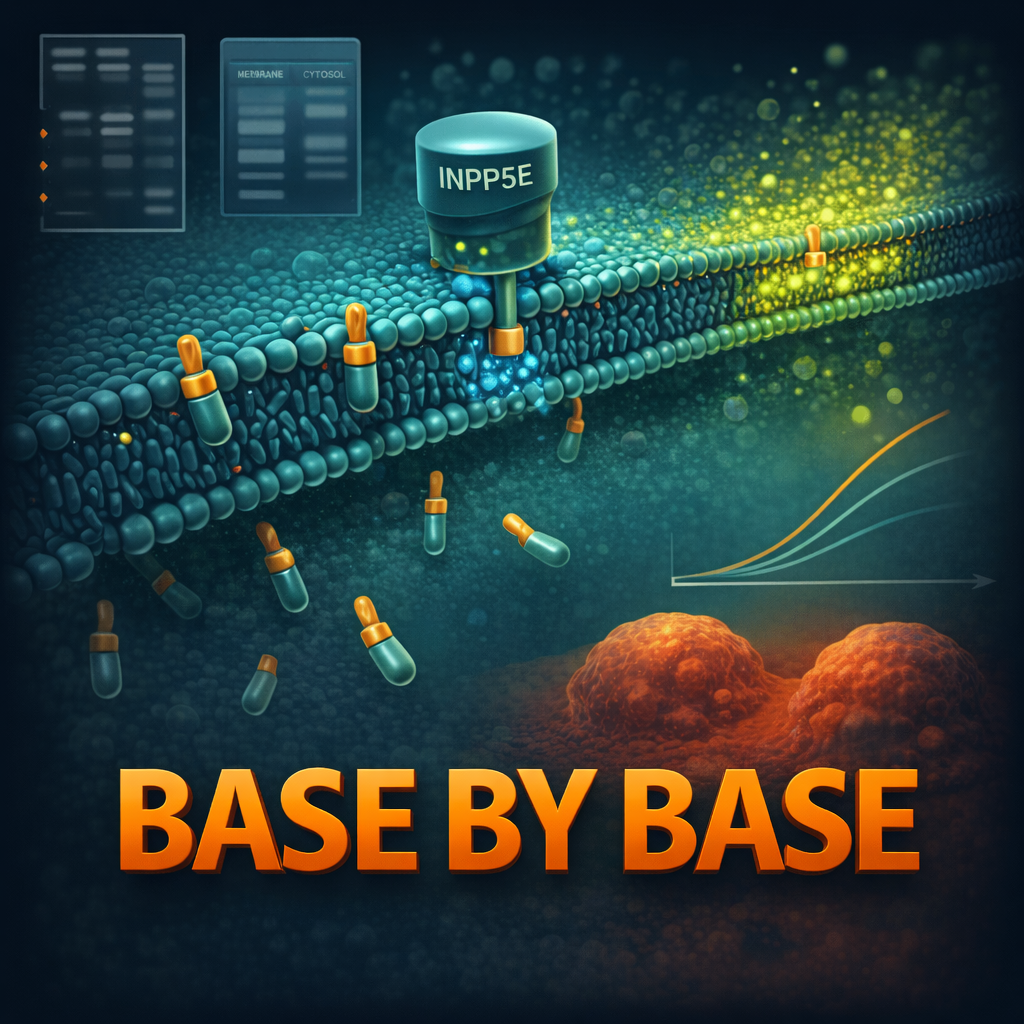
Cox RM et al., Cell Genomics 6, 101254 - Cox et al. reconstruct a conserved protein interaction network for the last eukaryotic common ancestor using >26,000 mass spectrometry experiments across 31 species and demonstrate how the ancient interactome predicts and explains modern human disease mechanisms. Key terms: LECA, protein interactome, co-fractionation mass spectrometry, ciliopathy, V-ATPase.

Study Highlights:
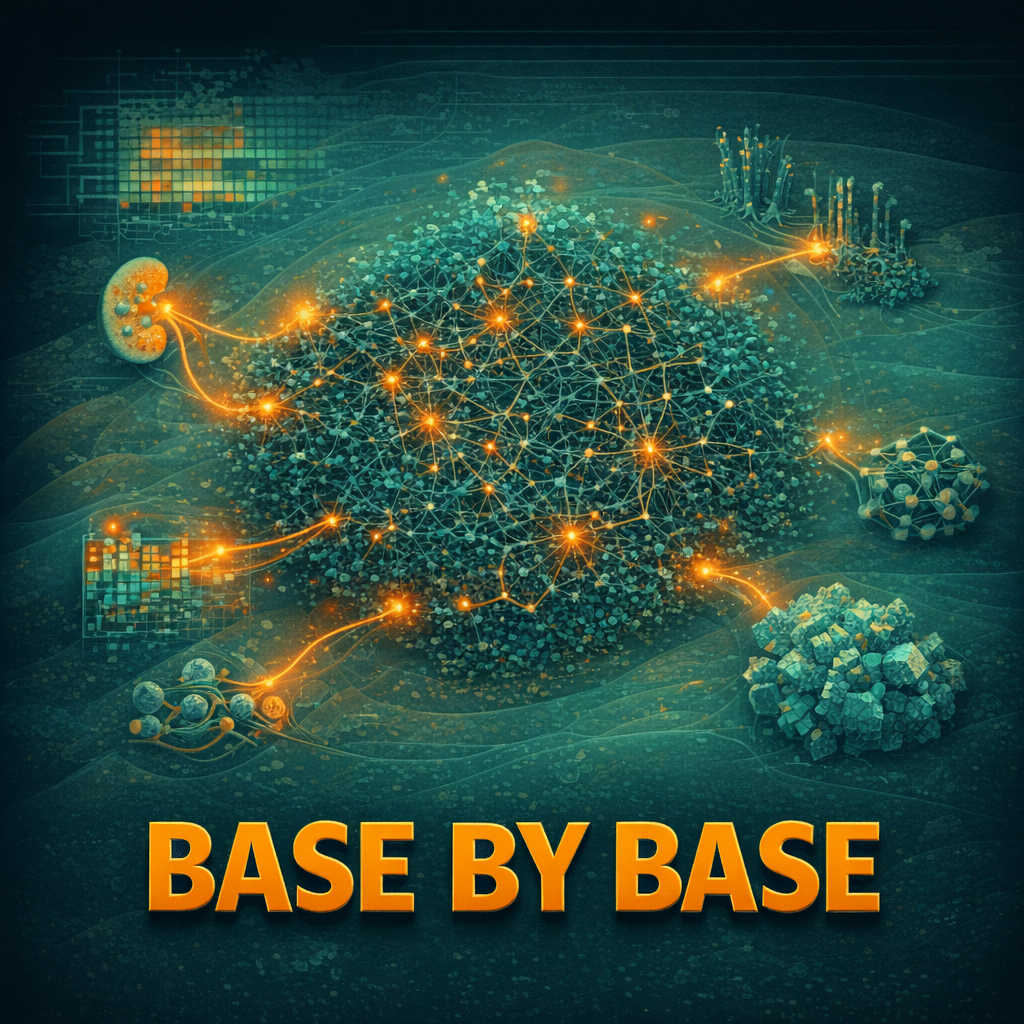
The authors inferred a core LECA gene set and integrated ∼26,000 mass spectrometry experiments from 31 eukaryotes to reconstruct a conserved interactome of 109,466 pairwise interactions among 3,193 orthogroups. The map recovers known complexes (e.g., ARP2/3, TRAPP, V-ATPase, HOPS/CORVET) and reveals unexpected ancient interactions and lineage-specific losses. Network propagation on this interactome predicted novel gene-disease links validated experimentally: EFHC2 mislocalization linked to ciliopathic renal failure, ATP6V1A implicated in osteopetrosis with corresponding increased bone density in mouse knockouts, and GLG1 disruption impairing IFT and ciliation relevant to SRTD. The dataset supports a complex LECA capable of cell projection machinery and provides a framework for linking deep conservation to medical phenotypes.

Conclusion:
An experimentally reconstructed LECA interactome defines deeply conserved macromolecular assemblies that have persisted for nearly two billion years and can predict modern disease mechanisms, as shown by validated links to ciliopathies, osteopetrosis, and short-rib thoracic dysplasia.

Music:
Enjoy the music based on this article at the end of the episode.

Article title:
A protein interactome for the last eukaryotic common ancestor illuminates the biochemical basis of modern genetic diseases

First author:
Cox RM

Journal:
Cell Genomics 6, 101254

DOI:
10.1016/j.xgen.2026.101254

Reference:
Cox RM, Papoulas O, Shril S, et al. A protein interactome for the last eukaryotic common ancestor illuminates the biochemical basis of modern genetic diseases. Cell Genomics. 2026;6:101254. https://doi.org/10.1016/j.xgen.2026.101254

License:
This episode is based on an open-access article published under the Creative Commons Attribution 4.0 International License (CC BY 4.0) – https://creativecommons.org/licenses/by/4.0/

Support:
Base by Base is independent and ad-free — no sponsors, no paywall. If an episode was worth your time, chip in and keep the papers audited and the original songs coming:
❤️ Support monthly: https://buy.stripe.com/cNifZhclVebvagk2JDgEg01
☕ One-time donation: https://donate.stripe.com/7sY4gz71B2sN3RWac5gEg00
More at basebybase.com

On PaperCast Base by Base you'll discover the latest in genomics, functional genomics, structural genomics, and proteomics.

Episode link: https://basebybase.com/episodes/leca-interactome-modern-disease

QC:
This episode was checked against the original article PDF and publication metadata for the episode release published on 2026-07-23.

QC Scope:
- article metadata and core scientific claims from the narration
- excludes analogies, intro/outro, and music
- transcript coverage: Substantively audited transcript sections: LECA concept and health relevance; CFMS data integration across 31 species; conserved vesicle tethering complexes and actin cytoskeleton in LECA; primordial origins of cell projection/phagocytosis; EFHC2 ciliopathy mechanism; ATP6V1A osteopetrosis; GLG1 in ciliogenesis and SRT
- transcript topics: LECA concept and health relevance; CFMS data integration across 31 species; Conserved vesicle tethering complexes (TRAPP, GARP/COG, HOPS); Actin cytoskeleton and ARP2/3 in LECA; Primordial origins of cell projection and phagocytosis; EFHC2 ciliary mechanism in renal disease

QC Summary:
- factual score: 10/10
- metadata score: 10/10
- supported core claims: 8
- claims flagged for review: 0
- metadata checks passed: 4
- metadata issues found: 0

Metadata Audited:
- article_doi
- article_title
- article_journal
- license

Factual Items Audited:
- LECA age range ∼1.5–1.8 billion years ago
- Approximately 13,571 human genes map to LECA OGs
- >26,000 mass spectrometry experiments across 31 species
- Final LECA interactome: 109,466 PPIs among 3,193 LECA OGs
- 199 to 2,014 protein complexes in the LECA interactome
- Conservation of vesicle tethering complexes (TRAPP, GARP, COG, HOPS) in LECA

QC result: Pass.

Chapters

  • (00:00:20) - Papercast: Dating the genetics of humans
  • (00:01:29) - Machine-learning maps the interactions of a billion year old cell
  • (00:04:44) - Could the LECA Intersectome Identify Human Diseases?

View Full Transcript

Episode Transcript

[00:00:20] Speaker A: Welcome to Bass by Bass, the papercast that brings genomics to you wherever you are. Thanks for listening and don't forget to follow and rate us in your podcast. Appreciate it. So what really happens when you trace human genetic diseases back like 1.8 billion years to a single celled ancestor? Just imagine looking at a 1.8 billion year old blueprint of a cell and finding the exact structural flaws that cause modern bone and kidney diseases in humans today. [00:00:46] Speaker B: I mean, the scale of this concept is just. It's staggering when you actually stop to think about it, because almost half of our human genes and really the protein complexes that they form, were already present in this ancient entity. [00:00:57] Speaker A: Right. It's like finding out that the software running your brand new smartphone was actually coded by a microscopic organism, you know, billions of years ago. It's wild. [00:01:05] Speaker B: Yeah, that's actually a really good way to put it. And before we really get into the weeds of this deep dive, we have to formally acknowledge the team behind this massive undertaking. Today we celebrate the work of Rachel M. Pox and colleagues at the University of Texas at Austin Boston Children's Hospital and their partner institutions who have advanced our understanding of how ancient protein networks influence modern genetic diseases. [00:01:28] Speaker A: Definitely. And to start, we need to talk about Leca. [00:01:31] Speaker B: Leca, right. [00:01:32] Speaker A: The last eukaryotic common ancestor. So this was a single celled organism that lived roughly 1.5 to 1.8 billion years ago. And the scientific problem here is that. Well, previous genomic reconstructions told us LSEA was highly complex. We knew it had a nucleus, mitochondria and cell cilia. [00:01:51] Speaker B: Those little hair like structures. [00:01:53] Speaker A: Right, exactly. But what we didn't have was an integrated picture of how its proteins actually interacted to create biological functions. It's one thing to know the parts exist, but. [00:02:01] Speaker B: Okay, let's unpack this. Why is mapping the interactions of a billion year old cell relevant to your health today? Like, as a listener? Well, clinically speaking, single genes rarely act alone. They form these large assemblies. And because about 13,571 human genes trace back to La Hay. [00:02:20] Speaker A: Thirteen thousand? [00:02:21] Speaker B: Yeah, 13,571 to be exact. And that includes, for instance, three quarters of the genes linked to human deafness. So understanding how these proteins interact in an ancient context gives us a baseline to see what goes wrong in modern diseases. [00:02:36] Speaker A: That makes a lot of sense. So to understand how these ancient diseases function, we first have to figure out how scientists can possibly reconstruct protein interactions from an organism that hasn't existed for a billion years. I mean, we don't exactly have fossils of its proteins, right? [00:02:49] Speaker B: No, we definitely don't, but we have its living dise descendants. And the core technology they used here is called CO fractionation mass spectrometry, or CFMs. [00:02:57] Speaker A: Okay, CFMs. [00:02:58] Speaker B: Yeah, it's a very gentle technique. It basically separates protein complexes based on size or charge without restoring them. So it proves which proteins stably interact with one another. [00:03:08] Speaker A: Oh, I see. It's kind of like sorting a giant Lego castle into intact rooms rather than just smashing it into individual bricks so you can see which pieces are, you know, permanently glued together. [00:03:18] Speaker B: Yes, that's a perfect analogy. You're finding the intact rooms. And the sheer scale and innovation of this study is just. It's unbelievable. The team integrated data from over 26,000 mass spectrometry experiments. Wow, 26,000 across 31 diverse eukaryotes. So they mapped about 379 million peptides from organisms as varied as a rotifer, a diatom, algae, and then, you know, pig trachea and frog sperm. [00:03:45] Speaker A: Okay, Big trachea and frog sperm. That is a very specific list of ingredients. [00:03:49] Speaker B: Right. Well, they needed tissues rich in cilia. And using machine learning, specifically a linear support vector classifier. They clustered all of these into a massive hierarchy of ancient protein complexes. [00:04:00] Speaker A: Wait, hang on. If they are just feeding all this data into an algorithm, how do we know these interactions aren't just false positives? Or, like computer hallucinations? We see AI hallucinate patterns all the time. [00:04:11] Speaker B: That is a very fair critique. And they actually built in a rigorous safeguard for that exact reason. The team required that any interaction be independently observed in at least two of the four major eukaryotic supergroups. [00:04:24] Speaker A: Oh, so it couldn't just be found in two closely related species. [00:04:28] Speaker B: Exactly. It had to cross massive evolutionary divides. This means the map is driven by hard experimental evidence across highly divergent lineages, not just phylogenetic modeling or computer guesswork. [00:04:41] Speaker A: Okay, so the methodology is rock solid across multiple species. Now that we know that, what did this map actually reveal about how less behaved? Because here's where it gets really interesting. [00:04:51] Speaker B: It does. [00:04:51] Speaker A: There's been this huge evolutionary debate, right? Could Lesea eat large particles like doing phagocytosis, or was it just a simple cell living in centrifuge, just sort of passively swapping nutrients with bacteria? [00:05:04] Speaker B: Yeah, that's been debated for decades. And the interactome data finally answers this. The map reveals extensive ancient interactions in the ARP23 complex, along with actin machinery like formans, coronins, and the F. Actin capping complex. [00:05:17] Speaker A: Okay, so all that machinery is related to movement. [00:05:20] Speaker B: Yes, specifically for building a dynamic cytoskeleton. This robustly proves LCA had the capability to create pseudopodia. Meaning it could reach out and engulf things. It was a predator capable of phagocytosis. [00:05:34] Speaker A: A billion year old microscopic predator. That is so cool. And there was another major finding, Right. About how the cell transports materials involving those vesicle tethering complexes. [00:05:43] Speaker B: Ah yes, the hops, treapp and COG complexes. The surprising discovery here is that the interactome found subunits that we previously thought were specific to modern animals. Like Treapc 12. [00:05:54] Speaker A: Right. They thought Treapc 12 was a newer invention. [00:05:57] Speaker B: Exactly. But it was actually present in the ancient core complex. This shows how ancient protein modules were highly flexible. They underwent these lineage specific adaptations over billions of years. But the core was already there in lesia. [00:06:10] Speaker A: So if this ancient protein map is accurate enough to settle debates about how a billion year old cell ate and moved, can it actually be used to diagnose unexplained human illnesses today? [00:06:19] Speaker B: Yes, absolutely. And they proved it. [00:06:21] Speaker A: Because there's this real world clinical application within the paper that is just fascinating. They described a male infant suffering from end stage renal failure, microcephaly and polycystic kidney disease. And when they did whole exome sequencing, they found a variant in a gene called EFHC2. [00:06:38] Speaker B: Right. And on the surface, that finding is baffling. [00:06:41] Speaker A: Exactly. Because EFHC2 is associated with motile cilia, which is like a cell's swimming tail. But human mammalian kidneys don't have motile cilia. They don't swim. How does a mutation in a swimming mechanism destroy a kidney? [00:06:54] Speaker B: So if we connect this to the bigger picture, the LECA interactome essentially solved this entire mystery. The maps show that EFHC2 is tightly linked to ancient ciliary components like like PCRG and Anker. [00:07:06] Speaker A: Oh, and those date back across multiple supergroups. [00:07:09] Speaker B: Precisely. It proved that EFHC2 actually has a deeply conserved non modal ciliary function. It's absolutely essential for the primary cilium, which acts like an antenna for the kidney cell sensing fluid flow. [00:07:21] Speaker A: So the kidney cell is basically blind to its environment without it. [00:07:25] Speaker B: Exactly. Which completely reframes how doctors view the disease. It's an antenna defect, not a broken motor. [00:07:31] Speaker A: Wow. And the team didn't stop there. Right. They used network propagation to predict entirely new gene disease links. [00:07:38] Speaker B: Yes, they did. Network propagation is incredibly powerful. Here they had two major predictive victories. First, they linked a specific protein subunit ATP6B1A to mammalian osteopetrosis, which is a [00:07:52] Speaker A: disease that causes excessively dense bones. [00:07:54] Speaker B: Right. And they confirmed this in knockout mice that actually developed those excessively dense bones because that protein is crazy crucial for the acid pump that breaks down old bone. [00:08:03] Speaker A: Acid pump from a single celled ancestor? [00:08:06] Speaker B: Yeah, the same basic machinery. Second, they predicted that a Golgi protein called GLG1 causes short rib thoracic dysplasia, or SRTD. [00:08:14] Speaker A: That's a lethal skeletal ciliopathy, right? [00:08:17] Speaker B: Unfortunately, yes. And they validated that prediction in frog models. So the predictions held up across entirely different animal models. [00:08:24] Speaker A: So what does this all mean? This the staggering implication here is that observing the protein interactions in like ancient single celled algae or amoebas can actively uncover the hidden biochemical mechanisms behind human bone and kidney defects. [00:08:41] Speaker B: That is the central insight, really. Over half of our human genetic blueprint and the vital protein complexes that maintain our health were forged in a single celled ancestor 1.8 billion billion years ago. [00:08:53] Speaker A: It's just incredible to think about. [00:08:54] Speaker B: It is by reconstructing this ancient protein interactome, researchers have created a powerful new tool that uses evolutionary history to successfully predict and understand modern genetic diseases. [00:09:05] Speaker A: Which leaves us with a huge what does this mean for the future of medicine? If our oldest molecular machinery holds the keys to solving modern genetic mysteries, what other cures are waiting to be found in the billions of years of evolutionary history we haven't even looked at yet? [00:09:20] Speaker B: It really makes you wonder what else is hiding in our own DNA? [00:09:22] Speaker A: It really does. This episode was based on an open Access article under the CC BY 4.0 license. You can find a direct link to the paper and the license in our episode description. If you enjoyed this, follow or subscribe in your podcast app and leave a five star rating. If you'd like to support our work, use the donation link in the description now. Stay with us for an original track created especially for this episode and inspired by the article you've just heard about. Thanks for listening and join us next time as we explore more science. Base by base. [00:10:13] Speaker C: Of cells A hidden map of who held who Old hands in the dark Ancient spells Connections strong enough to pull us through not just names on a glowing screen but gears that turn and slip and stall if we trace what used to be we can hear where the failures call which he's in the blueprint before the dawn thread by Till the mystery's gone when one small link breaks Whole worlds go wrong so we follow the network and we carry on. Vesicles drifting like notes in time Pumps that lift the acid Tight cilia beating in perfect world Till a single change makes the compass slide if a signal can't find its rightful place if a motor falters on the track we don't just treat the damage we face we find the first knot and we pull it back we're chasing the blueprint before the dawn Finding all truth in a new day Song from ancient teens that kept life Drawn to tomorrow's answ Clear and strong don't, don't.

Other Episodes