Show Notes
Ramírez Renta GM et al., The American Journal of Human Genetics, 113 (2026) 16-28. doi:10.1016/j.ajhg.2025.11.014 - GALS survey of >4,000 US respondents (GenPop and SPARK) shows confidence in genetic knowledge predicts Familiarity, Knowledge, and Skills, explaining ~25% of variance. Key terms: genetic literacy, confidence in knowledge, GALS, SPARK, science communication.
Study Highlights:
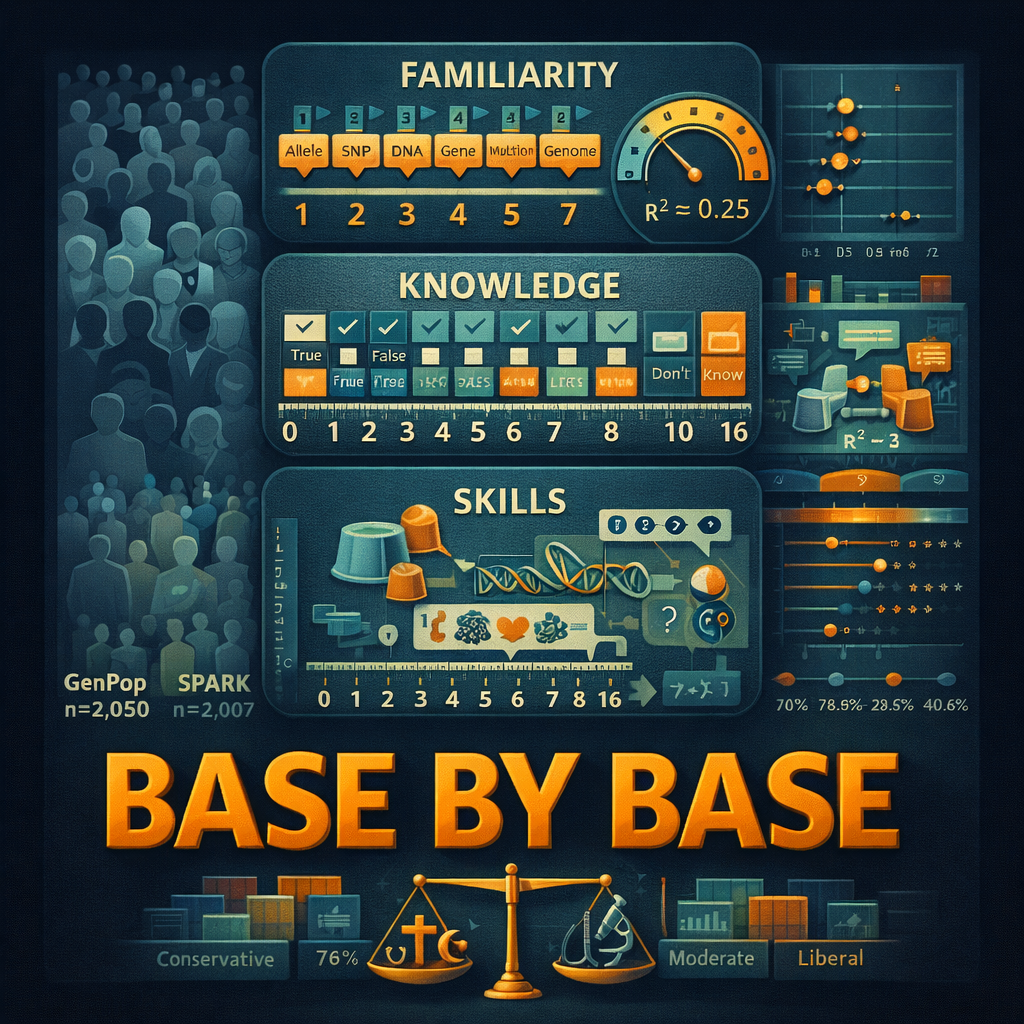
Using the Genetic and Autism Literacy Survey (GALS) in two US samples (GenPop and SPARK; n>4,000), the authors measured three genetic literacy components: Familiarity, Knowledge, and Skills via subjective familiarity ratings, objective true/false items, and a comprehension task. They modeled associations between these subscales and identity/belief measures including perceived importance, confidence, religiosity, religious affiliation, and political belief using linear regression adjusted for education and population. Confidence in one’s genetic knowledge was the strongest predictor, accounting for roughly 25% of variance in Familiarity and Knowledge and substantially improving model R2; perceived importance had a positive but smaller effect while religious and political measures showed mixed associations. The finding implies improving individuals’ confidence in genetic knowledge, alongside tailored communication strategies, could support better comprehension and uptake of genetics and genomics services.
Conclusion:
Confidence in one’s genetic knowledge, after education, is the largest modifiable predictor of genetic literacy and should be a focus for interventions to improve comprehension and uptake of genetics services.
Music:
Enjoy the music based on this article at the end of the episode.
Article title:
Interaction of identity and beliefs with genetic literacy
First author:
Ramírez Renta GM
Journal:
The American Journal of Human Genetics, 113 (2026) 16-28. doi:10.1016/j.ajhg.2025.11.014
DOI:
10.1016/j.ajhg.2025.11.014
Reference:
Ramírez Renta GM, Little ID, Koehly LM, et al. Interaction of identity and beliefs with genetic literacy. The American Journal of Human Genetics. 2026;113:16–28. https://doi.org/10.1016/j.ajhg.2025.11.014
License:
This episode is based on an open-access article published under the Creative Commons Attribution 4.0 International License (CC BY 4.0) - https://creativecommons.org/licenses/by/4.0/
Support:
Base by Base – Stripe donations: https://donate.stripe.com/7sY4gz71B2sN3RWac5gEg00
Official website https://basebybase.com
On PaperCast Base by Base you’ll discover the latest in genomics, functional genomics, structural genomics, and proteomics.
Episode link: https://basebybase.com/episodes/genetic-literacy-confidence-gals
QC:
This episode was checked against the original article PDF and publication metadata for the episode release published on 2026-02-07.
QC Scope:
- article metadata and core scientific claims from the narration
- excludes analogies, intro/outro, and music
- transcript coverage: Audited the transcript’s presentation of core scientific claims: the three GL pillars (Familiarity, Knowledge, Skills), cultural cognition framework, GALS sampling (GenPop and SPARK), key findings on confidence as predictor, religion/politics effects, disengagement, and implications for communication and trust.
- transcript topics: Genetic literacy pillars (Familiarity, Knowledge, Skills); Cultural cognition theory and identity filtering; GALS methodology and cohorts (GenPop vs SPARK); Confidence as a key predictor (~25% variance in GL scores); Religion/religiosity and science vs religion conflict effects; Political beliefs and GL differences
QC Summary:
- factual score: 10/10
- metadata score: 10/10
- supported core claims: 7
- claims flagged for review: 0
- metadata checks passed: 4
- metadata issues found: 0
Metadata Audited:
- article_doi
- article_title
- article_journal
- license
Factual Items Audited:
- Genetic literacy comprises three components: Familiarity, Knowledge, and Skills.
- Confidence in one’s genetic knowledge is the strongest predictor of GL scores, accounting for about 25% of the variance.
- Religious affiliation and religiosity are negative predictors of GL scores (relative to non-religious groups).
- When faced with science-religion conflict, participants who chose science had higher GL scores than those who chose religion.
- Liberals show higher GL scores across subscales than conservatives or moderates; conservatives differ mainly on Knowledge.
- SPARK participants scored higher on GL measures than GenPop participants.
QC result: Pass.